


Shoulder Arthroscopy: Causes, Procedure & Recovery Time
Reviewed by: Dr. Pratik Agarwal
Posted on
5 Min Read

Not sure what you’re looking for?
Get in touch with our representatives for help!
Contact UsShoulder pain is a common problem that can happen due to injury, improper posture, arthritis or other underlying reasons. Conventional methods like medication, pain relief and physiotherapy are often used as treatment options. However, persistent shoulder pain can disrupt your ability to do simple tasks, impacting your quality of life significantly. When conventional treatment approaches fail, doctors may recommend shoulder arthroscopy, a minimally invasive procedure to treat shoulder pain at its roots. This guide will walk you through essential information about shoulder arthroscopy, covering its purpose, the procedure itself, and what to expect during your recovery journey.
Understanding Shoulder Arthroscopy
Shoulder arthroscopy is a minimally invasive surgical procedure where orthopaedic surgeons use a small camera and specialised instruments to visualise, diagnose, and treat problems inside the shoulder joint. Instead of large incisions, the surgeon makes several small cuts, called portals, through which the arthroscope and other tools are inserted. This approach offers several advantages over traditional open surgery, including less pain, faster healing, reduced complications, quicker return to activities, and minimal scarring.
When is a Shoulder Arthroscopy Needed?
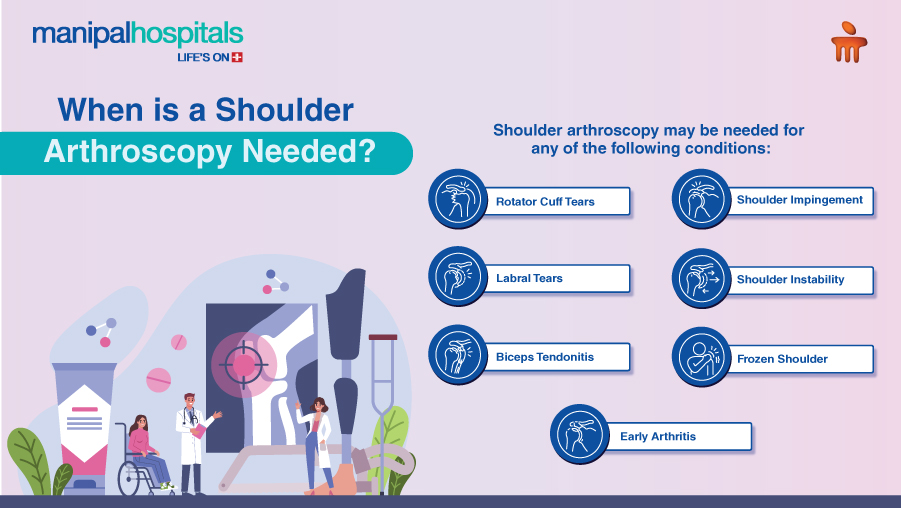
Shoulder arthroscopy may be needed for any of the following conditions:
-
Rotator Cuff Tears: Tears in the tendons surrounding the shoulder joint.
-
Shoulder Impingement: Where rotator cuff tendons are pinched.
-
Labral Tears: Damage to the cartilage rim stabilising the joint (e.g., SLAP tears and Bankart lesions).
-
Shoulder Instability: Recurrent dislocations.
-
Biceps Tendonitis: Inflammation or tears of the biceps tendon.
-
Frozen Shoulder: Stiffness requiring release of scar tissue.
-
Early Arthritis: Removal of loose bodies or inflamed tissue.
For many conditions, shoulder arthroscopy surgery has a high success rate, with clinical studies showing significant improvement in pain and function for a majority of patients.
The Shoulder Arthroscopy Procedure
The shoulder arthroscopy procedure typically involves the following steps:
-
Anaesthesia: You will receive general anaesthesia or a regional nerve block with sedation.
-
Preparation: The surgical area is cleaned, and your arm might be placed in traction for better visibility.
-
Incision and Scope Insertion: The surgeon makes a small incision to insert the arthroscope, transmitting images to a monitor.
-
Fluid Infusion: Sterile fluid expands the joint for clearer viewing.
-
Diagnosis and Repair: Additional small incisions are made for instruments to perform repairs, such as trimming damaged cartilage, repairing tears, or removing inflamed tissue.
-
Closure: Incisions are closed, and a sling is applied to protect the arm.
Shoulder Arthroscopy Recovery
Recovery is a gradual process, varying based on the condition's severity and the extent of repair. While incisions heal quickly, internal tissue healing takes longer.
-
Immediate Post-Op (Days 0-7): The arm is put in a sling, the patient is prescribed pain management via medication and ice, and initial gentle movements are recommended.
-
Early Rehabilitation (Weeks 1-6): Formal physical therapy begins, focusing on restoring range of motion. The sling may be gradually removed.
-
Strengthening and Functional Return (Weeks 6-12+): Strengthening exercises are introduced, gradually progressing to daily activities.
-
Advanced Strengthening (Months 3-6+): For those returning to sports, advanced drills are incorporated.
Full recovery following shoulder arthroscopy can take 3 to 6 months, sometimes longer. A consistent physical rehabilitation programme is crucial. Patients who diligently follow their regimen typically achieve excellent range of motion and strength, fully regaining their ability to move their shoulder joints without pain and discomfort.
Care Essentials: Do's and Don'ts
Some essential, yet simple, rules will help fasten recovery and provide long-term results:
Do's
-
Attend all physical therapy appointments.
-
Take prescribed pain medication.
-
Apply ice regularly to the shoulder area after the procedure.
-
Keep incision sites clean and dry.
-
Wear your sling as directed.
-
Communicate any concerns to your medical team.
Don'ts
-
Don't lift heavy objects or engage in overhead activities.
-
Don't ignore pain; avoid pushing through sharp or increasing discomfort.
-
Don't remove your sling prematurely.
-
Don't drive until cleared by your doctor.
-
Don't skip your exercises.
Conclusion
At Manipal Hospitals Siliguri, our highly trained orthopaedic specialists are dedicated to providing personalised treatment plans to help you achieve a lifelong solution to your shoulder problems. If you are suffering from chronic shoulder issues, book an appointment at Manipal Hospitals Siliguri today!
Frequently Asked Questions
While some discomfort is expected after shoulder arthroscopy, pain is generally well-managed with medication and ice packs. The minimally invasive nature often results in less pain compared to open surgery, and it progressively decreases during your recovery time with proper post-operative care.
Yes, physical therapy is an essential component of recovery following shoulder arthroscopy. A structured rehabilitation programme is crucial for regaining range of motion, strength, and function.
The duration of a shoulder arthroscopy procedure varies depending on the complexity of the condition being treated. Simple diagnostic arthroscopies might take less than an hour, while more complex repairs (like extensive rotator cuff tears) could take 1-2 hours or more. Your surgeon will provide a more precise estimate during your consultation.
While generally safe, as with any surgical procedure, shoulder arthroscopy surgery carries some potential risks. These can include infection, bleeding, nerve damage, blood clots, stiffness, or a reaction to anaesthesia. However, the benefits of shoulder arthroscopy far outweigh the risks.
The timeline for returning to normal activities, including work and sports, largely depends on the specific repair performed and your individual healing process. For sedentary jobs, you might return within a few days to a week. For physically demanding jobs or sports, the shoulder arthroscopy recovery time can range from 3 to 6 months, or even longer, with progressive rehabilitation.
Share this Article


Recent Blogs

পালমোনারি ফাংশন টেস্ট (PFT): এটি কি, কেন এটি করা হয় এবং এটি কীভাবে চিকিৎসায় সহায়তা করে
29 Jun 20265 Min Read
ফুসফুস শরীরের অন্যতম গুরুত্বপূর্ণ অঙ্গ, এবং এর সঠিক কার্যকারিতা সামগ্রিক স্বাস্থ্যের জন্য অপরিহার্য। পিএফটি (PFT) পরীক্ষা বা পালমোনারি ফাংশন পরীক্ষা হল এক ধরণের স্বাস্থ্য পরীক্ষা যার দ্বারা আপনার ফুসফুস কতটা ভালোভাবে কাজ করছে তা পরিমাপ করা হয়ে থাকে। এই নিবন্ধে আমরা পিএফটি পরীক্ষা বিষয়ে বিস্তারে আলোচনা করবো, এবং তার সাথে এটি কখন দরকার পরে, এবং কিভাবে এটি ফুসফুসের রোগের চিকিৎসায় সাহায্য করে, সেটিও দেখবো।
Read NowKidney Biopsy Explained: Why It’s Done and What to Expect
24 Jun 20267 Min Read
Medical procedures often bring questions and anxiety. A kidney biopsy is a crucial diagnostic tool that helps specialists understand underlying kidney issues, providing vital information often unobtainable through other tests. If your doctor recommended a kidney biopsy test, this blog explains why it is done and what to expect, along with effective treatment options and patient outcomes.
Read NowMechanical Ventilation Explained: What It Means When a Patient is 'Put on a Ventilator'
08 Jun 20264 Min Read
The term "being put on a ventilator" is often associated with critical illness, which is why it often evokes apprehension. Understanding what mechanical ventilation truly entails – its purpose, how it works, and the profound support it offers – can significantly alleviate anxiety. This guide explains more about mechanical ventilation, and how this vital medical intervention functions as a life support machine.
Read Nowপিত্তথলির পাথর: কারণ, লক্ষণ এবং অস্ত্রোপচারের প্রয়োজন
03 Jun 20267 Min Read
পিত্তথলি আমাদের যকৃতের নিচে অবস্থিত একটি ছোট অঙ্গ যা পিত্তরস জমা রাখে এবং খাদ্য হজমে সহায়তা করে। পিত্তথলিতে থাকা পিত্তরস যখন সেখান থেকে না বেরোনোর ফলে জমাট বাঁধতে থাকে, তখন সেটি ক্রমশ একটি শক্ত পাথর রূপে পরিণত হয়। এই অবস্থাকেই পিত্তথলির পাথর অথবা গলব্লাডার স্টোন বলা হয়ে থাকে। পিত্তরসের উপাদানগুলির ভারসাম্য নষ্ট হলে এই পাথরগুলি তৈরি হতে পারে, যা তীব্র ব্যথা এবং জটিলতা সৃষ্টি করে।
Read NowHepatitis B and C: Differences, How They Spread, Vaccination and Treatment Options
03 Jun 20267 Min Read
Hepatitis B and hepatitis C are distinct viral infections which target the liver, potentially leading to severe complications like cirrhosis and even liver cancer. Understanding their differences is crucial for prevention, diagnosis, and effective management. This blog highlights key aspects of Hepatitis B symptoms, causes and treatment options, and how it differs from Hepatitis C.
Read NowWhen patient required Dialysis and how to manage CKD patient on dialysis
27 May 20267 Min Read
Living with Chronic Kidney Disease (CKD) can be challenging. When kidneys can no longer perform their vital functions adequately due to kidney failure, a life-saving process called dialysis becomes the need of the hour. This blog provides you with all the necessary information on kidney failure dialysis procedure and its role in end-stage chronic kidney disease.
Read NowGout: Why Uric Acid Crystals Damage Your Joints and How to Manage It Long-Term
26 May 20267 Min Read
Gout, an inflammatory arthritis, is a painful condition affecting millions worldwide. Understanding its root cause- the uric acid crystals- is the first step towards effective, long-term management and reclaiming your quality of life. Statistics suggest that early diagnosis and treatment adherence can lead to successful management in over 90% of cases, significantly reducing the frequency and severity of attacks. This blog focuses on gout symptoms, causes and management strategies, to empower you with the right information.
Read NowHow Pollution effects lung and increase lung disease
26 May 20267 Min Read
In our rapidly urbanizing world, the air we breathe often carries an invisible burden: ‘pollution’. This pervasive environmental challenge is a critical concern for public well-being, particularly for respiratory health. It is paramount for communities to understand the profound impact of poor air quality on our lungs. This article delves into the air pollution effects on your lung health, the common respiratory problems from air pollution, and proactive steps to protect yourself. Air pollution effects: The invisible enemy of lung health Air pollution is a complex mixture of particles and gases like ozone, nitrogen dioxide, and particulate matter. When inhaled, these pollutants penetrate deep into the lungs, causing inflammation, oxidative stress, and structural damage.The long-term air pollution effects can develop slowly over time, often appearing years after exposure and gradually damaging important lung functions.
Read Nowঅ্যাপেন্ডিসাইটিস অস্ত্রোপচার: পদ্ধতি ও আরোগ্যলাভ
06 May 20265 Min Read
পেটের ডান দিকের নিচের অংশে তীব্র ব্যথা, বমি বমি ভাব এবং জ্বর- এই লক্ষণগুলি অনেকেই হালকাভাবে নিয়ে থাকেন, অথচ এগুলি কিন্তু অ্যাপেন্ডিসাইটিস-এর (Appendicitis) মতো একটি গুরুতর অবস্থার ইঙ্গিত হতে পারে। অ্যাপেন্ডিক্স হলো আমাদের কোলনের সঙ্গে সংযুক্ত আঙুলের মতো একটি ছোট অঙ্গ, এবং এটি যখন সংক্রমিত বা স্ফীত হয়, তখন তাকে অ্যাপেন্ডিসাইটিস বলা হয়। এটি একটি জরুরি অবস্থা যেখানে দ্রুত অ্যাপেন্ডিসাইটিস অস্ত্রোপচার প্রয়োজনীয় হয়ে পড়ে। সময়মতো চিকিৎসা না করা হলে অ্যাপেন্ডিক্স ফেটে যাওয়ার সম্ভাবনা থাকে, যা প্রাণঘাতী হতে পারে। এই ব্লগে, আমরা অ্যাপেন্ডিসাইটিস অস্ত্রোপচার, এর বিভিন্ন পদ্ধতি এবং অস্ত্রোপচারের পর সুস্থ হয়ে ওঠার প্রক্রিয়া সম্পর্কে বিস্তারিত আলোচনা করব, যাতে আপনি এই জরুরি অবস্থা সম্পর্কে সুপরিচিত থাকতে পারেন।
Read NowShoulder Arthroscopy: Causes, Procedure & Recovery Time
06 May 20265 Min Read
Shoulder pain is a common problem that can happen due to injury, improper posture, arthritis or other underlying reasons. Conventional methods like medication, pain relief and physiotherapy are often used as treatment options. However, persistent shoulder pain can disrupt your ability to do simple tasks, impacting your quality of life significantly. When conventional treatment approaches fail, doctors may recommend shoulder arthroscopy, a minimally invasive procedure to treat shoulder pain at its roots. This guide will walk you through essential information about shoulder arthroscopy, covering its purpose, the procedure itself, and what to expect during your recovery journey.
Read Now