


Mechanical Ventilation Explained: What It Means When a Patient is 'Put on a Ventilator'
Reviewed by: Manipal Hospitals
Posted on
4 Min Read

Not sure what you’re looking for?
Get in touch with our representatives for help!
Contact UsThe term "being put on a ventilator" is often associated with critical illness, which is why it often evokes apprehension. Understanding what mechanical ventilation truly entails – its purpose, how it works, and the profound support it offers – can significantly alleviate anxiety. This guide explains more about mechanical ventilation, and how this vital medical intervention functions as a life support machine.
What is Mechanical Ventilation?
Mechanical ventilation is a procedure that uses a machine, called a respirator or ventilator, to either assist or completely take over a critically ill patient’s respiratory mechanism. It is not a form of treatment for the underlying disease itself, but rather a crucial supportive measure that provides time for the body to heal and for medical treatments to take effect. When a person's lungs are unable to adequately take in oxygen or expel carbon dioxide – a condition termed as respiratory failure – a ventilator is then used to ensure vital organs receive the oxygen they need.
Invasive vs. Non-Invasive Ventilation: Understanding the Differences
Mechanical ventilation is a highly specialised procedure that assists critically ill patients to breathe when they are unable to respire efficiently by themselves. Depending on the patient's condition, healthcare providers may choose between two primary types of ventilator treatment: invasive and non-invasive ventilation.
Invasive Mechanical Ventilation
This intensive form involves placing an artificial airway directly into the trachea (windpipe).
-
Endotracheal Tube (ETT): This procedure is called intubation, where a flexible tube is inserted through the mouth or nose into the trachea. The ETT is then connected to the ventilator, which delivers air directly into the lungs.
-
Tracheostomy: For prolonged mechanical ventilation (typically more than 1-2 weeks), a surgical opening is created in the neck directly into the trachea for tube insertion.
Patients on invasive ventilation are typically sedated for comfort.
Non-Invasive Mechanical Ventilation (NIV)
NIV provides respiratory support without an invasive airway procedure. Air is delivered via a mask (nasal, oral, or full-face), which is put over the nose and/or mouth.
-
CPAP (Continuous Positive Airway Pressure): Delivers constant air pressure to keep airways open.
-
BiPAP (Bilevel Positive Airway Pressure): Delivers two levels of air pressure – higher during inhalation, lower during exhalation.
NIV can effectively help patients avoid the risks associated with intubation.
When is Mechanical Ventilation Necessary?
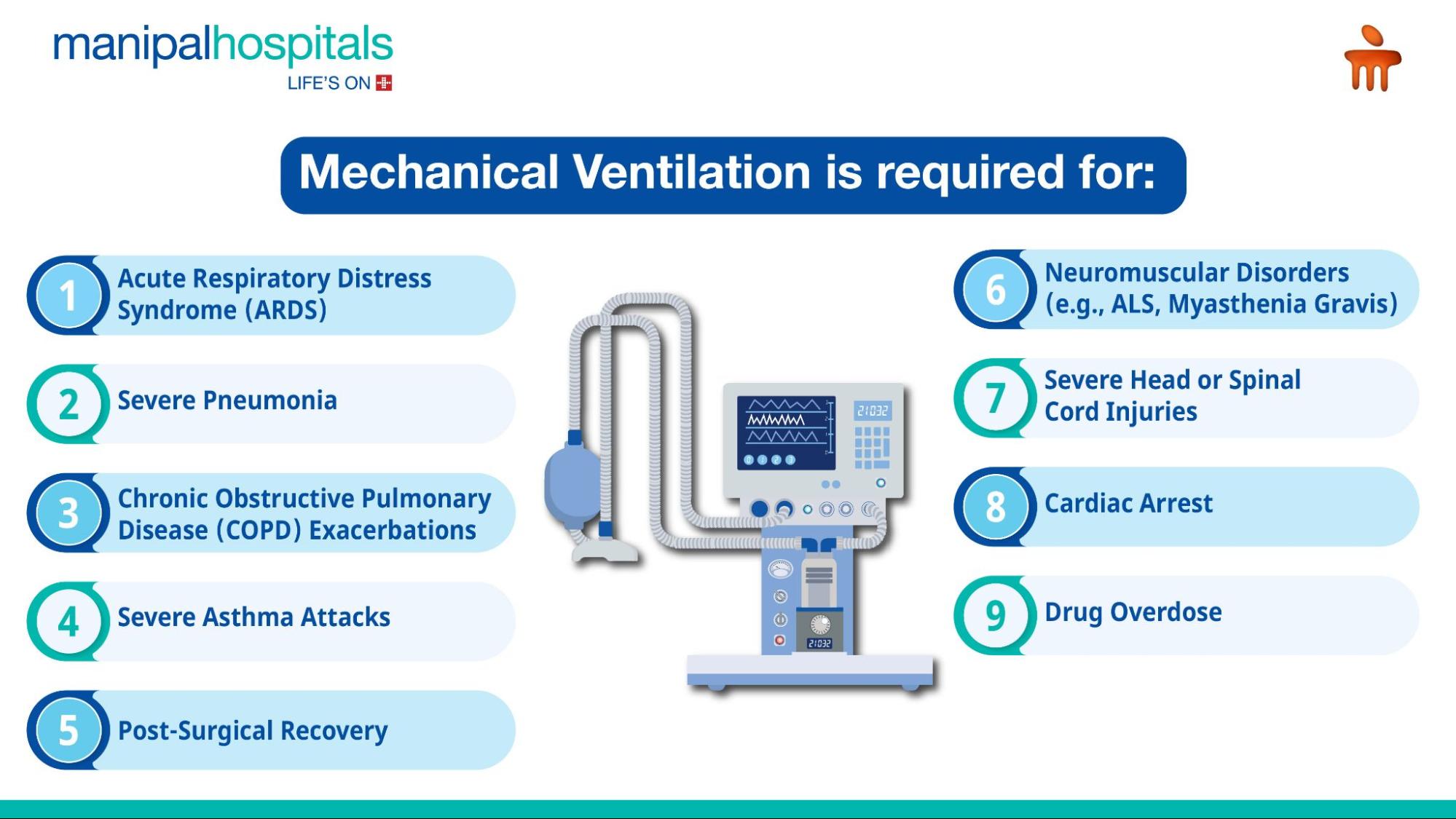
Mechanical ventilation is essentially a life support machine that is used when natural breathing mechanisms are compromised. It is commonly used for conditions like:
-
Acute Respiratory Distress Syndrome (ARDS)
-
Severe Pneumonia
-
Chronic Obstructive Pulmonary Disease (COPD) Exacerbations
-
Severe Asthma Attacks
-
Post-Surgical Recovery
-
Neuromuscular Disorders (e.g., ALS, Myasthenia Gravis)
-
Severe Head or Spinal Cord Injuries
-
Cardiac Arrest
-
Drug Overdose
What to Expect from Mechanical Ventilation
Being on a life support machine can be overwhelming. Patients on ventilation are continuously monitored, and they often receive sedation for comfort. Communication is facilitated through various methods as an ETT prevents speech. As condition improves, the medical team gradually reduces ventilator support, a process called "weaning’, to help restore natural breathing under the close supervision of specialist in ICU and Critical Care, ensuring safe recovery and optimal respiratory support.
Conclusion
While serious, mechanical ventilation is a temporary measure for many, paving the way for recovery. Modern advancements and critical care protocols have significantly improved outcomes. Many individuals successfully come off the ventilator and regain independence. Manipal Hospitals' multidisciplinary team provides personalised ventilator treatment, ensuring the best possible outcomes for patients requiring this vital life support machine.
Frequently Asked Questions
Patients on invasive ventilation are typically sedated to ensure comfort and minimise pain or anxiety. Non-invasive ventilation can feel uncomfortable initially, but is generally not painful.
The duration of mechanical ventilation varies widely, from a few hours post-surgery to several weeks or months, depending on the underlying condition and how patient responds.
Patients on invasive mechanical ventilation cannot eat or drink by mouth; they receive nutrition intravenously or via a feeding tube. Patients on non-invasive ventilation may consume liquids or soft foods, depending on their condition and mask type.
The process of gradually reducing ventilator support and allowing the patient to gradually breathe by themselves is called "weaning."
Risks can include ventilator-associated pneumonia (VAP), lung injury, temporary vocal cord damage, and muscle weakness.
Share this Article


Recent Blogs

পালমোনারি ফাংশন টেস্ট (PFT): এটি কি, কেন এটি করা হয় এবং এটি কীভাবে চিকিৎসায় সহায়তা করে
29 Jun 20265 Min Read
ফুসফুস শরীরের অন্যতম গুরুত্বপূর্ণ অঙ্গ, এবং এর সঠিক কার্যকারিতা সামগ্রিক স্বাস্থ্যের জন্য অপরিহার্য। পিএফটি (PFT) পরীক্ষা বা পালমোনারি ফাংশন পরীক্ষা হল এক ধরণের স্বাস্থ্য পরীক্ষা যার দ্বারা আপনার ফুসফুস কতটা ভালোভাবে কাজ করছে তা পরিমাপ করা হয়ে থাকে। এই নিবন্ধে আমরা পিএফটি পরীক্ষা বিষয়ে বিস্তারে আলোচনা করবো, এবং তার সাথে এটি কখন দরকার পরে, এবং কিভাবে এটি ফুসফুসের রোগের চিকিৎসায় সাহায্য করে, সেটিও দেখবো।
Read NowKidney Biopsy Explained: Why It’s Done and What to Expect
24 Jun 20267 Min Read
Medical procedures often bring questions and anxiety. A kidney biopsy is a crucial diagnostic tool that helps specialists understand underlying kidney issues, providing vital information often unobtainable through other tests. If your doctor recommended a kidney biopsy test, this blog explains why it is done and what to expect, along with effective treatment options and patient outcomes.
Read NowMechanical Ventilation Explained: What It Means When a Patient is 'Put on a Ventilator'
08 Jun 20264 Min Read
The term "being put on a ventilator" is often associated with critical illness, which is why it often evokes apprehension. Understanding what mechanical ventilation truly entails – its purpose, how it works, and the profound support it offers – can significantly alleviate anxiety. This guide explains more about mechanical ventilation, and how this vital medical intervention functions as a life support machine.
Read Nowপিত্তথলির পাথর: কারণ, লক্ষণ এবং অস্ত্রোপচারের প্রয়োজন
03 Jun 20267 Min Read
পিত্তথলি আমাদের যকৃতের নিচে অবস্থিত একটি ছোট অঙ্গ যা পিত্তরস জমা রাখে এবং খাদ্য হজমে সহায়তা করে। পিত্তথলিতে থাকা পিত্তরস যখন সেখান থেকে না বেরোনোর ফলে জমাট বাঁধতে থাকে, তখন সেটি ক্রমশ একটি শক্ত পাথর রূপে পরিণত হয়। এই অবস্থাকেই পিত্তথলির পাথর অথবা গলব্লাডার স্টোন বলা হয়ে থাকে। পিত্তরসের উপাদানগুলির ভারসাম্য নষ্ট হলে এই পাথরগুলি তৈরি হতে পারে, যা তীব্র ব্যথা এবং জটিলতা সৃষ্টি করে।
Read NowHepatitis B and C: Differences, How They Spread, Vaccination and Treatment Options
03 Jun 20267 Min Read
Hepatitis B and hepatitis C are distinct viral infections which target the liver, potentially leading to severe complications like cirrhosis and even liver cancer. Understanding their differences is crucial for prevention, diagnosis, and effective management. This blog highlights key aspects of Hepatitis B symptoms, causes and treatment options, and how it differs from Hepatitis C.
Read NowWhen patient required Dialysis and how to manage CKD patient on dialysis
27 May 20267 Min Read
Living with Chronic Kidney Disease (CKD) can be challenging. When kidneys can no longer perform their vital functions adequately due to kidney failure, a life-saving process called dialysis becomes the need of the hour. This blog provides you with all the necessary information on kidney failure dialysis procedure and its role in end-stage chronic kidney disease.
Read NowGout: Why Uric Acid Crystals Damage Your Joints and How to Manage It Long-Term
26 May 20267 Min Read
Gout, an inflammatory arthritis, is a painful condition affecting millions worldwide. Understanding its root cause- the uric acid crystals- is the first step towards effective, long-term management and reclaiming your quality of life. Statistics suggest that early diagnosis and treatment adherence can lead to successful management in over 90% of cases, significantly reducing the frequency and severity of attacks. This blog focuses on gout symptoms, causes and management strategies, to empower you with the right information.
Read NowHow Pollution effects lung and increase lung disease
26 May 20267 Min Read
In our rapidly urbanizing world, the air we breathe often carries an invisible burden: ‘pollution’. This pervasive environmental challenge is a critical concern for public well-being, particularly for respiratory health. It is paramount for communities to understand the profound impact of poor air quality on our lungs. This article delves into the air pollution effects on your lung health, the common respiratory problems from air pollution, and proactive steps to protect yourself. Air pollution effects: The invisible enemy of lung health Air pollution is a complex mixture of particles and gases like ozone, nitrogen dioxide, and particulate matter. When inhaled, these pollutants penetrate deep into the lungs, causing inflammation, oxidative stress, and structural damage.The long-term air pollution effects can develop slowly over time, often appearing years after exposure and gradually damaging important lung functions.
Read Nowঅ্যাপেন্ডিসাইটিস অস্ত্রোপচার: পদ্ধতি ও আরোগ্যলাভ
06 May 20265 Min Read
পেটের ডান দিকের নিচের অংশে তীব্র ব্যথা, বমি বমি ভাব এবং জ্বর- এই লক্ষণগুলি অনেকেই হালকাভাবে নিয়ে থাকেন, অথচ এগুলি কিন্তু অ্যাপেন্ডিসাইটিস-এর (Appendicitis) মতো একটি গুরুতর অবস্থার ইঙ্গিত হতে পারে। অ্যাপেন্ডিক্স হলো আমাদের কোলনের সঙ্গে সংযুক্ত আঙুলের মতো একটি ছোট অঙ্গ, এবং এটি যখন সংক্রমিত বা স্ফীত হয়, তখন তাকে অ্যাপেন্ডিসাইটিস বলা হয়। এটি একটি জরুরি অবস্থা যেখানে দ্রুত অ্যাপেন্ডিসাইটিস অস্ত্রোপচার প্রয়োজনীয় হয়ে পড়ে। সময়মতো চিকিৎসা না করা হলে অ্যাপেন্ডিক্স ফেটে যাওয়ার সম্ভাবনা থাকে, যা প্রাণঘাতী হতে পারে। এই ব্লগে, আমরা অ্যাপেন্ডিসাইটিস অস্ত্রোপচার, এর বিভিন্ন পদ্ধতি এবং অস্ত্রোপচারের পর সুস্থ হয়ে ওঠার প্রক্রিয়া সম্পর্কে বিস্তারিত আলোচনা করব, যাতে আপনি এই জরুরি অবস্থা সম্পর্কে সুপরিচিত থাকতে পারেন।
Read NowShoulder Arthroscopy: Causes, Procedure & Recovery Time
06 May 20265 Min Read
Shoulder pain is a common problem that can happen due to injury, improper posture, arthritis or other underlying reasons. Conventional methods like medication, pain relief and physiotherapy are often used as treatment options. However, persistent shoulder pain can disrupt your ability to do simple tasks, impacting your quality of life significantly. When conventional treatment approaches fail, doctors may recommend shoulder arthroscopy, a minimally invasive procedure to treat shoulder pain at its roots. This guide will walk you through essential information about shoulder arthroscopy, covering its purpose, the procedure itself, and what to expect during your recovery journey.
Read Now