


ASD Device Closure Procedure: What Patients Need to Know
Reviewed by: Dr. Suvradip Dutta
Posted on
6 Min Read

Not sure what you’re looking for?
Get in touch with our representatives for help!
Contact UsAn Atrial Septal Defect (ASD), often referred to as a ‘heart hole’, is a common congenital heart defect. While some small ASDs may close on their own, many require intervention to prevent long-term complications. Traditionally, this involved open-heart surgery. However, advancements in medical technology have introduced the less invasive procedure involving an ASD closure device that offers a safer and quicker path to recovery for many patients.
What is Atrial Septal Defect (ASD)?
An Atrial Septal Defect is a hole in the septum, the wall that separates the heart's upper two chambers (atria). This hole allows oxygen-rich blood from the left atrium to mix with oxygen-poor blood in the right atrium, leading to an overload of blood flowing to the lungs. Over time, this extra blood flow can strain the heart and lungs, potentially causing serious issues like pulmonary hypertension, heart failure, or stroke.
Early diagnosis and timely intervention are crucial. While some ASDs might be asymptomatic in childhood, symptoms like shortness of breath, fatigue, heart palpitations, and recurrent respiratory infections often emerge in adulthood. Identifying and treating these defects can significantly improve quality of life and prevent severe complications.
The ASD Device Closure Procedure
The ASD device closure procedure is a minimally invasive technique used to close most types of ASDs without the need for open-heart surgery. This innovative approach is a preferred option for many patients due to its numerous benefits. Studies show the ASD device closure procedure has an impressive success rate of over 95%, with excellent long-term outcomes for patients of all ages. This makes it a highly effective and safe option for congenital heart defect treatment.
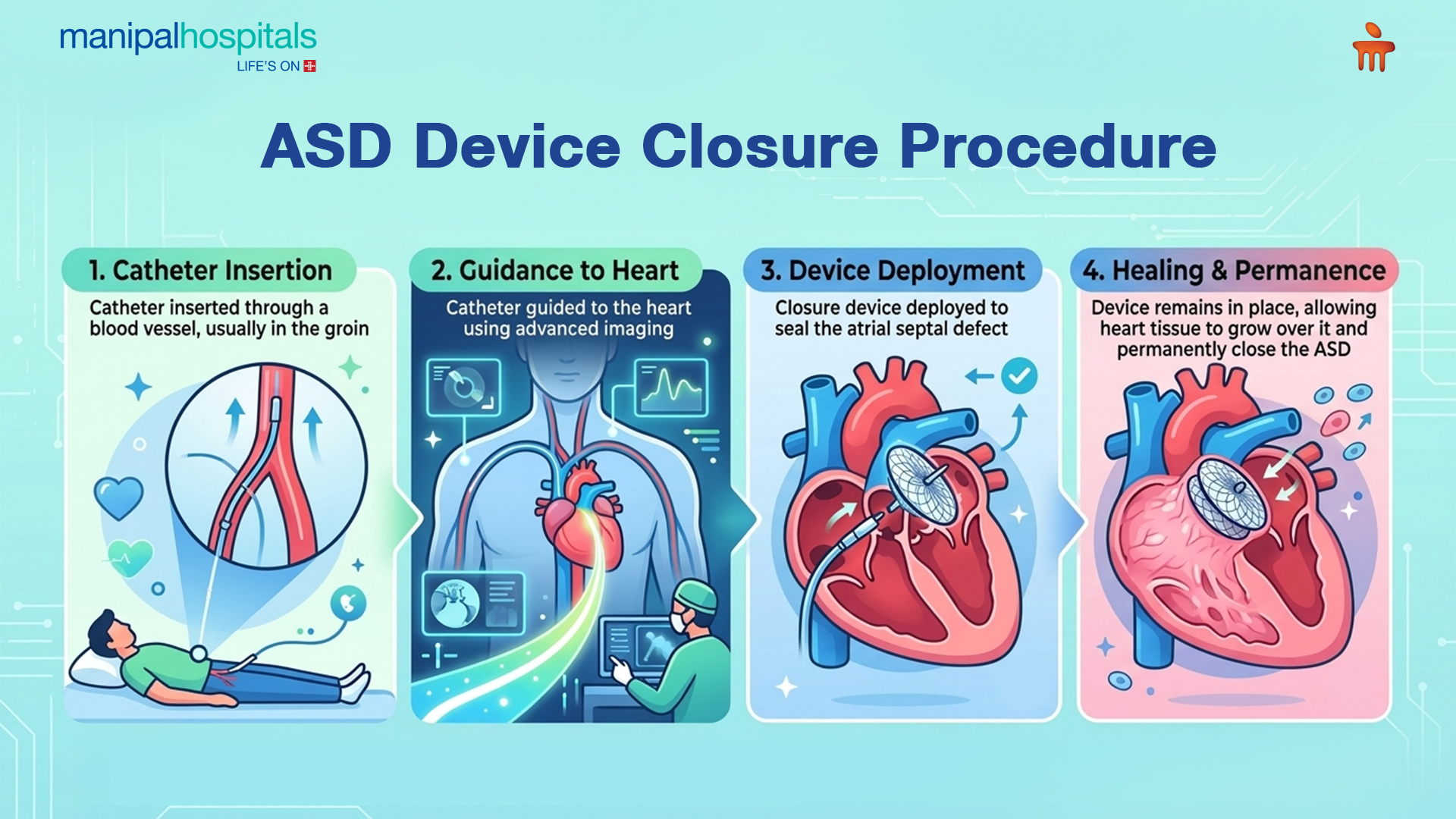
How does it work?
The ASD device closure procedure steps involve:
-
A thin, flexible tube called a catheter is inserted into a blood vessel, usually in the groin.
-
Guided by advanced imaging techniques, the catheter is carefully threaded up to the heart.
-
A specialized closure device, typically made of nitinol mesh, is deployed through the catheter to effectively seal the hole in the atrial septum.
-
Once in place, the device remains permanently to close the ASD, allowing heart tissue to grow over it.
What are the benefits?
The benefits of this procedure includes:
-
Minimally invasive- No large surgical incision, resulting in smaller scars and less pain.
-
Faster recovery- Patients often return to normal activities within a week, significantly quicker than open-heart surgery recovery.
-
Reduced hospital stay- Typically, patients stay for only 1-2 days.
-
Lower risk of complications- Generally associated with fewer risks compared to traditional surgery.
Who is a candidate for ASD Device Closure?
Not all ASDs are suitable for device closure. Candidates are usually those with secundum ASDs that are of an appropriate size and have sufficient surrounding tissue for the device to attach securely.
Expert cardiologist conduct a thorough evaluation to determine if this procedure is the right choice for you or your loved one. This evaluation involves:
-
Echocardiogram (transthoracic and/or transesophageal) to assess the size, location, and edges of the ASD.
-
Electrocardiogram (ECG) and Chest X-ray to evaluate heart function and lung health.
-
Consultation with the team of specialists.
Care essentials
|
Do’s |
Don’ts |
|
Follow medication schedule- Take prescribed medications, especially blood thinners, exactly as directed by your doctor. |
Avoid strenuous activities- Refrain from heavy lifting or vigorous exercise for the first few weeks or as advised. |
|
Attend follow-up appointments- Regular check-ups are vital to monitor your heart and the device's position. |
Do not submerge incision- Avoid baths, hot tubs, or swimming until the incision is fully healed. Showers are generally permitted. |
|
Maintain good hygiene- Keep the incision site clean and dry to prevent infection. |
Do not miss medications- Discontinuing blood thinners prematurely can lead to serious complications. |
|
Gradually resume activities- Start with light activities and slowly increase intensity as advised by your medical team. Most patients return to normal activities within a week. |
Avoid alcohol and smoking- These can impede healing and overall cardiovascular health. |
|
Report any concerns- Immediately contact your doctor if you experience fever, redness/swelling at the groin site, chest pain, or shortness of breath. |
Do not ignore symptoms- Any new or worsening symptoms should be reported promptly. |
Conclusion
ASD device closure is a safe, minimally invasive procedure that effectively treats Atrial Septal Defect and helps improve long-term heart health. At Manipal Hospitals EM Bypass, our expert interventional cardiology team combines advanced technology with compassionate care to deliver optimal treatment outcomes. Manipal Hospitals is committed to delivering personalised, compassionate care at every stage of your treatment journey. Book an appointment with our specialists today and take the next step towards a healthier future.
Frequently Asked Questions
The procedure is performed under local anaesthesia (general anaesthesia is used in special cases and for babies), so you will not feel any pain during the process. Possible mild discomfort at the groin incision site, after the procedure, can be managed with pain medication.
Typically, follow-up appointments with your cardiologist are scheduled at 1 month, 6 months, and 1 year after the procedure, and then annually thereafter. These visits usually include an echocardiogram to ensure the device is securely in place and the ASD remains closed.
Most patients are prescribed blood thinners for a period of 1 to 6 months post-procedure to prevent clots from forming on the device while tissue grows over it. Your cardiologist will provide specific instructions based on your individual needs.
You will have some restrictions on physical activity, especially strenuous exercise and heavy lifting, for a few weeks. Your doctor will provide a detailed list of activities to avoid and when you can safely resume normal routines. Most patients can resume light activities within a week.
While generally safe, like any medical procedure, there are potential risks, including bleeding, infection, device embolization (device moving from its intended position), allergic reaction to contrast dye, or rarely, perforation of heart structures. Your cardiologist will discuss all potential risks and benefits with you.
Share this Article


Recent Blogs
Robotic Breast Surgery: The Dawn of a New Era in Oncology
29 Jun 20267 Min Read
A breast cancer diagnosis is a life-altering event, but rapid advancements in diagnosis and treatments are offering patients more hope and improved clinical outcomes than ever before. One such ground-breaking advancement capturing the attention of the global medical community is Robotic Breast Surgery. The purpose of this post is to explore a specific procedure known as Robotic Nipple-Sparing Mastectomy (RNSM), detailing how this new and upcoming technique offers unparalleled advantages, and why it is revolutionising the surgical management of breast cancer.
Read NowUnderstanding Benign Brain Tumour: Symptoms, Surgery, and Recovery
24 Jun 20266 Min Read
Receiving a diagnosis of a benign brain tumour can be an overwhelming experience. While the term ‘benign’ offers reassurance that the tumour is non-cancerous and typically slow-growing, it does not diminish the natural concerns about its impact on health and daily life. These anxieties require compassionate, state-of-the-art care that can guide you through every step of your journey from diagnosis to recovery. An expert multidisciplinary team of neurosurgeons, neurologists, oncologists, and rehabilitation specialists can ensure a holistic approach, focusing on the best possible outcomes for the patient.
Read NowASD Device Closure Procedure: What Patients Need to Know
22 Jun 20266 Min Read
An Atrial Septal Defect (ASD), often referred to as a ‘heart hole’, is a common congenital heart defect. While some small ASDs may close on their own, many require intervention to prevent long-term complications. Traditionally, this involved open-heart surgery. However, advancements in medical technology have introduced the less invasive procedure involving an ASD closure device that offers a safer and quicker path to recovery for many patients.
Read Nowঅনিয়মিত মাসিক ও পিসিওডি: আপনার মাসিক চক্র কেন গুরুত্বপূর্ণ এবং এর প্রতিকার কী
29 May 20266 Min Read
হরমোনের ভারসাম্যহীনতার কারণে মাসিক চক্র অনিয়মিত হতে পারে; তবে সঠিক জীবনযাত্রার পরিবর্তন এবং ক্ষেত্রবিশেষে ওষুধের মাধ্যমে এই সমস্যাটি সমাধান হওয়া সম্ভব। অবশ্য, অনেক সময় অনিয়মিত মাসিক কোনো অন্তর্নিহিত শারীরিক সমস্যার লক্ষণ হতে পারে (যেমন পিসিওডি), যার জন্য আরও বিশেষায়িত চিকিৎসার প্রয়োজন হয়। এই ব্লগটিতে অনিয়মিত মাসিক এবং পিসিওডি - র বিষয় নিয়ে বিস্তারিত আলোচনা করা হয়েছে, যাতে আপনি আপনার সুস্বাস্থ্য ও সুস্থতার স্বার্থে এই দুটি শারীরিক অবস্থা সম্পর্কে একটি পূর্ণাঙ্গ ধারণা লাভ করতে পারেন।
Read NowHome Remedies vs Medical Treatment for Knee Pain: What Actually Provides Long-Term Relief
28 May 20265 Min Read
Knee pain is a common ailment affecting millions worldwide. It can range from a mild ache to severe discomfort that interferes with daily activities and mobility. Naturally, many people first turn to easy fixes and home remedies for knee pain. While these methods can provide temporary relief, understanding when to seek professional medical care is essential for achieving long-term knee pain relief and protecting joint health.
Read NowRheumatoid Arthritis v/s Osteoarthritis: Key Differences Every Joint Pain Patient Should Know
28 May 20265 Min Read
Joint pain is a prevalent issue across the world, and it becomes more common with increasing age. However, joint pain is not the same everywhere. Rheumatoid arthritis (RA) and osteoarthritis (OA) both affect joints but differ significantly in their origins, symptoms, and treatment. This blog highlights the key differences between rheumatoid arthritis and osteoarthritis, as understanding these distinctions is crucial for accurate diagnosis and management.
Read NowThe Dialysis Diet: Foods, Fluids, and Restrictions Every Kidney Patient Needs to Follow
28 May 20265 Min Read
Diet is a key component in maintaining overall health and well-being. A proper diet not only focuses on maintaining calories, but it is also meant to provide optimum nutrition fit for each person’s individual needs. For someone undergoing dialysis, a proper dialysis diet plan is essential for maintaining nutritional levels while also cutting out foods that could be harmful for their kidneys. This blog highlights the importance of a proper diet plan for those undergoing dialysis for a thorough understanding of suitable foods, proper fluid management, and what to avoid.
Read NowHigh BP Symptoms: Do not Miss These Crucial Early Signs
27 May 20265 Min Read
Often termed the ‘silent killer’, high blood pressure (hypertension) can stealthily damage your body without any obvious warning signs. Globally, an estimated 1.28 billion adults between the ages of 30 and 79 years have hypertension, and a staggering 46% of adults with hypertension are unaware that they have it. This makes recognising even the subtle high BP symptoms incredibly vital for preventing severe health complications like heart attack, stroke, and kidney disease. This blog aims to raise awareness of the early warning signs of high blood pressure and also guides you on how to reduce high blood pressure naturally.
Read NowAortic Aneurysm: Early Signs, Causes, and Available Treatments
06 May 20266 Min Read
The aorta is the largest blood vessel of your body which carries oxygen-rich blood from the heart and delivers it to the other organs. An aortic aneurysm occurs when a section of this vital artery weakens and bulges, posing a significant health risk. Without timely intervention, recovery can become extremely complicated. Understanding the warning signs, aortic aneurysm causes, and available treatment options is crucial for timely intervention and improved outcomes.
Read NowIdentifying Breast Cancer Symptoms: Early Detection Improves Survival
27 Apr 20265 Min Read
Breast cancer is the most common type of cancer among Indian women, and it is gradually rising in both urban and rural areas. Studies have reported that 14% of all cancers in women are breast cancer, with over 2,00,000 cases being reported each year. However, early detection can significantly improve survival rates; localised breast cancer detected early boasts over a 99% 5-year survival rate. Understanding the global health threat posed by breast cancer and the significance of early detection for improved outcomes is vital in building a strong awareness towards breast cancer symptoms, causes, risk factors, and available treatment options. This blog highlights all the details you should know about breast cancer.
Read Now