


Modern Ways to Remove Kidney Stones: No Big Cuts Required
Reviewed by: Manipal Hospitals
Posted on
7 Min Read

Not sure what you’re looking for?
Get in touch with our representatives for help!
Contact UsKidney stones, though common, can be incredibly painful and disruptive to daily life. For a long time, their removal often involved invasive surgeries with lengthy recovery periods. However, medical science has advanced remarkably, offering a new era of minimally invasive and highly effective kidney stone treatment options. Understanding these modern approaches to managing kidney stones can significantly ease anxieties and empower patients to make informed decisions about their health. The good news is that the vast majority of kidney stones can now be treated without the need for large incisions, thanks to advanced techniques like class kidney stone laser treatment and other state-of-the-art procedures.
The Prevalence and Causes of Kidney Stones
Kidney stones are a remarkably common health issue, particularly in India, where they affect a significant portion of the population. Studies suggest that urolithiasis (the medical term for kidney stones) is observed in about 12% of the Indian population, with many of these cases leading to kidney issues later in life if left untreated.
The prevalence is often attributed to various factors, including dietary habits, climate (leading to dehydration), and genetic predispositions common in the subcontinent. Despite their commonality and potential for immense pain, understanding what causes kidney stones is crucial for prevention and effective management.
Several factors contribute to their formation:
-
Dehydration: Not drinking enough water is a primary cause, leading to concentrated urine where minerals can crystallize.
-
Dietary Factors: A diet high in sodium, animal protein, and sugar can increase the risk. Foods rich in oxalate (e.g., spinach, chocolate, nuts) can also contribute, especially in susceptible individuals.
-
Obesity: Higher body mass index (BMI) has been linked to an increased risk of stone formation.
-
Medical Conditions: Certain conditions like hyperparathyroidism, urinary tract infections, and inflammatory bowel disease can predispose individuals to kidney stones.
-
Genetics: A family history of kidney stones can increase your likelihood of developing them. Studies indicate that up to 35% to 55% of individuals with recurrent kidney stones have a family history of the condition.
-
Certain Medications: Some diuretics and calcium-based antacids can increase stone risk.
Symptoms and Diagnosis of Kidney Stones
The symptoms of kidney stones can range from mild discomfort to severe, debilitating pain. It's important to recognize these signs to seek timely medical attention.
Common symptoms include:
-
Severe pain in the side and back, below the ribs (often referred to as renal colic)
-
Pain that radiates to the lower abdomen and groin
-
Pain that comes in waves and fluctuates in intensity
-
Burning sensation during urination
-
Frequent urge to urinate
-
Red, pink, or brown urine (hematuria)
-
Cloudy or foul-smelling urine
-
Nausea and vomiting
-
Fever and chills (if an infection is present)
Diagnosis involves a combination of methods, including a physical examination, urine tests, blood tests, and imaging studies such as X-rays, CT scans, or ultrasounds. These diagnostic tools help doctors determine the size, location, and type of the kidney stone, guiding the most appropriate kidney stone treatment plan.
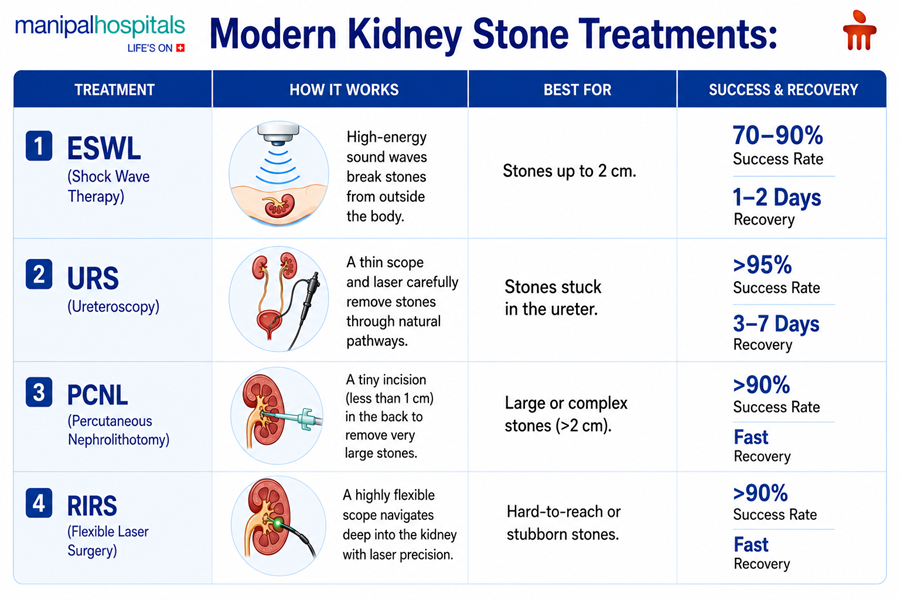
Modern Ways to Remove Kidney Stones: No Big Cuts Required
Gone are the days when major surgery was the only option for large or stubborn kidney stones. Today, modern medicine offers a spectrum of minimally invasive procedures, ensuring effective stone removal with reduced recovery times and patient comfort. Success rates for these advanced procedures are impressive, with many patients returning to their normal activities within days.
|
Key Minimally Invasive Treatments |
|
|
Extracorporeal Shock Wave Lithotripsy (ESWL) |
This non-invasive procedure uses high-energy sound waves to break kidney stones into tiny fragments that can then be passed in the urine. It's effective for stones up to 2 cm and boasts a success rate of 70-90% for suitable stones, with most patients recovering fully within a few days. |
|
Ureteroscopy (URS) |
For stones in the ureter or kidney, a thin, flexible scope is passed through the natural urinary openings (urethra and bladder) to reach the stone. Once located, the stone can be retrieved with a small basket or broken down using a kidney stone laser treatment (holmium laser). URS has an immediate success rate of over 95% for ureteral stones. |
|
Percutaneous Nephrolithotomy (PCNL) |
This is an option for very large or complex kidney stones (typically >2 cm). A small incision (less than 1 cm) is made in the back, and a narrow tube is inserted directly into the kidney to remove the stone. It's highly effective, clearing stones in over 90% of cases, and recovery is much faster compared to traditional open surgery. |
|
Flexible Ureterorenoscopy (RIRS—Retrograde Intrarenal Surgery) |
Using a flexible ureteroscope, our specialists can navigate into the kidney's collecting system to locate and fragment stones using laser energy. This procedure is especially suitable for stones that are difficult to reach or have failed other treatments, offering a high stone-free rate, often exceeding 90%. |
Our commitment to advanced kidney stone treatment in Bangalore means that you have access to the latest technology and a team of highly skilled urologists dedicated to your well-being. These modern techniques reduce hospital stays, minimize pain, and allow for a quicker return to your daily routine, often seeing patients discharged within 24-48 hours after procedures like URS or ESWL.
Conclusion
Kidney stones, though common and potentially debilitating, are no longer a cause for prolonged suffering or invasive surgeries. With advancements in medical technology, a range of minimally invasive kidney stone treatment options, including sophisticated kidney stone laser treatment, are available today. These modern approaches prioritize patient comfort, minimize recovery times, and offer high success rates, enabling you to return to your daily life quickly. If you're experiencing symptoms of kidney stones or have any concerns, don’t hesitate to seek expert medical advice.
Book an appointment with our expert urologists at Manipal Hospitals Bangalore.
Frequently Asked Questions
Modern kidney stone laser treatment (like that used in ureteroscopy or RIRS) is performed under anesthesia, so you won't feel pain during the procedure. Post-procedure, you might experience some discomfort, which can be managed with prescribed pain medication. Most patients report only mild to moderate discomfort.
test 1
Recovery time varies depending on the type of procedure. For ESWL, most patients can resume normal activities within 1-2 days. For ureteroscopy or PCNL, it might be 3-7 days. Our team at Manipal Hospitals Bangalore will provide specific post-operative care instructions for your quicker recovery.
test 2
While treatment removes existing stones, new stones can form if underlying causes are not addressed. It's estimated that up to 50% of individuals who have had one kidney stone will develop another within 5-10 years. Therefore, you need to follow preventive measures like adequate hydration and dietary adjustments, as advised by your doctor.
Share this Article


Recent Blogs

test blog 18/09--
06 Oct 20269 Min Read
Teseting h tags HH Teseting h tags HH Teseting h tags HH Teseting h tags HH Teseting h tags HH Teseting h tags HH Teseting h tags HH लहान मुलांमध्ये पोटदुखी ही एक अत्यंत सामान्य समस्या आहे. बऱ्याचदा पोटदुखी ही किरकोळ कारणांनी होत असते, मात्र काही वेळा ती गंभीर आजाराचे लक्षण देखील असू शकते. पालकांनी पोटदुखीला हलकं न घेता तिच्या कारणांचा शोध घेणे महत्त्वाचे आहे. योग्य वेळी उपचार झाले तर मुलांचे आरोग्य लवकर सुधारते आणि भविष्यातील गुंतागुंत टाळता येते. चला तर मग पाहूया मुलांमध्ये पोटदुखीची 7 संभाव्य कारणे आणि त्यावर उपाय. https://fedrevdev.cosmicnet.xyz/clinics-budigere/ Teseting h tags HH Teseting h tags HH
Read NowFlu Prevention Tips:test
18 Sept 20263 Min Read
When the weather shifts, so do the challenges to your health. You may notice how a sudden dip in temperature, an unexpected shower, or even a change from humid to dry air seems to bring on sniffles, fevers, or sore throats. Among the most common concerns during such transitions is the flu. Unlike a cold, the flu can leave you weak, feverish, and struggling for days. https://fedrevdev.cosmicnet.xyz/jaipur/ The good news? You can protect yourself. Flus prevention is not about doing one big thing; rather, it is about combining small, consistent actions with an understanding of how your body’s immunity works. Just as seasons change, your approach to health should adapt, too. Recognising early signs, strengthening your body from within, and knowing when to seek medical advice can make a world of difference. The Department of Internal Medicine at the Manipal Clinics Begur, Bengaluru, is well equipped with top specialists, infrastructure and advanced treatment facilities, which help in early diagnosis and recovery from flu-related diseases. https://fedrevdev.cosmicnet.xyz/jaipur/ The Department of Internal Medicine at the Manipal Clinics Begur, Bengaluru, is well equipped with top specialists, infrastructure and advanced treatment facilities, which help in early diagnosis and recovery from flu-related diseases test.
Read NowModern Ways to Remove Kidney Stones: No Big Cuts Required
19 Jun 20267 Min Read
Kidney stones, though common, can be incredibly painful and disruptive to daily life. For a long time, their removal often involved invasive surgeries with lengthy recovery periods. However, medical science has advanced remarkably, offering a new era of minimally invasive and highly effective kidney stone treatment options. Understanding these modern approaches to managing kidney stones can significantly ease anxieties and empower patients to make informed decisions about their health. The good news is that the vast majority of kidney stones can now be treated without the need for large incisions, thanks to advanced techniques like class kidney stone laser treatment and other state-of-the-art procedures.
Read NowDecoding Acid Reflux: Expert Insights on Causes, Symptoms, and Advanced Treatment Options
19 Jun 20268 Min Read
Acid reflux, often simply called heartburn, is a common digestive condition that affects millions worldwide. While often dismissed as a minor inconvenience, persistent acid reflux can significantly impact quality of life and, if left unaddressed, lead to more serious health issues. At Manipal Hospitals, we believe in empowering our patients with knowledge. This comprehensive guide will help you understand the core aspects of acid reflux, from its underlying causes and tell-tale symptoms to effective treatment strategies and lifestyle adjustments that can bring lasting relief. Recent studies indicate that up to 20% of the global population experiences acid reflux symptoms weekly, making it one of the most prevalent gastrointestinal disorders. The good news? With proper diagnosis and treatment, over 90% of patients can find substantial relief and manage their condition effectively. Let's dive deeper about acid reflux in this blog.
Read NowPreparing for Bypass Surgery: When It's Needed and How to Plan?
05 Jun 20268 Min Read
The journey through a diagnosis of coronary artery disease (CAD) can be daunting, bringing with it a cascade of questions and anxieties. When lifestyle changes and medical therapies are no longer sufficient to manage severe blockages, bypass surgery emerges as a highly effective intervention. For many, the phrase ‘bypass surgery’ might sound intimidating. However, understanding when this procedure becomes a vital step in your journey to a healthier heart and how to effectively prepare for it can transform apprehension into empowerment. In this blog, let us guide you through every step, ensuring you receive the most compassionate and advanced coronary artery disease treatment available.
Read NowNavigating Cancer: The Role of PET Scans in Diagnosis and Treatment Planning
03 Jun 20268 Min Read
In the complex journey of cancer diagnosis and treatment, understanding the extent and nature of the disease is paramount. Positron Emission Tomography (PET) scans, often combined with Computed Tomography (CT) scans, offer a powerful window into the body's metabolic activity, providing critical insights that traditional imaging alone cannot. This comprehensive guide aims to demystify the PET CT scan, explaining what is a PET scan, how it works, and when it becomes an indispensable tool in cancer management.
Read NowInflammatory Bowel Disease (IBD): How Early Diagnosis and Advanced Care Help 80% of Patients Achieve Better Health Outcomes
28 May 20266 Min Read
Inflammatory Bowel Disease (IBD) is a group of chronic inflammatory conditions affecting the gastrointestinal (GI) tract. Unlike more common digestive issues, IBD involves persistent inflammation, leading to a range of debilitating symptoms. Understanding what is Inflammatory Bowel Disease is the first step towards effective management and a significantly improved quality of life.
Read NowDemystifying C-Section Delivery: Why Doctors Recommend This Life-Saving Procedure
28 May 20266 Min Read
For many expectant parents, the journey to childbirth is filled with anticipation and detailed planning. While a vaginal delivery is often the preferred outcome, medical circumstances sometimes necessitate a cesarean section, commonly known as a C-section. Understanding the reasons behind this recommendation can empower parents and alleviate anxieties. Globally, C-sections account for a significant number of births, with some regions reporting rates over 30%. This highlights the critical role this procedure plays in modern obstetrics. In this blog, let us know why doctors recommend this procedure to some expectant mothers.
Read NowThe Silent Epidemic: Why Slip Disc Symptoms Are Rising Among Young People?
28 May 20268 Min Read
Once considered an ailment primarily affecting older adults, a ‘slip disc’ or herniated disc is now increasingly being diagnosed in young individuals. In recent times, doctors have observed a noticeable shift, with more young adults seeking consultation for persistent back and neck pain. This concerning trend prompts us to delve into the reasons behind this rise and empower you with knowledge about slip disc symptoms, causes, and effective management strategies. Understanding this condition is crucial, especially when early intervention can make a significant difference. Let's explore why this spinal issue is becoming a silent epidemic among the younger generation.
Read NowHyperthermia Symptoms: Causes, Signs, and Prevention of Excessive Body Heat
25 May 20268 Min Read
As temperatures rise, so does the risk of heat-related illnesses, with hyperthermia being one of the most critical. Understanding hyperthermia symptoms, its causes, and effective prevention strategies is vital for everyone, especially in regions prone to extreme heat. Hyperthermia, or excessive body heat, occurs when your body generates or absorbs more heat than it can dissipate, leading to a dangerous rise in core body temperature. Early recognition and timely intervention can significantly improve outcomes, with studies showing that prompt cooling can increase survival rates for severe heatstroke by over 90%.
Read Now