


Stress and Heart Attack: Understanding the Hidden Connection
Reviewed by: Dr. Pradeep Haranahalli
Posted on
8 Min Read

Not sure what you’re looking for?
Get in touch with our representatives for help!
Contact UsMost people associate a heart attack with unhealthy eating, smoking, diabetes, or high cholesterol. While these are important risk factors, emotional stress is also known to affect heart health. Long working hours, financial pressure, poor sleep, emotional trauma, and constant anxiety can gradually place extra strain on the cardiovascular system over time.
Doctors recognise that severe emotional stress can contribute to heart attacks, especially in people with existing cardiovascular risks. Greater awareness can help us identify warning signs and make informed choices to reduce the risk of heart attacks.
This blog explores the intricate biological relationship between emotional strain and cardiac health, detailing how stress causes heart attack. By understanding these mechanisms, you can take proactive steps toward both mental well-being and physical health.
How Stress Affects the Heart and Body
Stress is the body’s natural response to pressure or challenging situations. When a person feels anxious, stressed, or emotionally overwhelmed, the body releases hormones such as adrenaline and cortisol. These hormones can temporarily increase heart rate, blood pressure, breathing rate, and blood sugar levels.
For short periods, this response helps the body react quickly. But when stress continues for a long time, the body remains in a constant state of strain, which may gradually affect blood vessels and increase pressure on the heart.
Stress can also influence daily habits and overall health. People dealing with long-term stress are more likely to:
-
Have poor sleep
-
Smoke or consume alcohol more often
-
Exercise less
-
Eat unhealthy foods
-
Develop anxiety or depression
Over time, these changes can increase the chances of high blood pressure and other health problems that may affect the heart and raise the risk of a heart attack.
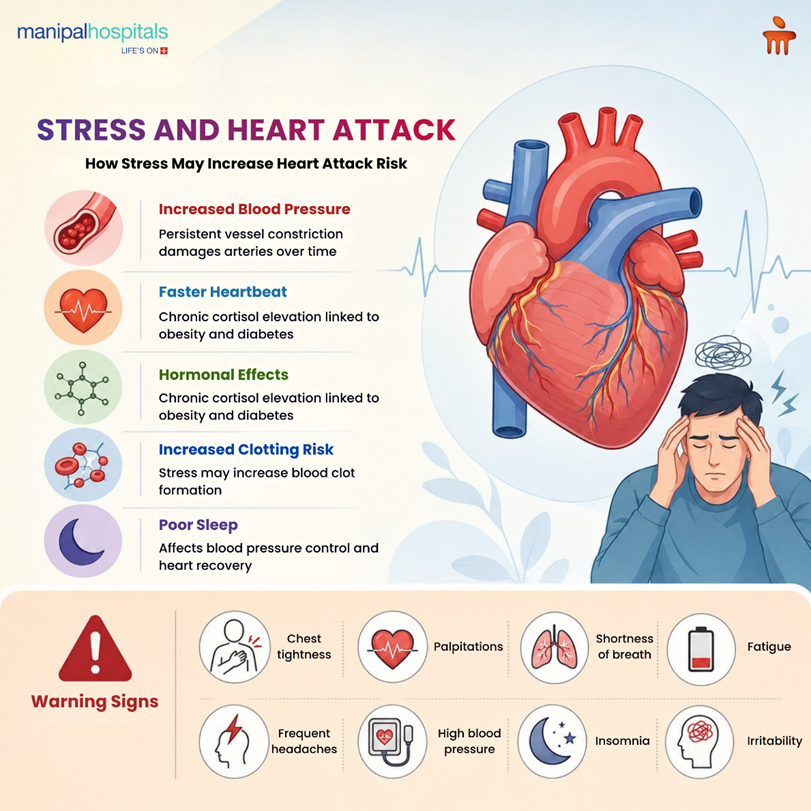
How Does Stress Increase Heart Attack Risk?
Many patients ask doctors exactly how stress causes heart attack problems. Several biological mechanisms may explain this connection.
Increased Blood Pressure
The hormones associated with stress may cause constriction of blood vessels, leading to increased blood pressure. A consistent increase in blood pressure can gradually damage the arteries over time.
Heartbeat Acceleration
Long-term stress results in a faster heartbeat due to extra workload on the heart, hence requiring more oxygen.
Effects Associated with Hormones
Cortisol levels are linked to obesity and diabetes.
Increased Clotting Risk
Some studies suggest stress may increase blood clot formation, which can trigger a heart attack if a coronary artery becomes blocked.
Sleep Disturbance
Poor sleep linked with stress affects blood pressure regulation and heart recovery.
Understanding how stress causes heart attack complications highlights why emotional health is now considered an important part of preventive cardiology care.
Warning Signs of Stress Affecting the Heart
Often, people overlook the early symptoms of stress until they worsen considerably. Nonetheless, one’s body can sometimes give out signals early on. Symptoms might include:
-
Constant fatigue
-
Constriction in the chest area
-
Heart palpitations
-
Shortness of breath
-
Insomnia
-
Frequent headaches
-
Irritability
-
Hypertension
Some patients experiencing a heart attack due to stress may initially dismiss symptoms as anxiety or exhaustion, delaying medical evaluation. Although these symptoms don’t necessarily imply a heart attack, they must not be overlooked, especially in people who have underlying heart conditions. Women, diabetic patients, and the elderly frequently experience a heart attack without classic crushing chest pain, presenting instead with isolated shortness of breath, unexplained profound fatigue, or atypical jaw/back pain.
Can Emotional Shock Trigger a Heart Attack?
Intense emotional distress may, under certain circumstances, lead to heart-related conditions. Situations such as loss, accidents, financial constraints, or sudden discoveries can exert substantial strain on the heart.
Doctors recognise a condition called stress cardiomyopathy (Takotsubo cardiomyopathy), also known as “broken heart syndrome," where severe emotional shock temporarily weakens the heart muscle. It can mimic a heart attack on an ECG and causes identical chest pain; however, it is physically distinct because there are no blocked coronary arteries.
Instead, a massive surge of stress hormones literally "stuns" the heart muscle, causing a temporary ballooning of the left ventricle.
While all forms of stress do not necessarily culminate in heart disorders, people with preexisting heart conditions could find themselves at greater risk during moments of intense emotional tension. The link between stress and heart attacks is hence corroborated.
Other Factors That Increase Heart Attack Risk
Stress alone is rarely the only cause of a heart attack. It often acts alongside other cardiovascular risk factors.
|
Risk Factor |
Effect on Heart Health |
|
Damages artery walls |
|
|
Diabetes |
Increases blood vessel damage |
|
Smoking |
Reduces oxygen supply |
|
High cholesterol |
Contributes to artery blockage |
|
Obesity |
Increases cardiac workload |
|
Chronic stress |
Raises hormonal and inflammatory strain |
People with multiple risk factors may face a higher chance of a heart attack due to stress and unhealthy lifestyle patterns combined.
How Do Lifestyle Habits Change Under Stress?
Stress affects behaviour as much as biology. Many individuals develop unhealthy coping habits without fully recognising their long-term impact.
-
Poor Eating Habits: Stress often increases cravings for processed foods high in salt, sugar, and unhealthy fats.
-
Reduced Physical Activity: Busy schedules and mental exhaustion may reduce exercise levels.
-
Increased Smoking or Alcohol Intake: Some people turn to tobacco or alcohol to manage emotional strain, increasing cardiovascular risk further.
-
Irregular Sleep: Stress frequently disrupts sleep quality, affecting blood pressure and overall recovery.
Doctors addressing stress and heart attack prevention often focus not only on medical treatment but also on healthier coping strategies.
Managing Stress to Protect Heart Health
Reducing stress does not mean eliminating every challenge from life. Instead, it involves developing healthier responses to pressure and emotional strain.
-
Regular Physical Activity: Exercise supports circulation, lowers stress hormones, and improves mood.
-
Healthy Sleep Routine: Consistent sleep helps regulate blood pressure and supports heart recovery.
-
Balanced Diet: Nutritious meals rich in vegetables, fruits, whole grains, and lean protein support cardiovascular health.
-
Mindfulness and Relaxation: Meditation, breathing exercises, and yoga may help reduce emotional tension.
-
Social Support: Spending time with supportive family and friends often improves emotional resilience.
Understanding how stress causes heart attack risk encourages many people to take mental well-being more seriously as part of heart care.
When Do Stress Symptoms Need Medical Attention?
Some symptoms require urgent medical evaluation because they may indicate a developing heart attack rather than stress alone.
Seek immediate medical care if symptoms include:
-
Chest pain or pressure
-
Pain spreading to the arm, jaw, or back
-
Severe breathlessness
-
Sudden sweating
-
Dizziness
-
Nausea
-
Loss of consciousness
A heart attack due to stress may sometimes present suddenly, particularly in people with pre-existing cardiovascular disease. Patients should never assume chest discomfort is “just stress” without proper medical assessment.
Why Preventive Heart Care Matters?
Modern cardiology increasingly focuses on prevention rather than waiting for severe disease to develop. Preventive strategies may include:
-
Blood pressure monitoring
-
Cholesterol management
-
Diabetes control
-
Smoking cessation
-
Stress reduction programmes
-
Weight management
-
Regular exercise
Doctors also encourage patients to discuss emotional health openly during consultations because stress and heart attack risk are now recognised as closely connected.
Patients seeking heart attack treatment in Whitefield should also ask cardiologists about preventive screening and long-term lifestyle guidance. For expert evaluation and care, consult an experienced cardiologist in Whitefield.
Recovery After a Heart Attack
Recovery after a heart attack involves more than physical healing alone. Emotional recovery is equally important.
Many patients experience:
-
Anxiety
-
Fear of recurrence
-
Sleep problems
-
Depression
-
Reduced confidence
Cardiac rehabilitation programmes often include counselling, supervised exercise, dietary support, and stress management techniques. Addressing stress and heart attack recovery together helps improve both emotional well-being and long-term cardiovascular outcomes.
Conclusion
It has been acknowledged today that stress plays a crucial role in increasing heart attack risk in modern medicine. Although stress alone might not be the sole factor causing a heart attack, it certainly has a considerable influence on various aspects, such as high BP, sleep patterns, lifestyles, etc. The awareness about how stress increases heart attack risk helps patients understand their warning signals and focus on both psychological and physical health.
If you require any information on heart attack treatment in Whitefield, Bangalore, then visit our cardiologists at Manipal Hospital Whitefield.
Frequently Asked Questions
Although stress does not alone cause a heart attack, continuous stress can definitely contribute to increased heart risks because of the influence on blood pressure, sleep, and hormones.
Symptoms may include chest pain, breathlessness, palpitations, sweating, dizziness, fatigue, or pain spreading to the arm, neck, jaw, or back during emotional strain.
Stress may cause high blood pressure, increased heart rate, inflammation, and poor lifestyle choices such as smoking, improper diet, and disturbed sleeping habits.
Absolutely. Stress reduction through physical activities, sound sleep, meditation, good food, and emotional well-being may greatly benefit cardiovascular health.
Patients seeking heart attack treatment in Whitefield should consult experienced cardiology specialists for emergency cardiac care, preventive evaluation, rehabilitation support, and personalised treatment recommendations.
Share this Article


Recent Blogs

Jawline Contouring: A Trending Facial Enhancement, and Is It Right for You?
30 Jun 20268 Min Read
A sharp, well-defined jawline is one of the most popular features in modern beauty. You’ve probably noticed how much attention a sharp jawline gets today, on social media, in movies, everywhere. But many people think that jawline contouring makes their natural features look better and gives them more confidence. We’ve all been there, tilting our heads just right in the mirror or searching for the perfect angle in a photo. A sharp, well-defined jawline has become one of the most sought-after features in modern beauty, and it’s easy to see why. From the sculpted looks trending on social media to the leading roles on the big screen, a strong profile often signals health, vitality, and fitness. But for most people, it’s about more than just a trend. Jawline contouring is a way to harmonize your natural features, providing a boost in confidence that radiates from the inside out. For some, the goal is to reduce a double chin, while others want a more defined and contoured look. Advances in plastic and reconstructive surgery have made jawline contouring safer, more precise, and possible without major surgery. In this blog post, we'll explain jawline contouring, the treatment options, the pros and cons of each, and whether it's the right choice for you.
Read NowSleeping with Back Pain: Small Posture Changes That Make a Big Difference
29 Jun 20267 Min Read
Back pain often makes itself felt as soon as you try to sleep. After a long day, you lie down hoping rest will ease the ache, but as soon as you settle, the pain in the lower back can feel louder. Nights can become restless—turning from side to side, shifting pillows, or waking up stiff and sore the next morning. Understanding the right sleeping posture for lower back pain can make a real difference. With a few thoughtful tweaks, from pillow placement to mattress choice, you can reduce strain and let the spine rest in a more natural position. This blog explains the science behind sleep posture and lower back health, shows the best sleeping position for back pain, and offers practical advice on how to sleep with back pain comfortably through the night.
Read NowHeart Attack in Young Adults: Early Warning Signs You Shouldn’t Ignore
24 Jun 20268 Min Read
It is a chilling realisation, but the pattern of cardiac health is changing rapidly in 2026. For decades, the general assumption was that heart issues were a "future problem," something to worry about in one's 50s or 60s. However, the reality in modern emergency rooms tells a different story. We are seeing a significant rise in the incidence of heart attacks in young adults, with people in their 20s and 30s experiencing life-threatening cardiac events. What’s changed in everyday life? Long hours, irregular meals, rising diabetes, weight gain, and constant stress are putting early strain on the heart. The body does send signals, but heart attack symptoms in younger people can feel vague or easy to brush off. That delay matters because early recognition can change outcomes completely, and knowing what to look for could be the difference between a close call and something far more serious. In this blog, we talk about the issue, the cause, and remedies.
Read NowDiabetic Foot Care: Practical Ways to Avoid Serious Foot Problems
10 Jun 20268 Min Read
People living with diabetes are usually screened for kidney, eye, or heart complications. But the foot is commonly neglected. Changes in the feet, such as less sensitivity, dry skin, and slow healing of wounds, may appear to be of little concern, but they could eventually grow into something more dangerous if one is not careful. Many people are surprised to learn that the majority of diabetic foot complications start out as common issues. These include an unnoticed blister, ill-fitting footwear, and cracks in the feet, which could eventually develop into more dangerous conditions if one is not careful. The good news is that many of the problems could be avoided if you are aware of the necessary diabetic foot care required. This blog aims to help you know more about the reasons for the effect of diabetes on the feet and the steps you can take for effective diabetes foot management.
Read NowKyphoplasty Explained: How the Procedure Restores Stability After Vertebral Fractures?
10 Jun 20267 Min Read
Back pain that starts suddenly after a minor fall or even a simple movement can feel alarming, especially when it turns out to be a spinal fracture. Many people are surprised to learn that fragile bones, particularly in older adults or those with weakened bone density, can collapse under everyday stress. The pain can be persistent, posture may slowly change, and routine tasks that were once easy become difficult. This is where kyphoplasty comes into the conversation. Designed to stabilise fractured vertebrae and restore spinal structure, the procedure has changed how clinicians manage painful vertebral compression fractures. When conservative measures do not ease symptoms, this minimally invasive option can offer meaningful improvement in mobility and comfort.
Read NowUnderstanding Common Sports Injuries and Effective Ways to Prevent Them Safely
29 May 20267 Min Read
Participating in sports and other physical activities yields many health benefits. These include improvements in fitness, strength, flexibility and mental well-being. However, the risk of injuries in athletics still remains. Sports injuries can affect players of all ages and skill levels, ranging from a major ligament tear to a minor sprain. Therefore, it is very important to understand what sports injuries are, their causes and the correct strategies to prevent them in order to maintain long-term physical health and performance. Whether you are a professional athlete, a fitness enthusiast or a leisure player, knowing how to avoid and treat common sports injuries will help minimise downtime and improve recovery.
Read NowChronic Kidney Disease in India: CKD Causes, Symptoms & Prevention
29 May 20268 Min Read
Many people do not realise they have kidney disease until the damage becomes more serious. Symptoms like swelling in the feet, tiredness, or waking up multiple times at night to urinate are often ignored in the beginning, but they can sometimes be early signs of chronic kidney disease (CKD). In India, CKD contributes to a high percentage of kidney problems, with recent studies showing a pooled prevalence of around 13-17% among adults and rising from 11% (2011-2017) to 16% (2018-2023). These diseases are becoming more common due to lifestyle changes, stress, obesity, poor eating habits, and lack of exercise. Now doctors are seeing kidney damage at an earlier age. Over time, uncontrolled diabetes and high blood pressure can damage the tiny blood vessels inside the kidneys, reducing their ability to filter waste properly. In this blog, we will discuss how diabetes affects the kidneys, the connection between high BP and kidney disease, common warning signs of CKD, and ways to protect long-term kidney health.
Read NowStress and Heart Attack: Understanding the Hidden Connection
27 May 20268 Min Read
Most people associate a heart attack with unhealthy eating, smoking, diabetes, or high cholesterol. While these are important risk factors, emotional stress is also known to affect heart health. Long working hours, financial pressure, poor sleep, emotional trauma, and constant anxiety can gradually place extra strain on the cardiovascular system over time. Doctors recognise that severe emotional stress can contribute to heart attacks, especially in people with existing cardiovascular risks. Greater awareness can help us identify warning signs and make informed choices to reduce the risk of heart attacks. This blog explores the intricate biological relationship between emotional strain and cardiac health, detailing how stress causes heart attack. By understanding these mechanisms, you can take proactive steps toward both mental well-being and physical health.
Read NowEnlarged Prostate Vs Prostate Cancer: Key Differences
27 May 20266 Min Read
As men get older, changes in urination become fairly common. The urine flow may feel weaker, trips to the bathroom become more frequent, and waking up at night to urinate may start happening more often. Most men brush these changes off as a normal part of ageing. But after a point, one concern starts coming up quite often: is it just an enlarged prostate, or could it be prostate cancer? The confusion is understandable because both conditions affect the prostate gland and can cause similar urinary symptoms. However, an enlarged prostate and prostate cancer are not the same. One is a non-cancerous condition that commonly develops with age, while the other involves abnormal cancerous growth inside the prostate gland. Knowing the difference between the two can help men understand when symptoms should not be ignored, when screening becomes important, and when to seek medical advice early.
Read NowAxillary Breast Removal Surgery: Procedure & Recovery
27 May 20268 Min Read
A small bulge near the underarm area is something many people ignore at first. Some think it is weight gain, while others assume it is just stubborn fat that does not go away with exercise. But for some people, that fullness is actually axillary breast tissue, which can become more noticeable over time. The area may feel uncomfortable while wearing fitted clothes, exercising, or even moving the arms normally. Some people also notice swelling, irritation, or tenderness during hormonal changes, pregnancy, or breastfeeding. While it is not always a serious medical problem, it can affect comfort and confidence in daily life. The good thing is that treatment options are available, and axillary breast removal surgery is commonly done to remove the excess tissue safely. This blog explains the condition, how the procedure is done, recovery after surgery, and what patients should know before considering treatment.
Read Now