


Jawline Contouring: A Trending Facial Enhancement, and Is It Right for You?
Reviewed by: Dr. Ramani C.V
Posted on
8 Min Read

Not sure what you’re looking for?
Get in touch with our representatives for help!
Contact UsA sharp, well-defined jawline is one of the most popular features in modern beauty. You’ve probably noticed how much attention a sharp jawline gets today, on social media, in movies, everywhere. But many people think that jawline contouring makes their natural features look better and gives them more confidence.
We’ve all been there, tilting our heads just right in the mirror or searching for the perfect angle in a photo. A sharp, well-defined jawline has become one of the most sought-after features in modern beauty, and it’s easy to see why. From the sculpted looks trending on social media to the leading roles on the big screen, a strong profile often signals health, vitality, and fitness.
But for most people, it’s about more than just a trend. Jawline contouring is a way to harmonize your natural features, providing a boost in confidence that radiates from the inside out.
For some, the goal is to reduce a double chin, while others want a more defined and contoured look. Advances in plastic and reconstructive surgery have made jawline contouring safer, more precise, and possible without major surgery.
In this blog post, we'll explain jawline contouring, the treatment options, the pros and cons of each, and whether it's the right choice for you.
What Does Jawline Contouring Mean?
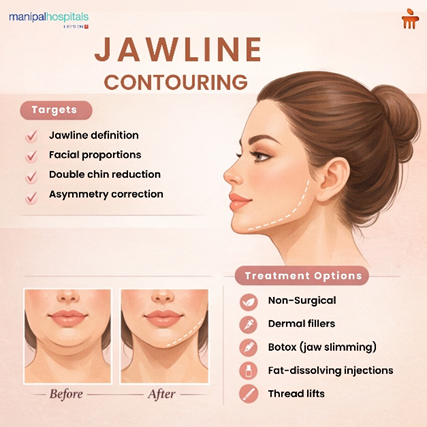
Jawline contouring is a series of procedures that make the jawline look better by changing its shape, definition, and symmetry. Usually, it includes the following:
-
Enhancing definition: Makes the jawline sharper and more structured for a more sculpted look.
-
Balancing the proportions of the face: Helps the chin, jaw, and cheeks look more in harmony with each other.
-
Reducing fullness: Gets rid of fat under the chin or along the jawline
-
Fixing uneven jawlines: To give a more balanced look
Depending on the person's needs, this type of facial contouring can be done with or without surgery.
What Type of Treatments Are Available For Jawline Contouring
The best way to contour your jawline depends on your goals and face shape. If you're considering Jawline Contouring treatment in Whitefield, your specialist will recommend the most suitable option based on your facial anatomy and desired results.
Treatments without surgery:
-
Dermal fillers: Get instant results by adding volume and definition along the jawline
-
Botox (for jaw slimming): Reduces masseter muscle hypertrophy
-
Fat-dissolving injections: Get rid of extra fat under the chin or jaw with multiple sessions
-
Thread lifts: Give a little lift and tighten
Treatments with surgery:
-
Liposuction: Gets rid of fat pockets from the chin and jaw area
-
Chin or jaw implants: improve structure and projection
-
Surgery to reshape bones: Changes the jaw's shape, resulting in many changes.
A lot of people prefer non-surgical options because they are less risky and heal faster.
What Is the Procedure of Jawline Contouring
The procedure depends on the type of treatment chosen, but most jawline contouring procedures follow a set plan.
An overview of the steps
-
Consultation: The doctor looks at the shape of your face, the quality of your skin, and your goals.
-
Planning for treatment: A personalised plan is made to get the best results.
-
How it's done: Fillers, injections, or surgery are used.
-
Shaping and refining: Changes are made to make things more balanced and symmetrical.
-
Care after treatment: Instructions are given to help with healing
This personalised method guarantees results that look natural when contouring the face. onsulting an experienced Jawline Contouring treatment doctor in Whitefield, Bangalore helps ensure the treatment plan is tailored to your facial structure and aesthetic goals.
What Are The Benefits of Jawline Contouring
Jawline contouring has a lot of benefits for the right person.
The main benefits are the following:
-
Better facial definition: Makes your face look sharper and more defined
-
Non-surgical: Some options don't involve surgery and don't require much time off.
-
Results that last: Depending on the treatment, effects can last for months or even years.
-
More confidence: Patients often feel better about how they look
Many people find jawline enhancement appealing because of these benefits.
Table of Differences: Surgical vs Non-Surgical Jawline Contouring
Patients can use this comparison to figure out which type of jawline contouring will work best for them.
|
Feature |
Non-Surgical Contouring |
Surgical Contouring |
|
Procedure type |
Minimally invasive |
Invasive surgery |
|
Recovery time |
1–3 days |
Weeks to months |
|
Results |
Temporary (6–18 months) |
Long-lasting |
|
Pain level |
Mild discomfort |
Moderate |
|
Cost |
Moderate |
Higher |
|
Risk level |
Low |
Higher |
Who Is a Suitable Candidate for Jawline Contouring?
Jawline contouring is best suited for people who want to enhance their natural features rather than entirely change their appearance.
-
Mild to moderate concerns: Slight fullness, a less defined jawline, or minor asymmetry tend to respond well to treatment.
-
Looking for natural enhancement: The aim is to refine your features, not create a drastic or artificial change.
-
Good skin elasticity: Skin that can adapt well helps achieve smoother and more balanced results.
-
Realistic expectations: Understanding what the treatment can and cannot do is important for satisfaction.
-
Medically fit: Being in good overall health supports better healing and safer outcomes.
-
Open to expert advice: A consultation helps determine the right approach based on your face shape and goals.
Who Should Avoid Jawline Contouring
Jawline contouring isn’t the right choice for everyone, and in some cases, it’s better to wait or explore other options.
-
Active skin issues: If you have acne, infection, or irritation in the area, it’s best to treat that first
-
Expectations that don’t match reality: The goal is enhancement, not completely changing your face
-
Loose or sagging skin: Non-surgical treatments may not give noticeable results in such cases
-
Ongoing health conditions: Certain medical issues can increase the risk of complications
-
Allergies to treatment materials: A history of reactions to fillers or medications needs careful review
-
Pregnancy or breastfeeding: Most cosmetic treatments are usually avoided during this time
A consultation helps decide what’s safe and what will actually give you the results you’re looking for.
What Are the Risks Involved?
Usually, jawline contouring, being a medical procedure, is quite safe.
Common risks involved are:
-
Swelling or bruising: common and usually goes away on its own
-
Asymmetry: Such an outcome could happen if you don't do it right.
-
Infection: Uncommon but possible during invasive procedures
-
Allergic reactions: Especially with fillers
-
Temporary pain: A little pain after treatment
Is Jawline Contouring the Right Thing for You?
Jawline contouring can help define your face while keeping your natural look. Some people want a sharper line; others just a subtle tweak.
Dermal fillers can add structure and sharpen the shape without surgery, while fat-dissolving injections help slim down fullness for better definition.
These treatments are usually minimally invasive, with quick results and little downtime. However, suitability depends on factors like skin elasticity, bone structure, and fat distribution, which are best assessed during a consultation with experienced Jawline Contouring treatment surgeons in Whitefield.
The goal is not to change how you look, but to enhance your natural features in a balanced and subtle way.
Conclusion
Jawline contouring is becoming more popular as more people look for personalised and less invasive cosmetic treatments. With advances in modern medicine, achieving a well-defined jawline is now safer and more accessible. Jawline contouring can help you feel more confident and balance out your face. You can do it with fillers, injections, or surgery. An experienced professional can help you choose the right treatment.
A professional evaluation can help you figure out what jawline enhancement method is best for your face shape and goals if you're thinking about it. Patients looking for the best jawline contouring treatment in Whitefield, Bangalore, can get help from experts, cutting-edge methods, and individualised care plans.
Frequently Asked Questions
The results depend on the method used. Dermal fillers usually last between 6 and 18 months, but with the right care and upkeep, surgical procedures can last longer.
Most non-surgical procedures don't hurt much and use numbing agents. Surgery may cause moderate pain, which can be managed with medication and excellent care after the procedure.
Yes, when done by trained professionals, the results are meant to enhance natural facial features rather than make them look fake or over-the-top, so the results are always balanced and subtle.
People who are 18 or older can get treatment. But for non-surgical procedures, age alone doesn't matter as much as skin condition, facial structure, and overall health.
Most non-surgical treatments allow a return to work within 24–48 hours. Surgical recovery, however, varies with procedure complexity and individual healing.
Share this Article


Recent Blogs

Jawline Contouring: A Trending Facial Enhancement, and Is It Right for You?
30 Jun 20268 Min Read
A sharp, well-defined jawline is one of the most popular features in modern beauty. You’ve probably noticed how much attention a sharp jawline gets today, on social media, in movies, everywhere. But many people think that jawline contouring makes their natural features look better and gives them more confidence. We’ve all been there, tilting our heads just right in the mirror or searching for the perfect angle in a photo. A sharp, well-defined jawline has become one of the most sought-after features in modern beauty, and it’s easy to see why. From the sculpted looks trending on social media to the leading roles on the big screen, a strong profile often signals health, vitality, and fitness. But for most people, it’s about more than just a trend. Jawline contouring is a way to harmonize your natural features, providing a boost in confidence that radiates from the inside out. For some, the goal is to reduce a double chin, while others want a more defined and contoured look. Advances in plastic and reconstructive surgery have made jawline contouring safer, more precise, and possible without major surgery. In this blog post, we'll explain jawline contouring, the treatment options, the pros and cons of each, and whether it's the right choice for you.
Read NowSleeping with Back Pain: Small Posture Changes That Make a Big Difference
29 Jun 20267 Min Read
Back pain often makes itself felt as soon as you try to sleep. After a long day, you lie down hoping rest will ease the ache, but as soon as you settle, the pain in the lower back can feel louder. Nights can become restless—turning from side to side, shifting pillows, or waking up stiff and sore the next morning. Understanding the right sleeping posture for lower back pain can make a real difference. With a few thoughtful tweaks, from pillow placement to mattress choice, you can reduce strain and let the spine rest in a more natural position. This blog explains the science behind sleep posture and lower back health, shows the best sleeping position for back pain, and offers practical advice on how to sleep with back pain comfortably through the night.
Read NowHeart Attack in Young Adults: Early Warning Signs You Shouldn’t Ignore
24 Jun 20268 Min Read
It is a chilling realisation, but the pattern of cardiac health is changing rapidly in 2026. For decades, the general assumption was that heart issues were a "future problem," something to worry about in one's 50s or 60s. However, the reality in modern emergency rooms tells a different story. We are seeing a significant rise in the incidence of heart attacks in young adults, with people in their 20s and 30s experiencing life-threatening cardiac events. What’s changed in everyday life? Long hours, irregular meals, rising diabetes, weight gain, and constant stress are putting early strain on the heart. The body does send signals, but heart attack symptoms in younger people can feel vague or easy to brush off. That delay matters because early recognition can change outcomes completely, and knowing what to look for could be the difference between a close call and something far more serious. In this blog, we talk about the issue, the cause, and remedies.
Read NowDiabetic Foot Care: Practical Ways to Avoid Serious Foot Problems
10 Jun 20268 Min Read
People living with diabetes are usually screened for kidney, eye, or heart complications. But the foot is commonly neglected. Changes in the feet, such as less sensitivity, dry skin, and slow healing of wounds, may appear to be of little concern, but they could eventually grow into something more dangerous if one is not careful. Many people are surprised to learn that the majority of diabetic foot complications start out as common issues. These include an unnoticed blister, ill-fitting footwear, and cracks in the feet, which could eventually develop into more dangerous conditions if one is not careful. The good news is that many of the problems could be avoided if you are aware of the necessary diabetic foot care required. This blog aims to help you know more about the reasons for the effect of diabetes on the feet and the steps you can take for effective diabetes foot management.
Read NowKyphoplasty Explained: How the Procedure Restores Stability After Vertebral Fractures?
10 Jun 20267 Min Read
Back pain that starts suddenly after a minor fall or even a simple movement can feel alarming, especially when it turns out to be a spinal fracture. Many people are surprised to learn that fragile bones, particularly in older adults or those with weakened bone density, can collapse under everyday stress. The pain can be persistent, posture may slowly change, and routine tasks that were once easy become difficult. This is where kyphoplasty comes into the conversation. Designed to stabilise fractured vertebrae and restore spinal structure, the procedure has changed how clinicians manage painful vertebral compression fractures. When conservative measures do not ease symptoms, this minimally invasive option can offer meaningful improvement in mobility and comfort.
Read NowUnderstanding Common Sports Injuries and Effective Ways to Prevent Them Safely
29 May 20267 Min Read
Participating in sports and other physical activities yields many health benefits. These include improvements in fitness, strength, flexibility and mental well-being. However, the risk of injuries in athletics still remains. Sports injuries can affect players of all ages and skill levels, ranging from a major ligament tear to a minor sprain. Therefore, it is very important to understand what sports injuries are, their causes and the correct strategies to prevent them in order to maintain long-term physical health and performance. Whether you are a professional athlete, a fitness enthusiast or a leisure player, knowing how to avoid and treat common sports injuries will help minimise downtime and improve recovery.
Read NowChronic Kidney Disease in India: CKD Causes, Symptoms & Prevention
29 May 20268 Min Read
Many people do not realise they have kidney disease until the damage becomes more serious. Symptoms like swelling in the feet, tiredness, or waking up multiple times at night to urinate are often ignored in the beginning, but they can sometimes be early signs of chronic kidney disease (CKD). In India, CKD contributes to a high percentage of kidney problems, with recent studies showing a pooled prevalence of around 13-17% among adults and rising from 11% (2011-2017) to 16% (2018-2023). These diseases are becoming more common due to lifestyle changes, stress, obesity, poor eating habits, and lack of exercise. Now doctors are seeing kidney damage at an earlier age. Over time, uncontrolled diabetes and high blood pressure can damage the tiny blood vessels inside the kidneys, reducing their ability to filter waste properly. In this blog, we will discuss how diabetes affects the kidneys, the connection between high BP and kidney disease, common warning signs of CKD, and ways to protect long-term kidney health.
Read NowStress and Heart Attack: Understanding the Hidden Connection
27 May 20268 Min Read
Most people associate a heart attack with unhealthy eating, smoking, diabetes, or high cholesterol. While these are important risk factors, emotional stress is also known to affect heart health. Long working hours, financial pressure, poor sleep, emotional trauma, and constant anxiety can gradually place extra strain on the cardiovascular system over time. Doctors recognise that severe emotional stress can contribute to heart attacks, especially in people with existing cardiovascular risks. Greater awareness can help us identify warning signs and make informed choices to reduce the risk of heart attacks. This blog explores the intricate biological relationship between emotional strain and cardiac health, detailing how stress causes heart attack. By understanding these mechanisms, you can take proactive steps toward both mental well-being and physical health.
Read NowEnlarged Prostate Vs Prostate Cancer: Key Differences
27 May 20266 Min Read
As men get older, changes in urination become fairly common. The urine flow may feel weaker, trips to the bathroom become more frequent, and waking up at night to urinate may start happening more often. Most men brush these changes off as a normal part of ageing. But after a point, one concern starts coming up quite often: is it just an enlarged prostate, or could it be prostate cancer? The confusion is understandable because both conditions affect the prostate gland and can cause similar urinary symptoms. However, an enlarged prostate and prostate cancer are not the same. One is a non-cancerous condition that commonly develops with age, while the other involves abnormal cancerous growth inside the prostate gland. Knowing the difference between the two can help men understand when symptoms should not be ignored, when screening becomes important, and when to seek medical advice early.
Read NowAxillary Breast Removal Surgery: Procedure & Recovery
27 May 20268 Min Read
A small bulge near the underarm area is something many people ignore at first. Some think it is weight gain, while others assume it is just stubborn fat that does not go away with exercise. But for some people, that fullness is actually axillary breast tissue, which can become more noticeable over time. The area may feel uncomfortable while wearing fitted clothes, exercising, or even moving the arms normally. Some people also notice swelling, irritation, or tenderness during hormonal changes, pregnancy, or breastfeeding. While it is not always a serious medical problem, it can affect comfort and confidence in daily life. The good thing is that treatment options are available, and axillary breast removal surgery is commonly done to remove the excess tissue safely. This blog explains the condition, how the procedure is done, recovery after surgery, and what patients should know before considering treatment.
Read Now