


Meniscus Tear: Understanding Symptoms, Diagnosis, and the Repair vs. Removal Decision
Reviewed by: Dr. Rajesh Kumar Kanoji
Posted on
11 Min Read

Not sure what you’re looking for?
Get in touch with our representatives for help!
Contact UsA sudden twist, a missed step, or even the wear and tear of time can lead to a common knee injury that impacts millions worldwide: a meniscus tear. At Manipal Hospitals, we understand the debilitating pain and disruption a meniscus tear can bring to your daily life. Our dedicated orthopaedic specialists in Jaipur are here to guide you through understanding this condition, from the initial symptoms of a meniscus tear to advanced meniscus tear treatment options, ensuring you regain your mobility and quality of life.
What is a Meniscus Tear?
Your knee joint contains two C-shaped pieces of cartilage, known as menisci (plural for meniscus), that act as shock absorbers between your thigh bone (femur) and shin bone (tibia). The medial meniscus is on the inside of your knee, and the lateral meniscus is on the outside. These tough, rubbery structures protect your knee, distribute weight evenly, and contribute to joint stability. A meniscus tear occurs when this cartilage is damaged, often due to forceful twisting or rotation of the knee, especially when bearing weight. This can happen during sports activities, heavy lifting, or even from degenerative changes over time.
Types of Meniscus Tear
A meniscus tear is a common knee injury involving damage to the C-shaped cartilage discs that cushion and stabilise the joint. The two menisci in each knee—the medial meniscus (inner side) and the lateral meniscus (outer side)—can tear in several distinct patterns based on the direction, location, and severity of the rupture.
Classification by Tear Pattern and Shape
Orthopaedic specialists classify meniscus tears by their visual appearance and the direction of the structural break:
1. Radial Tear
-
Description: This is the most common type of meniscus tear.
-
Characteristics: The tear begins at the sharp inner edge of the meniscus and extends straight outward across the width of the cartilage.
-
Impact: Because it cuts across the circular fibres of the meniscus, it disrupts the structural integrity of the cushion, often requiring surgical trimming (meniscectomy) if it cannot heal on its own.
2. Horizontal Tear
-
Description: A tear that runs parallel to the surface of the cartilage.
-
Characteristics: It splits the meniscus like a pita pocket, dividing the top layer from the bottom layer.
-
Impact: This pattern is highly responsive to meniscus repair surgery if it occurs in a region with good blood supply, as the two flat surfaces can be stitched back together.
3. Longitudinal or Vertical Tear
-
Description: A tear that runs lengthwise, parallel to the outer curve of the meniscus.
-
Characteristics: It slices through the cartilage vertically without crossing the circular fibres.
-
Impact: This type is often caused by repetitive trauma in younger, athletic individuals and has a high success rate for surgical repair.
4. Bucket-Handle Tear
-
Description: A severe sub-type of a large longitudinal tear.
-
Characteristics: The torn, inner portion of the meniscus pulls away from the outer edge, flipping inward into the centre of the joint like a bucket handle.
-
Impact: The displaced cartilage mechanically blocks the knee joint, frequently causing the knee to lock up completely, preventing the leg from fully straightening. It requires urgent surgical intervention.
5. Flap Tear
-
Description: A complex tear where a small segment of the cartilage pulls away.
-
Characteristics: A piece of the meniscus splits and peels back, creating a loose flap that can catch or get stuck inside the moving parts of the joint.
-
Impact: The loose flap often causes clicking, popping, or sharp catching pain during knee rotation.
6. Complex Tear
-
Description: A combination of multiple tear patterns.
-
Characteristics: The injury involves a mix of radial, horizontal, and longitudinal tears, usually resulting in severely frayed or shredded cartilage.
-
Impact: These tears are typical of degenerative conditions or severe multi-directional trauma. Because the tissue is heavily degraded, it is rarely repairable and usually requires debridement (smoothing down the edges).
Recognising the Symptoms of a Meniscus Tear
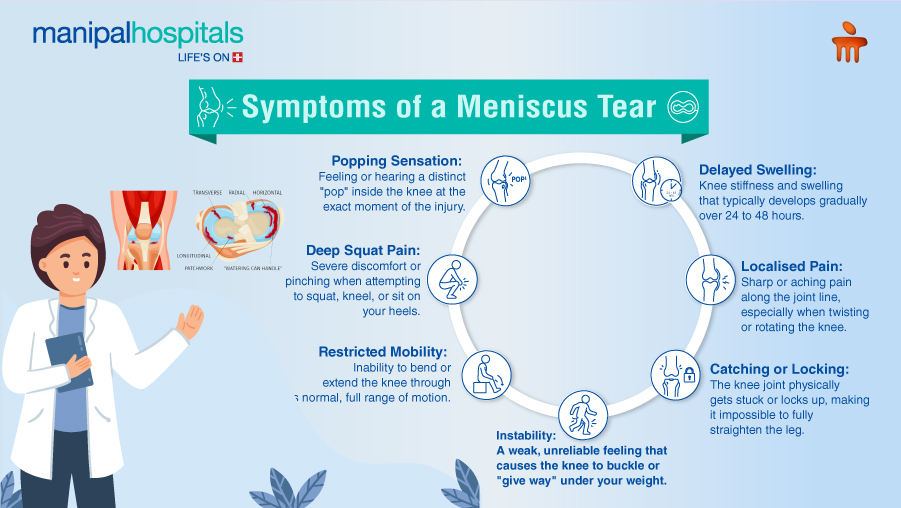
The symptoms of a meniscus tear can vary depending on the severity and location of the tear. While some tears might present with immediate, sharp pain, others might develop gradually. It's crucial to pay attention to these signs:
-
Pain: Often localised along the joint line, either on the inside (indicating a medial meniscus tear treatment might be needed) or outside of the knee. The pain can worsen with activity, especially twisting or squatting.
-
Swelling: Your knee might feel stiff and swell within a few hours or days after the injury.
-
Stiffness and Limited Movement: Difficulty bending or straightening your knee completely.
-
Clicking or Popping Sensation: You might hear or feel a "pop" at the time of injury.
-
Catching or Locking: A piece of torn meniscus can get caught in the knee joint, causing it to lock up, making it impossible to move the knee. This is a common and concerning symptom.
-
Weakness: A feeling that your knee might give way.
If you experience any of these symptoms, especially after a knee injury, prompt medical evaluation is recommended to prevent further damage and to begin appropriate meniscus tear treatment.
Diagnosing a Meniscus Tear
Accurate diagnosis is the first step towards effective meniscus tear treatment. At Manipal Hospitals, our orthopaedic specialists employ a comprehensive approach:
-
Medical History and Physical Examination: Your doctor will ask about your symptoms, how the injury occurred, and perform specific tests to assess your knee's range of motion, stability, and tenderness. The McMurray test is a common manoeuvre used to detect meniscus tears.
-
Imaging Tests:
-
X-rays: While X-rays cannot visualise cartilage, they can rule out other conditions like fractures or arthritis.
-
Magnetic Resonance Imaging (MRI): An MRI scan provides detailed images of soft tissues, including the menisci, making it the most effective tool for confirming a meniscus tear and determining its type, location, and meniscus tear grades.
-
Understanding the meniscus tear grades (Grade 1, 2, or 3) is crucial as it directly influences the treatment plan. Grade 1 and 2 tears are often less severe and might respond to conservative management, while Grade 3 tears are complete tears, often requiring surgical intervention.
Meniscus Tear Treatment: Repair vs. Removal — What Surgeons Decide
Once a meniscus tear is diagnosed, your orthopaedic surgeon at Manipal Hospitals will discuss the most appropriate meniscus tear treatment options. The primary decision often revolves around whether to repair the torn meniscus or remove the damaged part (meniscectomy).
Factors Influencing the Decision
The choice between meniscus repair surgery and partial meniscectomy (removal) is complex and depends on several factors:
-
Location of the Tear: The meniscus has areas with different blood supplies. Tears in the "red zone" (outer one-third with good blood supply) often have a better chance of healing after meniscus repair surgery. Tears in the "white zone" (inner two-thirds with poor blood supply) typically do not heal well and are often candidates for removal.
-
Size and Pattern of the Tear: Smaller, stable tears (like radial or horizontal tears) might be repairable. Complex or degenerate tears (e.g., bucket-handle tears) might be more challenging to repair and could necessitate partial removal.
-
Patient's Age and Activity Level: Younger, more active individuals are generally better candidates for repair, as preserving the meniscus helps prevent future arthritis. In older patients with degenerative tears, removal might be preferred for quicker pain relief and recovery, though the long-term risk of arthritis increases.
-
Overall Knee Health: The presence of existing arthritis or other ligament injuries can influence the decision.
-
Associated Injuries: If there are other ligament injuries (like an ACL tear), a repair might be performed concurrently.
Meniscus Repair Surgery
The goal of meniscus repair surgery is to stitch the torn edges of the meniscus back together, allowing it to heal. This preserves the natural cushioning and protective function of the meniscus, significantly reducing the risk of developing early-onset arthritis. This procedure is typically performed arthroscopically, using small incisions and a camera to guide the surgeon.
-
Benefits: Preserves knee anatomy, reduces future arthritis risk.
-
Recovery: Generally longer than removal, often involving several weeks of limited weight-bearing and physical therapy. We see over 90% successful healing rates in appropriately selected patients at Manipal Hospitals who undergo meniscus repair, leading to long-term knee health.
Partial Meniscectomy (Meniscus Removal)
When repair is not feasible or advisable, a partial meniscectomy is performed. In this arthroscopic procedure, the surgeon carefully trims away only the damaged, torn portion of the meniscus, leaving as much healthy tissue as possible. This aims to alleviate symptoms of locking, clicking, and pain by removing the problematic segment.
-
Benefits: Quicker recovery, faster return to daily activities, and effective symptom relief.
-
Recovery: Shorter rehabilitation period, often with weight-bearing allowed much sooner. While highly effective for symptom relief, it's important to note that removing meniscal tissue can increase stress on the articular cartilage over time, potentially leading to arthritis down the line. Over 95% of patients report significant pain relief after partial meniscectomy at Manipal Hospitals.
Care Essentials: Do's and Don'ts After Meniscus Surgery
Regardless of whether you undergo meniscus repair surgery or partial meniscectomy, adhering to post-operative guidelines is crucial for a successful recovery and the best possible outcome.
Do's:
-
Follow Rehabilitation Protocol: Diligently perform your prescribed physical therapy exercises. This is vital for regaining strength, flexibility, and range of motion.
-
Manage Pain and Swelling: Use ice, elevation, and prescribed pain medication as directed by your doctor.
-
Keep Incision Clean and Dry: Follow wound care instructions to prevent infection.
-
Attend Follow-up Appointments: Regular check-ups with your orthopaedic surgeon are essential to monitor your healing process.
-
Listen to Your Body: Avoid activities that cause pain or discomfort.
Don'ts:
-
Don't Rush Recovery: Avoid high-impact activities or returning to sports too soon, as this can re-injure the meniscus.
-
Don't Ignore Pain: Persistent or worsening pain could indicate a complication; report it to your doctor.
-
Don't Skip Physical Therapy: Skipping sessions can hinder your progress and prolong recovery.
-
Don't Overdo It: While activity is good, excessive or strenuous movements early in recovery can be detrimental.
-
Don't Neglect Proper Footwear: Wear supportive shoes to provide stability to your knee.
Frequently Asked Questions
Some small tears, especially those in the "red zone" (area with good blood supply), can potentially heal on their own with conservative management. However, larger or more complex tears, particularly those in the "white zone," often require meniscus tear treatment, including surgery, to heal effectively and prevent further issues.
Recovery time varies. For partial meniscectomy, patients can often bear weight soon after surgery and return to light activities within a few weeks, with full recovery in 4-6 weeks. For meniscus repair surgery, recovery is longer, often involving limited weight-bearing for 4-6 weeks and a return to sports in 4-6 months, depending on the individual and the extent of the repair.
A medial meniscus tear occurs on the inside of the knee, while a lateral meniscus tear is on the outside. Medial meniscus tears are generally more common due to the knee's anatomy and mechanics, often requiring specific medial meniscus tear treatment considerations.
A meniscus tear, particularly if left untreated or if a significant portion of the meniscus is removed, can increase the long-term risk of developing knee arthritis. Meniscus repair surgery aims to preserve the meniscus and reduce this risk, while partial meniscectomy, though effective for symptom relief, can slightly increase the likelihood over many years.
Meniscus tears are typically graded based on MRI findings:
-
Grade 1: Small, internal tears not extending to the surface. Often asymptomatic or minor symptoms.
-
Grade 2: More extensive internal tears, but still not extending to the surface. Can cause pain and swelling.
-
Grade 3: Complete tears extending to the meniscal surface. These are often symptomatic and may require surgical intervention.
Share this Article


Recent Blogs

Hernia Surgery: Open vs Laparoscopic — Which Approach Suits You Best?
29 Jun 20267 Min Read
A hernia occurs when an organ or fatty tissue squeezes through a weak spot in a surrounding muscle or connective tissue. While some hernias might not cause immediate discomfort, they can lead to serious hernia surgery complications if left untreated, such as strangulation of the incarcerated tissue. Common types include inguinal hernia surgery (groin), umbilical hernia surgery (belly button), hiatal, and incisional hernia. The good news is that hernia surgery is a highly effective and safe hernia treatment for millions of patients worldwide, with success rates often exceeding 95% for long-term relief.
Read NowPancreatitis: Acute vs Chronic — Causes, Symptoms and Treatment
29 Jun 20268 Min Read
The pancreas, a vital organ nestled behind your stomach, plays a crucial dual role: producing digestive enzymes that help break down food and hormones like insulin that regulate blood sugar. When this delicate organ becomes inflamed, a condition known as pancreatitis occurs. This inflammation can manifest in two primary forms – acute pancreatitis and chronic pancreatitis – each with distinct characteristics, causes, and treatment approaches. Understanding the differences is key to effective management and maintaining your long-term health. At Manipal Hospitals, our gastroenterology experts are dedicated to providing comprehensive care for all types of pancreatic disease, employing cutting-edge diagnostics and personalised treatment plans to ensure the best possible outcomes for our patients.
Read NowICD vs CRT: Understanding Implantable Devices for Dangerous Heart Rhythms and Heart Failure
22 Jun 20268 Min Read
At Manipal Hospitals, we understand that a diagnosis involving a serious heart condition can be daunting. You may have heard terms like Implantable Cardioverter Defibrillator (ICD) or Cardiac Resynchronization Therapy (CRT) device, and perhaps you're wondering what they are and how they differ. These advanced implantable devices represent significant breakthroughs in modern cardiology, offering renewed hope and significantly improving the quality of life for patients with dangerous heart rhythms and heart failure. Through this blog, our commitment is to empower you with clear information, delivered with the empathy you deserve. We'll explore these life-saving technologies, helping you understand their roles in managing complex heart conditions and showcasing how Manipal Hospitals stands at the forefront of providing exceptional arrhythmia treatment and heart failure treatment.
Read NowUnderstanding Multiple Sclerosis: Symptoms, Diagnosis, and Advanced Care at Manipal
22 Jun 20268 Min Read
Multiple Sclerosis (MS) is a complex and often misunderstood condition that affects millions worldwide. At Manipal Hospitals, we believe in empowering our patients with knowledge and providing compassionate, state-of-the-art care. Understanding multiple sclerosis symptoms, its progression, and the latest treatment options is the first step towards managing this chronic neurological disease effectively. Our expert team is dedicated to guiding you through every stage, ensuring you receive personalised care designed to improve your quality of life.
Read NowLiving With Epilepsy: Medication, Triggers and When to Consider Surgery
19 Jun 20266 Min Read
Living with epilepsy can present unique challenges, but with the right knowledge, medical care, and supportive community, a fulfilling life is not just possible—it's the reality for a significant majority. This comprehensive guide will delve into understanding epilepsy symptoms, exploring effective epilepsy treatment options, including medication and surgical considerations, and empowering you to manage triggers for better epilepsy management.
Read Nowहिप रिप्लेसमेंट सर्जरी: संकेत कि आपको इसकी ज़रूरत है, प्रक्रिया और रिकवरी टाइमलाइन
19 Jun 20266 Min Read
कूल्हे का दर्द आपकी दैनिक गतिविधियों और जीवन की गुणवत्ता को गंभीर रूप से प्रभावित कर सकता है। जब नॉन-सर्जिकल उपचार विफल हो जाते हैं, तो हिप रिप्लेसमेंट सर्जरी (Total Hip Arthroplasty) एक प्रभावी समाधान हो सकती है। मणिपाल अस्पताल में, हम समझते हैं कि यह निर्णय आसान नहीं होता, और इसलिए हम आपको इस प्रक्रिया के बारे में विस्तृत जानकारी प्रदान करने के लिए यहाँ हैं। आइए समझते हैं कि आपको हिप रिप्लेसमेंट सर्जरी की आवश्यकता कब हो सकती है, इसमें क्या प्रक्रिया शामिल है और रिकवरी की टाइमलाइन क्या है।
Read NowHPV Vaccine for Cervical Cancer Prevention: Who Should Get It and When
12 Jun 202610 Min Read
Cervical cancer, a significant health concern for women globally, is largely preventable. At the forefront of this prevention strategy is the HPV vaccine, a medical marvel that has transformed our approach to this disease. Here at Manipal Hospitals, we are committed to empowering our community with knowledge and access to life-saving interventions. This comprehensive guide will shed light on the Human Papillomavirus (HPV), its link to cervical cancer, and why the HPV vaccine is a cornerstone of women's health.
Read NowWhat is TAVI/TAVR? A Patient's Guide to Transcatheter Aortic Valve Replacement
12 Jun 20266 Min Read
At Manipal Hospitals, we understand that facing a heart condition can be daunting. When it comes to aortic valve disease, the thought of traditional open-heart surgery can be particularly intimidating. Fortunately, advancements in medical science offer less invasive, highly effective alternatives. One such groundbreaking innovation is the TAVI procedure, also known as TAVR. This guide aims to demystify Transcatheter Aortic Valve Replacement (TAVR/TAVI), providing you with comprehensive, patient-centric information to help you understand this life-changing treatment option.
Read NowMeniscus Tear: Understanding Symptoms, Diagnosis, and the Repair vs. Removal Decision
08 Jun 202611 Min Read
A sudden twist, a missed step, or even the wear and tear of time can lead to a common knee injury that impacts millions worldwide: a meniscus tear. At Manipal Hospitals, we understand the debilitating pain and disruption a meniscus tear can bring to your daily life. Our dedicated orthopaedic specialists in Jaipur are here to guide you through understanding this condition, from the initial symptoms of a meniscus tear to advanced meniscus tear treatment options, ensuring you regain your mobility and quality of life.
Read NowOver 90% Preventable: How HPV Vaccine & Early Screening Can Eradicate Cervical Cancer
08 Jun 202610 Min Read
Cervical cancer, a disease that affects the cervix (the lower part of the uterus that connects to the vagina), stands as a significant health concern for women worldwide. However, the good news is that it is largely preventable and, when detected early, highly treatable. At Manipal Hospitals, we are committed to empowering women with the knowledge and resources to protect themselves against this disease. This comprehensive guide will walk you through the essential aspects of cervical cancer prevention, from understanding its causes of cervical cancer to embracing the power of the HPV vaccine and regular cervical cancer screening. The global fight against cervical cancer has seen remarkable progress, with preventative strategies demonstrating incredible success. For instance, countries with robust cervical cancer screening programs have seen a reduction in incidence and mortality rates by up to 80%. This highlights the immense power of proactive health measures in safeguarding women's well-being.
Read Now