


Laparoscopic Management of Right Inguinal Hernia with Caecum and Adhesions
Reviewed by: Dr. Bhaskar Mallaiah
Posted on
7 Min Read

Not sure what you’re looking for?
Get in touch with our representatives for help!
Contact UsAn inguinal hernia is something doctors see regularly, but not every case is as straightforward as it sounds. In many people, the hernia sac contains fat or a simple loop of intestine, and the repair is relatively routine. However, there are situations where things are not that simple. When the contents include structures like the caecum (the first portion of the colon located in the lower right abdomen), along with dilated bowel loops and adhesions, the surgery becomes more complex and needs a more thoughtful approach. In these cases, the focus is not just on repairing the defect but on safely handling what is inside the hernia and protecting the surrounding structures. Choosing the right surgical method becomes important here. While open surgery is still a reliable option, laparoscopic repair can offer better visual clarity and more controlled dissection, especially when dealing with adhesions or unusual findings.
In this blog, a top general surgeon in Malleshwaram, Bengaluru, helps you understand how inguinal hernias develop and the usual ways they are treated and walks you through a real case of a right inguinal hernia where the caecum was part of the hernia contents. This case shows how careful planning and the right surgical technique can make a significant difference in achieving a safe and successful outcome.
What Is an Inguinal Hernia?
An inguinal hernia occurs when tissue pushes through a weak area in the groin region. It may appear as a swelling and may or may not cause pain. Some hernias stay small for a long time, while others enlarge or become more complex over time. In certain cases, abdominal contents can enter the hernia sac, which makes surgical repair more demanding.
The main goal of hernia surgery is to return the contents to their proper place and reinforce the weak area so the hernia does not recur. Hernia repair with mesh is commonly used because it provides support to the abdominal wall and helps reduce the risk of recurrence. In this case, the laparoscopic hernia repair offered a minimally invasive way to handle a hernia with unusual intraoperative findings.
The Case Study
The patient was a 46-year-old male with no significant past medical history. He presented with a swelling in the right groin region for a few days, and there was no associated pain. On evaluation, he was conscious, stable, and vitally normal. No other systemic abnormalities were noted.
He was diagnosed with a right inguinal hernia and taken up for surgery. What made this case notable was the intraoperative finding. The hernia was a complete indirect inguinal hernia, and its contents included the caecum, dilated small bowel loops, and adhesions. This added complexity because the hernia contents had to be reduced carefully without injury to the bowel or surrounding structures.
Causes of an Inguinal Hernia
Inguinal hernias usually develop because of weakness in the abdominal wall. This weakness may be present from birth or may develop over time. Increased pressure inside the abdomen can also contribute.
Common contributing factors include:
-
Strain on the abdominal wall
-
Heavy lifting
-
Chronic coughing
-
Constipation with repeated straining
-
Weakness in the groin area
In this case, the exact cause was not stated, but the hernia developed in the right groin and became clinically visible as swelling.
Treatment Options
Not all hernias are managed the same way. Small or minimally symptomatic hernias may sometimes be observed for a time, but surgical repair is the definitive treatment.
Treatment options may include:
-
Observation in selected mild cases
-
Open hernia repair
-
Laparoscopic hernia repair
-
Mesh reinforcement during repair
In this case, laparoscopic hernia repair with mesh was chosen. Since the hernia contained the caecum, bowel loops, and adhesions, operative repair was the correct approach to safely reduce the contents and close the defect.
Treatment Decision
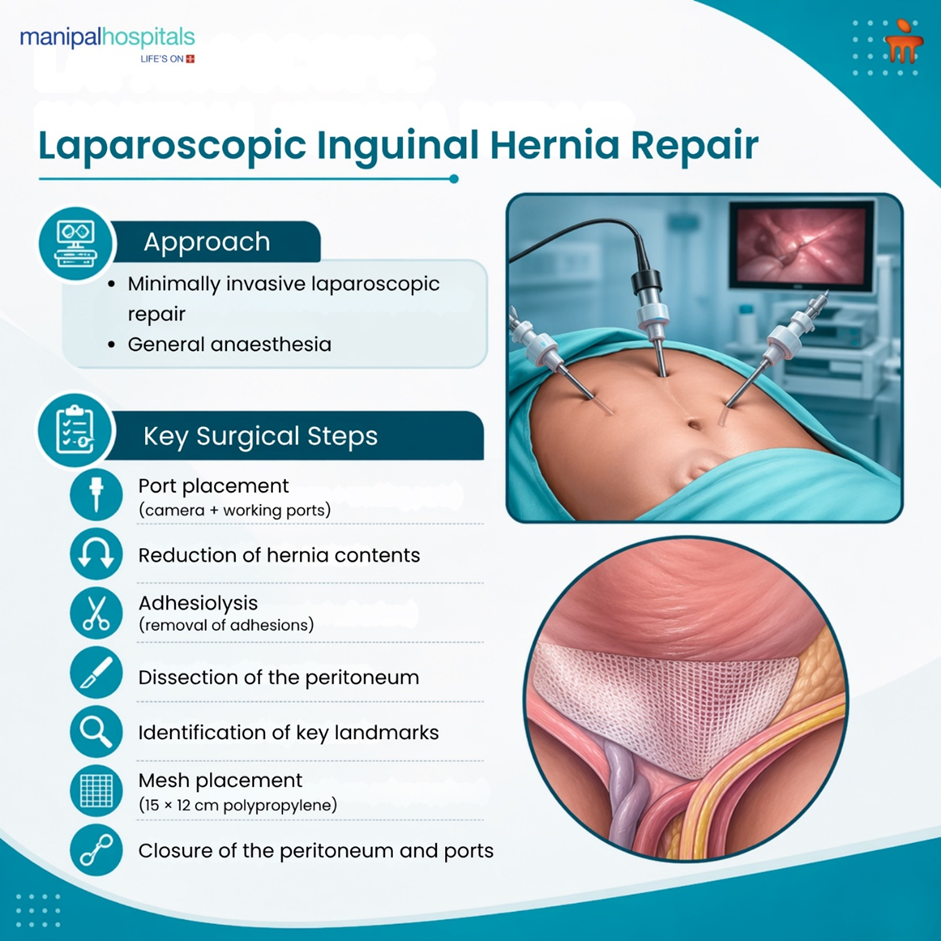
The team proceeded with laparoscopic right inguinal hernia repair under general anaesthesia. A 10 mm supraumbilical camera port was inserted, and pneumoperitoneum was established. Two 5 mm working ports were placed at the umbilical level lateral to the epigastric vessels. Intraoperatively, a complete indirect inguinal hernia with caecum as content and associated adhesions was identified. The surgical team performed:
-
Reduction of hernia contents
-
Adhesiolysis
-
Incision and dissection of the peritoneum
-
Exposure of the myopectineal orifice
-
Identification of key landmarks such as the pubic symphysis, Cooper’s ligament, epigastric vessels, iliopubic tract, and cord structures
-
Placement of a 15 × 12 cm polypropylene mesh
-
Closure of the peritoneum with absorbable sutures
-
Release of pneumoperitoneum and layered port closure
This procedure was a well-planned repair because it addressed both the hernia defect and the unusual intraoperative findings.
Outcome of the Treatment
The surgery was completed without complications. The patient tolerated the procedure well and had an uneventful recovery. Post-operatively, he remained hemodynamically stable and was managed with IV fluids, antibiotics, and analgesics.
He was discharged in a stable condition with advice to:
-
Gradually resume daily activities
-
Avoid strenuous activity and heavy lifting for three months
-
Follow breathing exercises
-
Maintain proper wound care
-
Attend scheduled follow-up
The overall outcome was favourable, with successful repair and stable postoperative recovery.
What Laparoscopic Hernia Repair Involves
Laparoscopic hernia repair is a minimally invasive technique that uses small incisions, a camera, and working ports to access the hernia from inside the abdomen. It allows the surgeon to inspect the defect, reduce hernia contents, and reinforce the area with mesh.
Why it Helped in This Case
This approach offered several advantages:
-
Smaller incisions
-
Clear visualisation of internal structures
-
Careful adhesiolysis under direct vision
-
Accurate mesh placement
-
Better handling of a complex hernia with bowel content
Because the hernia contained the caecum and adhesions, the laparoscopic view helped the surgeon identify landmarks and reduce the contents safely.
Comparison: Surgical Approach & Case Complexity
|
Open Surgery for Hernia Repair |
Laparoscopic Surgery for Hernia Repair |
|
Open hernia repair is a widely used and dependable technique |
Laparoscopic repair offers a minimally invasive alternative with enhanced precision |
|
Involves a larger incision and more extensive tissue dissection |
Requires smaller incisions with reduced tissue handling |
|
Suitable in many standard situations, including some complex cases |
Particularly advantageous in complex cases due to superior internal visualisation |
|
Provides limited internal view compared to laparoscopy |
Enables better visualisation of intra-abdominal structures for safer intervention |
|
Routine hernia cases are generally straightforward to manage |
This case was more demanding due to bowel contents and adhesions |
|
Standard procedures usually require less intricate dissection |
Required careful reduction and meticulous adhesiolysis |
|
Considered a typical inguinal hernia repair approach |
Stands out as a complex case needing advanced surgical planning and execution |
Key Takeaways for Readers
-
An inguinal hernia may present as painless groin swelling.
-
The contents of a hernia can sometimes be unusual, as in this case where the caecum was involved.
-
Adhesions can complicate surgery and require careful dissection.
-
Mesh repair helps reinforce the abdominal wall and lower recurrence risk.
-
Laparoscopic repair can be an effective option in selected cases, even when the hernia is technically challenging.
-
Good recovery depends on following postoperative advice, especially avoiding heavy lifting.
Conclusion
This case shows how a right inguinal hernia can occasionally present with unexpected findings that influence the surgical plan. Although the patient initially came in with painless right groin swelling, surgery revealed a complete indirect hernia containing the caecum, dilated small bowel loops, and adhesions—adding to the complexity of the procedure.
This case is a good example of how careful planning, good anatomical identification, and the right surgical technique can lead to a successful outcome even in a more complex hernia case. For those seeking hernia repair surgery near Malleshwaram, the expertise of experienced general surgeons at Manipal Hospital Malleshwaram plays a crucial role in managing such complex presentations effectively.
Frequently Asked Questions
An inguinal hernia is a bulge in the groin that happens when tissue pushes through a weak area in the abdominal wall. It may cause swelling, discomfort, or no symptoms at all.
This case was more complex because the hernia contained the caecum, dilated small bowel loops, and adhesions. That made reduction and repair more technically demanding.
Mesh is used to reinforce the weak area of the abdominal wall. It helps support the repair and lowers the chance of the hernia coming back.
Mesh is used to reinforce the weak area of the abdominal wall. It helps support the repair and lowers the chance of the hernia coming back.
Laparoscopy allowed the surgeon to see the anatomy clearly, reduce the hernia contents carefully, perform adhesiolysis, and place the mesh through a minimally invasive approach.
Share this Article


Recent Blogs

From First Signs to Recovery: A Complete Guide to Mouth Cancer
19 Jul 20268 Min Read
Changes inside your mouth can be easy to overlook at first. A minor ulcer that is not healing, some discoloration, or slight discomfort while eating that does not seem significant right away. However, these subtle changes may be a sign that something may need attention. Mouth cancer is not always immediately apparent. It often starts gently, with signs that seem harmless or temporary. This is why understanding the early changes matters so much. Recognising mouth cancer symptoms at the right time can make a significant difference in how smoothly treatment progresses and how well you recover. This blog walks you through what mouth cancer is, how it develops, the signs of mouth cancer you should watch for, what happens in the starting stage, and the treatment options available today. This way, you can feel informed, prepared, and supported every step of the way.
Read NowUnderstanding Pancreatic Cancer: Early Signs and Risk Factors
19 Jul 20268 Min Read
Most people are quick to address a sharp headache or a visible injury, but internal digestive changes often get pushed to the back of our minds. We tend to blame a heavy meal, a stressful week, or “just getting older” for vague stomach discomfort. Unlike some other conditions, pancreatic problems can be subtle and easy to ignore. Pancreatic cancer, in particular, tends to develop quietly. By the time the pancreatic cancer symptoms become noticeable, they may be confused with common digestive issues or even conditions like acute pancreatitis. Understanding pancreatic cancer and how it differs from acute pancreatitis symptoms is essential for timely intervention. This blog examines the risk factors, the nature of pancreatic discomfort, and the steps to take if you notice persistent changes.
Read NowBack Pain in Elderly People: Don’t Ignore the Warning Signs
30 Jun 20267 Min Read
As we grow older, occasional body pain may seem normal. But persistent back pain in senior citizens should never be ignored. Back pain in elderly people can significantly affect walking, sleep, independence, and overall quality of life. In many cases, it may indicate underlying spine problems that may need expert medical attention. Today, spine-related disorders are becoming increasingly common among the geriatric population due to aging, weak bones, arthritis, poor posture, and sedentary lifestyles. Fortunately, with modern spine care, advanced diagnosis, physiotherapy, minimally invasive procedures, and expert treatment, most elderly patients can return to a comfortable and active life. In fact, studies show that over 85% of elderly individuals experiencing back pain can achieve pain reduction and improved mobility with a personalized treatment plan.
Read NowHypertrophic Cardiomyopathy Explained: A Complete Patient Guide
22 Jun 20267 Min Read
We have all had those moments where we feel a bit "out of breath" after a few flights of stairs or notice a sudden, brief flutter in the chest while rushing through a busy morning. Usually, we dismiss these sensations as a sign of a poor night's sleep, too much caffeine, or perhaps just being “out of shape." We assume our bodies will simply reset once we catch our breath. However, for some, these small physical protests are not about fitness; they are the subtle signals of hypertrophic cardiomyopathy. Understanding what is hypertrophic cardiomyopathy is the first step toward moving from uncertainty to a clear, managed path for heart health. In this blog, we explain what this condition is, its causes, warning signs, diagnosis, and treatment options.
Read NowCervical Cancer Prevention: The Power of HPV Vaccination & Early Screening
12 Jun 202610 Min Read
Cervical cancer remains the second most common cancer among women in India, with over 1.2 lakh new cases and nearly 80,000 deaths annually. But, do you know that it is highly preventable? Thanks to increasing awareness and significant medical advancements, women today have many options for cervical cancer prevention. A key focus in this battle for women’s health is understanding the crucial connection between Human Papillomavirus (HPV) infection and cervical cancer. In this blog, let us explore the life-saving potential of both the HPV vaccine and early screening of cervical cancer.
Read NowSummer Food Guide: Top 10 Foods to Eat in Summer Season
01 Jun 20266 Min Read
Changes in appetite, thirst and energy levels are quite common during the summer months. Picking healthy foods in summer is therefore not only an effort to pick healthy snacks to enjoy, but it also entails selecting summer foods which will help us maintain proper fluid balance in our bodies. As summer comes with an increased risk of dehydration, heat stroke and food-borne infections, it becomes essential for us to pay attention to what we consume. In this blog, we tell you about the top 10 summer foods that will certainly help you stay hydrated and improve digestion, even amid the intense heat.
Read NowHypertension Explained: Understanding High Blood Pressure, Its Risks, and How to Manage It Effectively
20 May 202610 Min Read
Hypertension, commonly known as high blood pressure, is a pervasive health challenge affecting millions worldwide. Often called the ‘silent killer,' it can go unnoticed for years while quietly damaging your arteries and vital organs. This blog by an experienced Internal medicine doctor in Malleshwaram discusses more about hypertension, its early signs, risks, and effective management, which can help us safeguard heart health and lead a much healthier life in general.
Read NowComplications of Delaying Gallbladder Surgery: Why Timely Treatment Matters
15 May 20267 Min Read
It is a common scenario: you experience a sudden, sharp pain in your upper abdomen after a heavy meal. It’s uncomfortable, perhaps even distressing, but after an hour or two, the sensation fades. You might tell yourself it was just a bout of indigestion or something that didn't agree with you. However, when these episodes, often called “gallbladder attacks," become a recurring part of your life, they are usually a signal that your gallbladder is struggling to function. Ignoring these symptoms of gallbladder problems doesn't make the stones go away; it simply gives them more time to cause irreversible damage to your internal plumbing. This blog explores the biological risks of waiting, the warning signs your body is sending, and why choosing gallbladder removal surgery may be the best way to protect your long-term digestive health.
Read NowLaparoscopic Management of Right Inguinal Hernia with Caecum and Adhesions
13 May 20267 Min Read
An inguinal hernia is something doctors see regularly, but not every case is as straightforward as it sounds. In many people, the hernia sac contains fat or a simple loop of intestine, and the repair is relatively routine. However, there are situations where things are not that simple. When the contents include structures like the caecum (the first portion of the colon located in the lower right abdomen), along with dilated bowel loops and adhesions, the surgery becomes more complex and needs a more thoughtful approach. In these cases, the focus is not just on repairing the defect but on safely handling what is inside the hernia and protecting the surrounding structures. Choosing the right surgical method becomes important here. While open surgery is still a reliable option, laparoscopic repair can offer better visual clarity and more controlled dissection, especially when dealing with adhesions or unusual findings. In this blog, a top general surgeon in Malleshwaram, Bengaluru, helps you understand how inguinal hernias develop and the usual ways they are treated and walks you through a real case of a right inguinal hernia where the caecum was part of the hernia contents. This case shows how careful planning and the right surgical technique can make a significant difference in achieving a safe and successful outcome.
Read NowShort-Term Memory Loss in Young Adults: What’s Really Going On?
08 May 20268 Min Read
Noticing that you’re forgetting small things, like names, tasks, or where you kept your phone, can feel unsettling, especially when it starts happening more often than usual. It’s easy to brush it off as stress or a busy lifestyle, but when these moments begin to repeat, they can quietly chip away at your confidence and peace of mind. Short-term memory loss in young adults is more common than many realise, and in most cases, it is linked to manageable and reversible factors rather than something serious. Still, understanding what’s behind these lapses is essential, not just to ease your worry, but to take the right steps early on. This blog walks you through the real reasons for memory loss, how to recognise memory loss symptoms, when it may indicate a deeper memory loss disease, and the practical, science-backed ways you can improve your memory and regain control.
Read Now