


Secondary Hypertension: When High Blood Pressure Has an Underlying Cause
Reviewed by: Dr. Manohar Sakhare
Posted on
6 Min Read

Not sure what you’re looking for?
Get in touch with our representatives for help!
Contact UsHigh blood pressure is often called the “silent killer” because it can develop without obvious symptoms while quietly damaging the heart, kidneys, brain, and blood vessels. Most people diagnosed with hypertension are found to have primary hypertension, where no specific cause can be identified. However, for a smaller group of patients, high blood pressure may be a warning sign of an underlying medical condition. This condition is known as secondary hypertension.
At Manipal Hospitals Pune, specialists frequently evaluate patients whose blood pressure remains unusually high despite medication or appears suddenly without a clear explanation. In many of these cases, identifying and treating the root cause can significantly improve health outcomes and blood pressure control.
What is Secondary Hypertension?
Secondary hypertension refers to high blood pressure caused by another medical condition. Unlike primary hypertension, which develops gradually over time, secondary hypertension often appears suddenly and can be more severe.
The good news is that secondary hypertension is often treatable. Once the underlying cause is identified and managed, blood pressure levels may improve significantly, and in some cases, return to normal.
Doctors may suspect secondary hypertension if:
-
High blood pressure develops before the age of 30 or after 50
-
Blood pressure rises suddenly
-
Blood pressure remains uncontrolled despite multiple medications
-
There is no family history of hypertension
-
Certain abnormal blood test results are detected
Recognising these warning signs early can help prevent long-term complications.
Common Causes of Secondary Hypertension
Secondary hypertension can develop due to problems affecting the kidneys, hormones, blood vessels, heart, or sleep patterns.
1. Kidney Disorders
The kidneys play a vital role in regulating blood pressure. When kidney function is affected, blood pressure can rise.
Common kidney-related causes include:
-
Polycystic kidney disease
-
Renal artery stenosis (narrowing of the arteries supplying blood to the kidneys)
Reduced blood flow to the kidneys can trigger hormonal changes that increase blood pressure.
2. Adrenal Gland Disorders
The adrenal glands produce hormones that help regulate blood pressure.
Conditions that can cause secondary hypertension include:
-
Primary Aldosteronism
-
Excess production of aldosterone causes the body to retain sodium and water, leading to elevated blood pressure.
-
Cushing's Syndrome
-
High levels of cortisol can contribute to weight gain and persistent hypertension.
-
Pheochromocytoma
This rare adrenal tumour releases excessive adrenaline, causing sudden spikes in blood pressure, palpitations, headaches, and sweating.
3. Thyroid and Parathyroid Disorders
Hormonal imbalances can significantly affect cardiovascular health.
These include:
-
Hypothyroidism
-
Hyperthyroidism
-
Hyperparathyroidism
Both underactive and overactive thyroid conditions can contribute to hypertension.
4. Congenital Heart Conditions
Some individuals are born with structural abnormalities that affect blood flow.
One example is:
Coarctation of the Aorta, a narrowing of the body's main artery that leads to elevated blood pressure, particularly in the upper body.
5. Obstructive Sleep Apnoea
Sleep apnoea causes repeated interruptions in breathing during sleep. These episodes reduce oxygen levels and place additional strain on the cardiovascular system.
Common symptoms include:
-
Loud snoring
-
Daytime fatigue
-
Morning headaches
-
Poor concentration
Studies show that sleep apnoea is one of the most overlooked causes of resistant hypertension.
6. Medications and Substances
Certain medications can increase blood pressure, including:
-
Oral contraceptive pills
-
Steroids
-
Some pain relievers
-
Decongestants
-
Certain antidepressants
Excessive alcohol consumption and recreational drug use can also contribute to secondary hypertension.
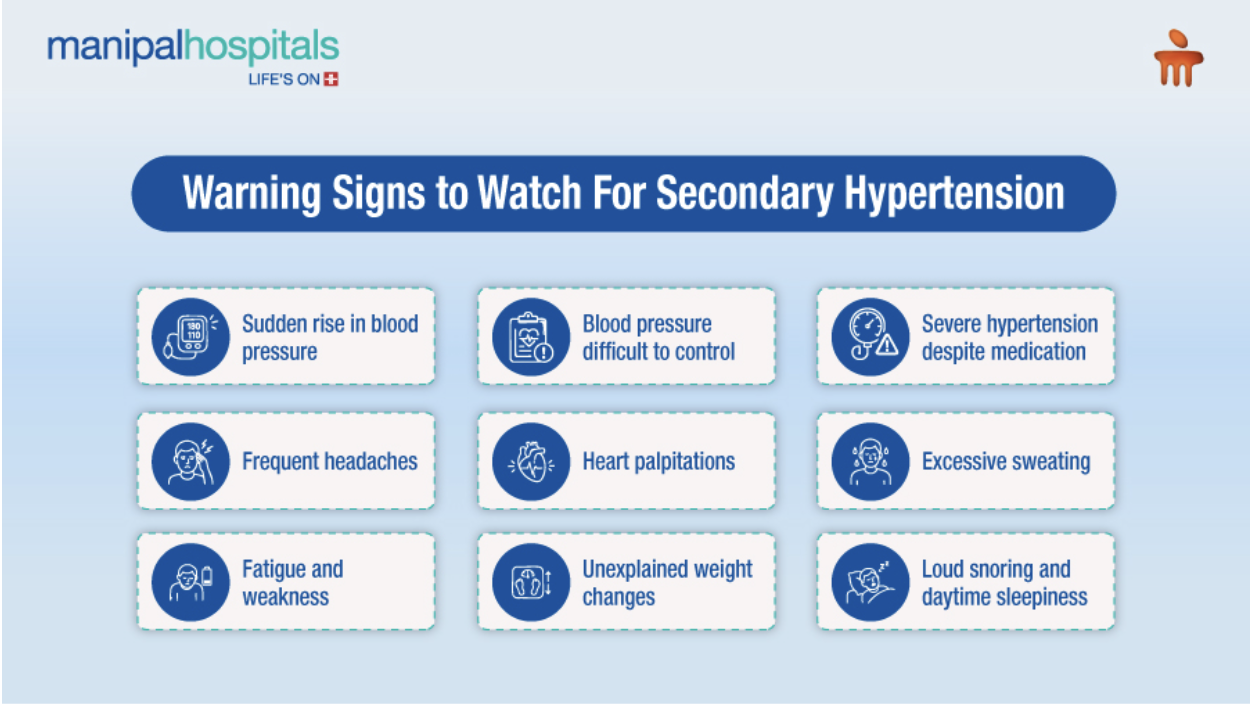
Symptoms of Secondary Hypertension
Many people with secondary hypertension experience the same symptoms as those with primary hypertension, and often, there may be no symptoms at all.
However, some warning signs may suggest an underlying cause:
-
Sudden onset of high blood pressure
-
Very high blood pressure readings
-
Difficulty controlling blood pressure despite treatment
-
Frequent headaches
-
Heart palpitations
-
Excessive sweating
-
Fatigue
-
Shortness of breath
-
Unexplained weight changes
-
Swelling in the legs or feet
-
Low potassium levels on blood tests
Symptoms often vary depending on the underlying medical condition causing the hypertension.
How is Secondary Hypertension Diagnosed?
Accurate diagnosis is the key to effective treatment.
At Manipal Hospitals nephrologist in kharadi, Pune use a comprehensive evaluation process to determine whether high blood pressure is caused by an underlying condition.
Medical History and Examination
Doctors review:
-
Family history
-
Current medications
-
Lifestyle habits
-
Existing medical conditions
Symptoms that may indicate hormonal or kidney disorders
Blood and Urine Tests
These tests help assess:
-
Kidney function
-
Electrolyte levels
-
Hormone levels
-
Blood sugar levels
Imaging Investigations
Depending on the suspected cause, imaging may include:
-
Kidney ultrasound
-
CT scan
-
MRI scan
-
Doppler studies of renal arteries
Hormonal Testing
Specialised hormone tests may be recommended to diagnose adrenal or thyroid disorders.
Sleep Studies
Patients with symptoms of sleep apnoea may undergo overnight sleep testing to confirm the diagnosis.
Early identification of the root cause can dramatically improve treatment success.
Secondary Hypertension Treatment
The most effective treatment focuses on correcting the underlying condition.
Treating Kidney Disorders
Management may include:
-
Blood pressure medications
-
Kidney-specific treatments
Procedures to improve blood flow in renal artery stenosis
Managing Hormonal Conditions
Treatment depends on the specific disorder and may involve:
-
Hormone-blocking medications
-
Surgical removal of adrenal tumours
-
Thyroid medications
Treating Sleep Apnoea
Options include:
-
Weight management
-
CPAP therapy
-
Lifestyle modifications
-
Oral appliances
Surgical Interventions
Certain conditions, such as coarctation of the aorta or adrenal tumours, may require surgery for long-term blood pressure control.
In many cases, blood pressure medications remain necessary while the underlying condition is being treated.
Lifestyle Changes That Support Blood Pressure Control
Even when a medical condition is responsible for hypertension, healthy habits remain essential.
Do's
-
Monitor blood pressure regularly
-
Follow prescribed treatment plans
-
Eat a balanced, low-sodium diet
-
Maintain a healthy weight
-
Exercise regularly
-
Manage stress effectively
-
Attend scheduled follow-up appointments
Don'ts
-
Do not stop medications without medical advice
-
Do not ignore new symptoms
-
Avoid smoking
-
Limit alcohol consumption
-
Avoid excessive processed and salty foods
-
Do not delay medical evaluation if blood pressure remains uncontrolled
Why Early Detection Matters
Secondary hypertension is often overlooked because it mimics primary hypertension. However, identifying the underlying cause can prevent serious complications such as:
-
Heart attack
-
Stroke
-
Heart failure
-
Kidney damage
-
Vision problems
At Manipal Hospitals Kharadi, a multidisciplinary team of cardiologists, nephrologists, endocrinologists, and sleep specialists works together to uncover hidden causes of hypertension and develop personalised treatment plans for each patient.
Not all high blood pressure is the same. Sometimes, elevated blood pressure is the body's way of signalling a deeper health issue that requires attention. Secondary hypertension may be less common than primary hypertension, but its impact can be significant if left untreated.
The encouraging news is that many causes of secondary hypertension are treatable, and early diagnosis can lead to better blood pressure control, improved quality of life, and reduced risk of long-term complications. If your blood pressure appears suddenly, remains difficult to control, or is accompanied by unusual symptoms, seeking specialist evaluation can make all the difference.
Frequently Asked Questions
Primary hypertension develops without a specific identifiable cause, while secondary hypertension occurs due to an underlying medical condition such as kidney disease, hormonal disorders, or sleep apnoea.
In many cases, yes. Treating the underlying condition can significantly improve blood pressure and may even normalise it completely.
Individuals with sudden-onset hypertension, resistant hypertension, kidney disease, hormonal disorders, or sleep apnoea may be at higher risk.
If left untreated, it can increase the risk of heart disease, stroke, kidney failure, and other serious complications.
You should seek medical advice if your blood pressure remains consistently high, rises suddenly, or does not respond well to prescribed treatment.
Share this Article


Recent Blogs
Joint Stiffness Causes, Treatment, and Prevention: Expert Guide to Better Mobility
24 Jun 20267 Min Read
Have you ever woken up in the morning and felt like your joints simply did not want to cooperate? Maybe your knees feel tight when you get out of bed, your fingers seem stiff after a long night's sleep, or your shoulders ache after sitting at your desk for hours. Joint stiffness is a common problem that affects people of all ages, but it is often ignored until it starts interfering with daily life. At Manipal Hospital Pune, our orthopaedic specialists frequently meet patients who believe joint stiffness is a normal part of ageing. While ageing can contribute to reduced flexibility, persistent stiffness may indicate an underlying condition that needs attention. Understanding the causes, treatment options, and preventive measures can help you maintain healthy joints and enjoy an active lifestyle.
Read NowSecondary Hypertension: When High Blood Pressure Has an Underlying Cause
22 Jun 20266 Min Read
High blood pressure is often called the “silent killer” because it can develop without obvious symptoms while quietly damaging the heart, kidneys, brain, and blood vessels. Most people diagnosed with hypertension are found to have primary hypertension, where no specific cause can be identified. However, for a smaller group of patients, high blood pressure may be a warning sign of an underlying medical condition. This condition is known as secondary hypertension. At Manipal Hospitals Pune, specialists frequently evaluate patients whose blood pressure remains unusually high despite medication or appears suddenly without a clear explanation. In many of these cases, identifying and treating the root cause can significantly improve health outcomes and blood pressure control.
Read NowMultiple Myeloma: Bone Pain That Turns Out to Be Blood Cancer -What You Must Know
22 Jun 20266 Min Read
Bone pain is something many people experience at some point in life. It is often blamed on ageing, overexertion, poor posture, or arthritis. While these causes are common, persistent or unexplained bone pain should never be ignored. In some cases, it can be an early warning sign of a serious condition known as multiple myeloma, a type of blood cancer that affects the bone marrow. Multiple Myeloma may not receive as much attention as other cancers, but it affects thousands of individuals every year. Because its symptoms often resemble those of more common health conditions, diagnosis can sometimes be delayed. Understanding the signs and seeking medical attention early can make a significant difference in treatment outcomes and quality of life. At Manipal Hospitals Pune, our team of haematologists and cancer specialists focuses on early diagnosis, advanced treatment, and comprehensive support for patients living with blood cancers, including multiple myeloma.
Read NowSurgical Pathways for Ovarian and Uterine Cancer: Understanding Your Treatment Options
22 Jun 20267 Min Read
Receiving a diagnosis of ovarian or uterine cancer can feel overwhelming. Along with the emotional impact, many women and their families are left with important questions about treatment, recovery, and long-term health. One of the most effective treatment approaches for both conditions is surgery. Understanding the available surgical pathways can help patients make informed decisions and approach treatment with greater confidence. At Manipal Hospitals, patients receive personalised cancer care backed by advanced technology, experienced specialists, and a multidisciplinary approach to treatment. At Manipal Hospital Kharadi, our expert gynaecologic oncology team focuses on delivering comprehensive and compassionate care tailored to every patient's needs.
Read NowWorld Alzheimer’s Day 2026: Early Signs of Memory Loss You Shouldn’t Ignore
22 Jun 20267 Min Read
As we observe World Alzheimer’s Day 2026, it is important to raise awareness of Alzheimer’s disease and its impact on individuals, families, and communities. Alzheimer’s disease is the most common cause of dementia, a condition that affects memory, thinking, behaviour, and the ability to carry out daily activities. While occasional forgetfulness can be a normal part of ageing, persistent memory problems and cognitive changes should never be ignored. One of the greatest challenges with Alzheimer’s disease is that its early symptoms are often mistaken for normal aging. However, recognising the warning signs early can make a significant difference. Studies have shown that timely diagnosis and appropriate care can improve quality of life for more than 70% of patients and caregivers. Early intervention also enables individuals to maintain independence for longer and access the support they need. At Manipal Hospitals Kharadi, our specialists believe that awareness and early detection are key to managing Alzheimer’s disease effectively. Understanding the early signs can help individuals and families seek medical advice at the right time and plan for a healthier future.
Read NowMigraine and Headache Awareness Month: Signs, Triggers & Relief Tips
22 Jun 20267 Min Read
Headaches are among the most common health complaints across all age groups. Most people experience a headache occasionally due to stress, lack of sleep, dehydration, or illness. However, for millions of people worldwide, migraines are far more than just a headache. They are a complex neurological condition that can interfere with work, family life, social activities, and overall well-being. As we observe Migraine and Headache Awareness Month, it is important to raise awareness about the symptoms, triggers, and treatment options available for those struggling with recurrent headaches and migraines. Many individuals continue to suffer silently, assuming that frequent headaches are a normal part of life. In reality, proper diagnosis and timely treatment can significantly improve quality of life. At Manipal Hospital Kharadi, our experienced neurologists help patients identify the root cause of their headaches and provide personalised treatment plans to help them regain control of their daily lives.
Read Nowमुलांमधील घसा खवखवणे आणि ईएनटी संसर्गांवर प्रभावी उपचार: पालकांसाठी संपूर्ण मार्गदर्शक
19 Jun 20264 Min Read
लहान मुलांना वारंवार सर्दी, खोकला, घसा खवखवणे किंवा कान-नाक-घसा (ENT) संबंधित संसर्ग होणे ही अत्यंत सामान्य बाब आहे. मुलांची रोगप्रतिकारक शक्ती अद्याप विकसित होत असल्यामुळे ते अशा संसर्गांना अधिक बळी पडतात. मुलाला गिळताना त्रास होणे, कान दुखणे किंवा सतत नाक बंद राहणे यामुळे त्याच्या खाण्या-पिण्यावर, झोपेवर आणि दैनंदिन क्रियाकलापांवर परिणाम होऊ शकतो. अनेक वेळा पालक या लक्षणांकडे सामान्य सर्दी म्हणून पाहतात, परंतु काही प्रकरणांमध्ये योग्य वेळी उपचार न केल्यास संसर्ग गंभीर स्वरूप धारण करू शकतो. त्यामुळे लक्षणे ओळखणे आणि वेळेवर तज्ज्ञांचा सल्ला घेणे अत्यंत महत्त्वाचे आहे. मणिपाल हॉस्पिटल खराडी येथे अनुभवी ईएनटी तज्ज्ञ आणि बालरोग तज्ज्ञ मुलांमधील विविध ईएनटी समस्यांचे अचूक निदान व आधुनिक उपचार उपलब्ध करून देतात.
Read NowUnderstanding the Heart-Lung Bypass Machine: Your Lifeline During Open-Heart Surgery
19 Jun 20267 Min Read
Open-heart surgery, a procedure that has saved countless lives, often requires the heart to be temporarily stopped to allow surgeons to repair it with precision. But what happens to the body when the heart isn't pumping blood, and the lungs aren't breathing? This is where the remarkable heart lung machine, also known as the cardiopulmonary bypass machine, plays its critical role. At Manipal Hospitals, we utilize state-of-the-art technology and expertise to ensure the safest and most effective outcomes for our patients.
Read NowFrequent Headaches Causes: When Should You See a Neurologist?
19 Jun 20267 Min Read
Headaches are among the most common health complaints worldwide. Almost everyone experiences a headache at some point, whether due to stress, lack of sleep, dehydration, or illness. However, when headaches become frequent, persistent, or severe, they can interfere with your daily activities and significantly affect your quality of life. Understanding frequent headache causes is essential because recurring headaches may sometimes indicate an underlying neurological condition that requires medical attention. At Manipal Hospital Kharadi, our experienced neurology specialists help patients identify the root cause of their headaches and provide personalised treatment plans to improve their overall well-being. If you find yourself reaching for painkillers regularly or experiencing headaches several times a month, it may be time to seek professional guidance.
Read NowWorld Brain Tumor Day 2026: Early Detection and Modern Brain Tumor Treatment
19 Jun 20267 Min Read
Every year, World Brain Tumor Day serves as an important reminder that awareness, timely diagnosis, and access to advanced treatment can make a significant difference in the lives of people affected by brain tumours. While a brain tumour diagnosis can feel overwhelming, medical advancements over the last decade have transformed the way these conditions are detected and treated. At Manipal Hospital Kharadi, Pune, our specialists believe that knowledge is one of the most powerful tools in the fight against brain tumours. Understanding the warning signs, knowing when to seek medical help, and accessing expert care early can improve outcomes and quality of life.
Read Now