


The Pinched Core: Understanding Spine Disc Injuries and Modern Care
Reviewed by: Dr. Somashekar D
Posted on
8 Min Read

Not sure what you’re looking for?
Get in touch with our representatives for help!
Contact UsMost people do not think much about their spine until everyday movements start hurting. One day you may be bending down to pick something up or getting out of bed as usual, and the next, you are dealing with back pain that shoots into your leg or makes walking uncomfortable. This is often how the journey with a spine disc injury begins. It does not always start with a major trauma but through gradual wear and tear within the spinal discs that makes simple daily tasks feel completely exhausting.
The reassuring fact is that a slipped disc is not permanently debilitating. Instead, it occurs when one of the discs in your spine becomes damaged and begins pressing on nearby nerves. Although the symptoms can feel alarming, many people recover successfully with the right diagnosis, activity modifications, and treatment plan. Modern treatments have come a long way from the limited options used in the past. In this blog, we explain the risk factors, symptoms, diagnosis, treatment options, and what you can expect during the healing process.
What is a Slipped Disc?
A spine disc injury occurs when part of a spinal disc bulges or pushes through a tear in its outer layer, sometimes pressing on nearby nerves. The damaged disc can irritate nearby nerves and cause pain, numbness, or weakness.
-
Disc Annulus: This is the tough outer layer of the spinal disc that helps keep the disc in place. Daily strain or sudden twisting can cause this outer layer to develop small tears or structural weak spots.
-
Nucleus Pulposus: This is the soft inner portion of the disc that acts as a shock absorber. When the outer wall breaks down, this gel-like material bulges outward into the narrow spaces of the spinal canal.
When this inner material forces its way past its normal boundary, it creates a compressed nerve root. Nerve irritation can cause pain, numbness, or tingling that radiates into the arms or legs.
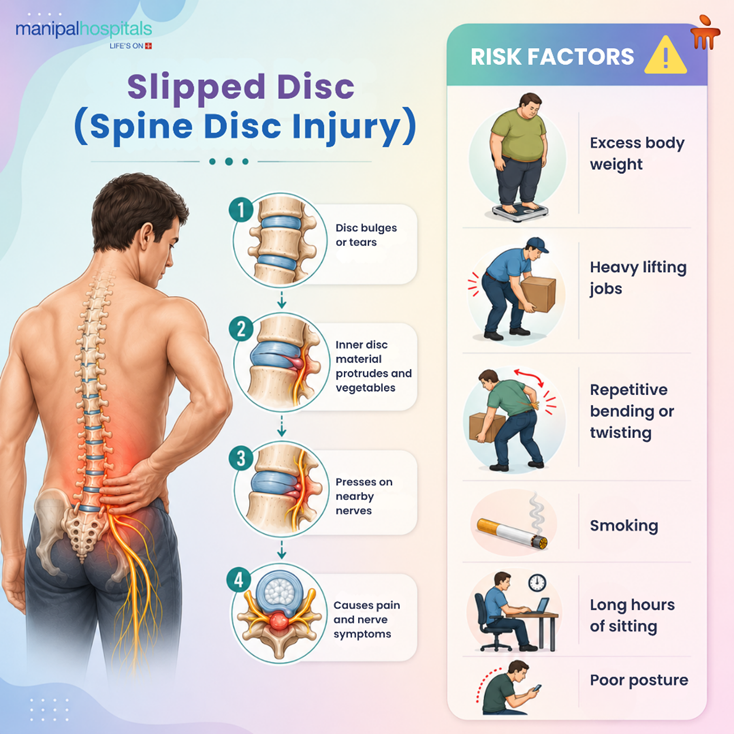
Key Risk Factors
Recognising the lifestyle choices and physical habits that weaken the back early can be the difference between a simple exercise routine and long-term medical care. Several common elements significantly elevate your baseline risk.
-
Weight Accumulation: Carrying excess body weight places continuous mechanical stress on the lower cushions. This accelerated load forces the inner gel to push against the outer walls even during basic movements.
-
Occupational Exposure: Jobs that require repetitive heavy lifting, continuous twisting, or sitting for long hours on machinery that vibrates can slowly wear down the protective outer boundaries.
-
Nicotine Use: Smoking reduces the overall oxygen and nutrient supply to the spinal column. Because these discs lack a direct blood supply, nutrient deprivation leaves them brittle and far more fragile.
-
Long Hours of Sitting: Slouching over a computer desk increases pressure on the lower back and can weaken the muscles that support the spine over time, weakening your spine's natural support network.
Slip Disk Symptoms to Watch For
The symptoms of a spine disc injury depend entirely on where the damage is along your spine and which specific nerve pathway is feeling the squeeze.
-
Radiating Shooting Pain: If the issue sits in your lower back, it can cause sciatica, which is a sharp, hot pain that travels through your hip and down the back of one leg. This severe discomfort is a primary indicator that you need a targeted slipped disc treatment plan.
-
Pins and Needles: A constant tingling, prickling, or numbness often develops in the exact areas of skin connected to the irritated nerve root.
-
Muscle weakness: Squeezed nerves struggle to carry clear signals from your brain to your limbs, making your leg feel heavy or causing you to trip over your feet.
Depending on which disc is affected, slip disk symptoms may also occur in the neck, shoulders, arms, or hands. If these symptoms persist or begin affecting your daily activities, consult experienced spine specialists in Kanakapura Road, Bangalore, for a comprehensive evaluation and timely treatment.
Diagnosis of Spine Disc Injury
If you suspect a problem, the diagnostic process is straightforward but thorough. Specialists use a combination of physical assessment and advanced imaging to map out the mechanical damage before recommending a path for slipped disc treatment.
|
Method |
What the Doctor Does |
What it Reveals |
|
Clinical Evaluation |
Checks physical reflexes, tests muscle strength, and raises your leg straight up while you lie flat on your back. |
Identifies the specific nerve pathway that is compressed or irritated by a suspected spine disc injury. |
|
MRI Scan |
Uses powerful magnets to take clear, highly detailed pictures of the soft tissues inside your back. |
Shows the precise shape and size of the disc bulge and confirms whether the bulging disc is compressing nearby nerves. |
|
CT Scan |
Takes a series of detailed X-ray images from different angles to provide a sharp view of your back anatomy. |
Helps your care team rule out other bone conditions, like arthritic bone spurs or small fractures. |
Imaging is usually recommended when symptoms persist, neurological deficits are present, or surgery is being considered.
Modern Options for Slipped Disc Treatment
The philosophy of spinal care has shifted dramatically. Most patients are initially managed with non-surgical treatment approaches to relieve nerve pressure and allow the affected disc and surrounding tissues time to recover.
Conservative Care: The First Line of Defence
For many, the problem can be managed successfully without ever stepping into an operating theatre, making simple therapies the primary goal of modern slipped disc treatment.
-
Core Stabilisation: This isn't about general fitness; it is about strengthening the muscles that support and stabilise the spine. A stronger core acts like an internal brace, holding the spine in a better position and lifting the physical burden off your healing tissues.
-
Posture and Movement Adjustments: Through specialised physical therapy, patients learn how to sit, walk, and lift safely to keep the spine in a safe, neutral alignment.
-
Medication Plans: Doctors frequently recommend anti-inflammatory medicines or muscle relaxants to dull the sharp initial ache, making it easier for you to move around and complete your exercises.
-
Targeted Cortisone Injections: If standard pills fail to give enough relief, a specialist can use an injection to place powerful anti-inflammatory medicine directly around the irritated nerve root to reduce inflammation around the affected nerve and improve symptoms.
Advanced Surgical Intervention
If severe nerve pain persists after therapy, or if nerve damage threatens your mobility, surgery becomes necessary. Modern techniques are highly precise and minimally invasive to speed up your recovery.
The primary goal is removing nerve pressure. This usually involves a microdiscectomy, where a surgeon removes only the tiny piece of protruding disc gel pinching the nerve, leaving the healthy cushion intact. In rare cases where bones are unstable, a spinal fusion joins the vertebrae together into a single, secure bone.
Recovery: What to Expect?
Whether you choose a conservative path or a surgical one, rebuilding your spinal health is a steady marathon that requires patience.
-
Non-Surgical Path: Many patients experience significant symptom improvement and a major return of mobility within four to six weeks of starting a dedicated physical therapy and slipped-disc treatment plan. Once the initial swelling drops, in many cases, the body gradually reduces the size of the disc bulge over time, leading to symptom improvement.
-
Surgical Path: If you undergo a microdiscectomy, you will generally be encouraged to begin assisted walking within a day or two after surgery. However, it takes about six weeks to three months for the deep tissues to heal securely and for the spinal structures to completely stabilise.
Conclusion
Living with a spinal disc injury can certainly disrupt your daily life, but it is a highly manageable condition with a very positive outlook. From noticing a loss of strength to choosing a personalised physical recovery plan, there are clear ways to feel better.
If you are noticing changes in your posture, persistent back fatigue, or progressive weakness in one side of your body, do not dismiss it as a normal part of getting older. Early intervention is the most powerful tool we have. Seeking professional slipped disc treatment in Kanakapura Road, Bangalore, ensures you get a clear diagnosis and access to world-class medical help. With the guidance of the spine specialist at Manipal Hospital Kanakapura Road, you can regain your balance, reduce your pain, and return to a comfortable, active lifestyle.
Frequently Asked Questions
No. A slipped disc is a localised problem involving one specific cushion between your bones, bulging out of place. A spinal deformity involves a much larger, structural change in the actual alignment and natural curvature of your entire back.
Exercise cannot physically reposition a herniated disc, but strengthening deep core muscles stabilises the spine. This relieves nerve pressure, significantly reduces pain, and acts as an effective non-surgical treatment.
You must go to an emergency room right away if you experience sudden weakness in one side of body, total numbness in your groin area, or a sudden loss of bowel or bladder control. These are signs of dangerous nerve compression.
The vast majority of cases are successfully managed without surgery using physical therapy, core stabilisation, anti-inflammatory medicines, and lifestyle adjustments. Surgery is reserved for patients who do not find relief through conservative means.
Most people see a major improvement within four to six weeks of starting a dedicated, non-surgical plan. In some cases, symptoms improve as inflammation settles and the disc protrusion reduces over time. This protects your posture and helps you avoid movements that re-injure the back.
Share this Article


Recent Blogs

The Pinched Core: Understanding Spine Disc Injuries and Modern Care
17 Jun 20268 Min Read
Most people do not think much about their spine until everyday movements start hurting. One day you may be bending down to pick something up or getting out of bed as usual, and the next, you are dealing with back pain that shoots into your leg or makes walking uncomfortable. This is often how the journey with a spine disc injury begins. It does not always start with a major trauma but through gradual wear and tear within the spinal discs that makes simple daily tasks feel completely exhausting. The reassuring fact is that a slipped disc is not permanently debilitating. Instead, it occurs when one of the discs in your spine becomes damaged and begins pressing on nearby nerves. Although the symptoms can feel alarming, many people recover successfully with the right diagnosis, activity modifications, and treatment plan. Modern treatments have come a long way from the limited options used in the past. In this blog, we explain the risk factors, symptoms, diagnosis, treatment options, and what you can expect during the healing process.
Read NowClinical Insights on Monsoon Diseases: Practical Prevention and Seasonal Care
17 Jun 202610 Min Read
When the heavy rains arrive, they bring welcome relief from the scorching summer heat. Unfortunately, it also brings a noticeable rise in infections. From mosquito-borne illnesses and stomach infections to seasonal flu and skin problems, many health issues become more common once the rains begin. A few simple precautions can help protect your family during this time. Understanding rainy season diseases and prevention while recognising early warning signs as they appear can make the season much easier to navigate. This blog explains the most common health risks during the rainy months and health tips for monsoon season you can take to stay well.
Read NowWhat Causes Blocked Heart Arteries? Signs, Treatment & Prevention
17 Jun 20267 Min Read
Most people do not think about their heart arteries until a problem develops. These blood vessels play an important role in carrying oxygen-rich blood to the heart muscle, helping it pump blood throughout the body. Over time, however, fatty deposits, cholesterol, and other substances can gradually build up inside the arteries. This slow buildup can lead to blocked heart arteries, reducing the amount of blood that reaches the heart and increasing the risk of serious heart-related complications. Because this process progresses slowly, the body may show warning signs long before a serious event such as a heart attack occurs. However, while a heart artery blockage can be a serious diagnosis, advances in prevention, diagnosis, and treatment have significantly improved outcomes for many patients. This blog explores the causes, symptoms, diagnosis, and management of blocked coronary arteries to make you better equipped to deal with it in the case of emergencies.
Read NowBloating Symptoms and Remedies: How to Avoid and Reduce Bloating Naturally
05 Jun 20265 Min Read
Almost everyone deals with bloating at some point. It usually shows up as a tight, full, or swollen feeling in your belly, often right after you finish a meal. It might seem like just a small annoyance, but it can really affect your comfort, appetite, and daily routine. Bloating varies from person to person. You might notice it only once in a while, while others deal with it as a regular, frustrating part of their day. Because the intensity varies so much, it can be hard to identify what triggers it or how to find lasting relief. This blog helps you recognise bloating symptoms and understand practical ways to deal with them. It brings together simple lifestyle adjustments that can help you learn how to avoid bloating and reduce it naturally over time, without relying on quick fixes.
Read NowWhat Is Electrolyte Imbalance? Symptoms, Causes, and Treatment Explained
25 May 20267 Min Read
Most of us have experienced those moments when we feel inexplicably 'off,' perhaps a persistent muscle twitch in our eyelid that won't stop, a sudden, sharp cramp in our calf during a walk, or a sense of mental fogginess that a cup of coffee can’t seem to fix. We often tell ourselves we are just tired or need more water, but beneath the surface, your body may be struggling with a specific chemical disruption. A delicate internal grid of minerals effectively powers our hearts, brains, and muscles. When the levels of these minerals shift even slightly, they can have an immediate and widespread physical impact. This disruption is known as an electrolyte imbalance. Because these minerals govern the electrical signals in our cells, an imbalance doesn't just affect one area; it can change how your heart beats and how your nerves communicate. In this blog, you will learn what an electrolyte imbalance is, the early warning signs, and why you need to deal with it immediately.
Read NowWhat Is Myasthenia Gravis? Definition, Signs, and Medical Overview
25 May 20267 Min Read
It is a common experience to feel physical exhaustion after a long day of activity. Usually, rest allows the body to recover its strength. However, for some individuals, muscle weakness does not follow this predictable pattern. They may find that their muscles function correctly in the morning, but as the day progresses, simple tasks, such as keeping their eyes open, speaking clearly, or lifting a light object, become increasingly difficult. This specific type of fluctuating muscle weakness is a hallmark of a chronic condition known as myasthenia gravis. Because the symptoms can be subtle or intermittent at first, they are often misidentified as general fatigue or stress. Learning about myasthenia gravis, recognising early myasthenia gravis symptoms, and seeking help on time can make a real difference. With proper treatment, many people continue to live active, independent lives. This blog examines the underlying causes of myasthenia gravis, the specific symptoms that warrant medical attention, and the modern myasthenia gravis treatment protocols available to manage the condition effectively.
Read Nowಯೋನಿಯ ಈಸ್ಟ್ ಸೋಂಕು: ಸೋಂಕಿನ ಲಕ್ಷಣಗಳು, ಕಾರಣಗಳು ಮತ್ತು ಚಿಕಿತ್ಸೆ
25 May 20265 Min Read
ಮಹಿಳೆಯರ ಆರೋಗ್ಯವು ಸಮಾಜದ ಒಟ್ಟಾರೆ ಯೋಗಕ್ಷೇಮಕ್ಕೆ ಅತ್ಯಗತ್ಯ. ಆದರೆ, ಹಲವು ಬಾರಿ ಮಹಿಳೆಯರು ಕೆಲವು ನಿರ್ದಿಷ್ಟ ಆರೋಗ್ಯ ಸಮಸ್ಯೆಗಳಿಂದ ಬಳಲುತ್ತಾರೆ, ಅದರಲ್ಲಿ ಯೋನಿಯ ಸೋಂಕು (Vaginal Infection) ಪ್ರಮುಖವಾದುದು. ಈ ಸೋಂಕುಗಳಲ್ಲಿ ಅತ್ಯಂತ ಸಾಮಾನ್ಯವಾದದ್ದು ಯೋನಿಯ ಈಸ್ಟ್ ಸೋಂಕು ಅಥವಾ ಯೋನಿಯ ಶಿಲೀಂಧ್ರ ಸೋಂಕು. ಇದು ಅನೇಕ ಮಹಿಳೆಯರಿಗೆ ಅಹಿತಕರ ಅನುಭವವನ್ನು ನೀಡುವ ಸಾಮಾನ್ಯ ಸಮಸ್ಯೆಯಾಗಿದ್ದು, ಇದರ ಬಗ್ಗೆ ಸರಿಯಾದ ಮಾಹಿತಿ ಹೊಂದುವುದು ಬಹಳ ಮುಖ್ಯ. ಈ ಬ್ಲಾಗ್ ಪೋಸ್ಟ್‌ನಲ್ಲಿ, ನಾವು ಯೋನಿಯ ಈಸ್ಟ್ ಸೋಂಕಿನ ಲಕ್ಷಣಗಳು, ಕಾರಣಗಳು, ಅದನ್ನು ಹೇಗೆ ರೋಗನಿರ್ಣಯ ಮಾಡಲಾಗುತ್ತದೆ ಮತ್ತು ಪರಿಣಾಮಕಾರಿ ಯೋನಿಯ ಈಸ್ಟ್ ಸೋಂಕಿನ ಚಿಕಿತ್ಸೆ ಕುರಿತು ವಿವರವಾಗಿ ಚರ್ಚಿಸುತ್ತೇವೆ. ಮಣಿಪಾಲ್ ಹಾಸ್ಪಿಟಲ್ಸ್, ಕನಕಪುರ ರಸ್ತೆಯಲ್ಲಿ ಲಭ್ಯವಿರುವ ಕನಕಪುರ ರಸ್ತೆಯಲ್ಲಿ ಯೋನಿಯ ಈಸ್ಟ್ ಸೋಂಕಿನ ಚಿಕಿತ್ಸೆ ಕುರಿತು ಸಹ ನಾವು ಮಾಹಿತಿ ನೀಡುತ್ತೇವೆ. ಈ ಮಾಹಿತಿಯು ನಿಮ್ಮ ಆರೋಗ್ಯದ ಬಗ್ಗೆ ಉತ್ತಮ ನಿರ್ಧಾರಗಳನ್ನು ತೆಗೆದುಕೊಳ್ಳಲು ಸಹಾಯ ಮಾಡುತ್ತದೆ.
Read NowBone Marrow Transplant: A Lifesaving Treatment for Blood Disorders
22 May 20268 Min Read
Most people don’t think about how important their bone marrow is until something goes wrong. It quietly works in the background every day, producing the blood cells your body depends on for energy, immunity, and overall health. When this system is affected, even simple activities can start to feel difficult, and that is often when doctors begin discussing advanced treatment options. One such option is a bone marrow transplant, a treatment that can sound intimidating at first. Many patients imagine a complicated surgical procedure, but in reality, it is a carefully planned medical process designed to restore the body’s ability to produce healthy blood cells. In many cases, it is also referred to as a stem cell transplant, depending on the source of the cells being used. Understanding the meaning of a bone marrow transplant is the first step in reducing uncertainty. This treatment is not just about managing a condition temporarily. It focuses on resolving the underlying problem so the body can function more effectively over time. In this article, we will walk through when this treatment is recommended, what the bone marrow transplant procedure involves, the different approaches available, and what patients can realistically expect during bone marrow transplant recovery.
Read NowThe Role of a Radiation Oncologist: Fighting Cancer with Precision
22 May 20266 Min Read
Cancer treatment in most cases needs more than one approach, and radiation is one of the frequently used methods. A radiation oncologist is the doctor trained to treat cancer using carefully planned radiation. The primary aim is to target cancer cells while preserving surrounding healthy tissue. Treatment is not delivered in a routine manner. Each plan is designed after studying the tumour type, its location, and the patient’s overall health. The role of a radiation oncologist in cancer treatment includes controlling tumour growth, reducing symptoms like pain or pressure, and, in many cases, working towards a cure or long-term control of the disease.
Read NowBlood Cancer: Symptoms, Types, and Advanced Treatment Options Explained
22 May 20269 Min Read
Hearing a doctor mention the possibility of blood cancer is a moment that feels as though time has stopped. It is an experience filled with immediate questions, deep-seated fears, and a sudden need to understand complex medical terms that most people have never heard before. Blood cancer is not a single disease; it is a broad category that includes several different conditions, each with its own unique behaviour and response to therapy. The first step in navigating this journey is moving from fear to information. By understanding the different blood cancer types and learning how to recognise the early signs, you can work more effectively with your medical team. This blog explores the biological roots of these conditions, the variety of blood cancer symptoms you might notice, and the innovative blood cancer treatment options that are helping patients reclaim their health every day.
Read Now