


Knee Pain When Bending: Causes, Symptoms, and Treatment Options
Reviewed by: Manipal Hospitals
Posted on
6 Min Read

Not sure what you’re looking for?
Get in touch with our representatives for help!
Contact UsKnee pain is a common ailment, but when it specifically flares up while bending, it can be particularly debilitating, affecting daily activities from walking to climbing stairs. The knee is a complex joint, crucial for movement and supporting body weight. When you experience knee pain when bending, it signals an issue within its bones, ligaments, tendons, and cartilage. This discomfort can range from a dull ache to sharp, intense pain, often accompanied by other symptoms.
Causes of Knee Pain When Bending
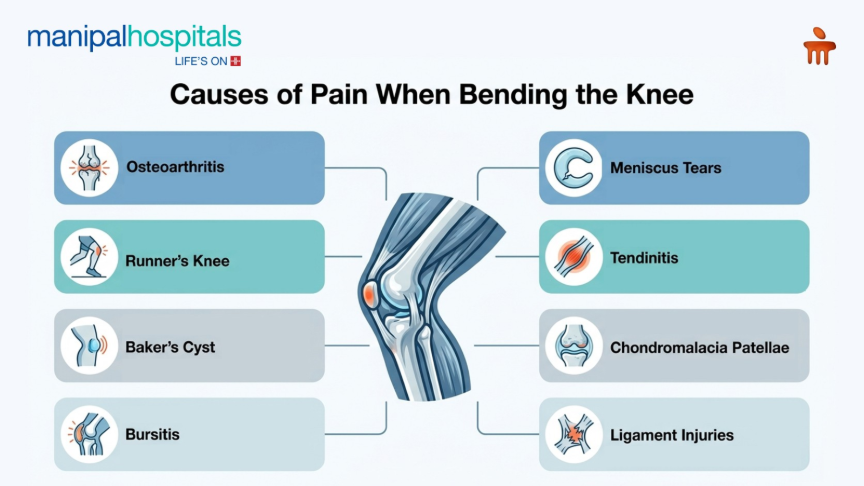
Several conditions can lead to knee pain when bending. Identifying the exact cause is the first step towards effective treatment. Some common causes include:
-
Osteoarthritis: This degenerative joint disease is a leading cause, particularly affecting the cartilage. Patients often describe a deep ache or pain on the inside of the knee when bending and straightening as the cartilage wears down. It accounts for a significant portion of chronic knee pain cases.
-
Meniscus Tears: The meniscus ligament acts as a shock absorber in the knee. A tear can cause sharp pain, especially when the knee is twisted or fully bent, and might manifest as pain on the inside or side of the knee.
-
Patellofemoral Pain Syndrome (Runner's Knee): Often felt around or behind the kneecap, this condition causes knee pain when bending the leg, especially during activities like running, climbing stairs, or prolonged sitting. It's particularly common among athletes.
-
Tendinitis: Inflammation of the tendons (like the patellar or quadriceps tendon) can cause pain, often isolated to the front of the knee, which worsens when bending or squatting.
-
Bursitis: Inflammation of the bursae (small fluid-filled sacs that cushion the joint) can lead to localised tenderness and pain with movement.
-
Ligament Injuries: Sprains or tears to circulate ligaments like the ACL, PCL, MCL, or LCL can cause instability and pain, including side knee pain when bending, depending on the affected ligament.
-
Baker's Cyst: A fluid-filled sac that forms at the back of the knee, often associated with other knee problems, can cause fullness, tightness, and pain in the back of the knee when bending.
-
Chondromalacia Patellae: Softening and breakdown of the cartilage on the underside of the kneecap, leading to pain around the kneecap, particularly with bending motions.
Common Symptoms to Look Out For
Beyond the primary symptom of knee pain when bending, be aware of these accompanying signs:
-
Sharp or dull aching pain that worsens with movement.
-
Swelling and tenderness around the knee joint.
-
Stiffness, especially after periods of inactivity or in the morning.
-
Clicking, popping, or grinding sensations when bending or straightening the knee.
-
Limited range of motion or difficulty fully bending or straightening the leg.
-
A feeling of weakness or instability in the knee.
Diagnosing Knee Pain
An accurate diagnosis is essential for effective treatment. Some of the strategies for diagnosing knee pain especially when bending include:
-
Detailed Medical History and Physical Examination: The doctor will ask about your symptoms, medical history, and perform a thorough physical assessment of your knee's range of motion, stability, and tenderness.
Imaging Tests:
-
X-rays: To visualise bone structures and identify issues like arthritis or fractures.
-
MRI (Magnetic Resonance Imaging): Provides detailed images of soft tissues, including ligaments, tendons, cartilage, and meniscus, which are crucial for diagnosing conditions like meniscus tears or ligament injuries.
Effective Treatment Options for Knee Pain When Bending
The usual course of treatment for knee pain that occurs when bending includes either non-surgical management techniques or surgical procedures. The Orthopedics Department plays an important role in evaluating knee pain and determining the most appropriate treatment approach for each patient.
Conservative Management
For many patients, non-surgical treatments are highly effective, leading to significant improvements and avoiding the need for surgery. These include:
-
RICE Protocol: Rest, Ice, Compression, and Elevation can help reduce inflammation and pain, especially after an acute injury or flare-up of knee pain when bending the leg.
-
Physical Therapy: Physiotherapy strengthens the muscles supporting the knee, improves flexibility, and corrects biomechanical issues.
-
Bracing: Knee braces can provide support, stability, and help offload stress from affected areas, aiding in pain relief and healing.
-
Medications: Non-opioid pain relievers and anti-inflammatory medications can help manage pain and reduce swelling.
-
Injections: Depending on the diagnosis, options such as specific anti-inflammatory injections or lubrication injections can provide targeted pain relief and improve joint function.
Surgical Interventions
When conservative treatments do not yield sufficient results, or for severe injuries, surgical options may be considered. Our skilled orthopaedic surgeons specialise in advanced procedures:
-
Arthroscopy: A minimally invasive procedure using a small camera to diagnose and treat problems inside the knee, such as repairing meniscus tears or removing loose bodies. Arthroscopic procedures lead to improved function and reduced knee pain when bending post-surgery.
-
Partial or Total Knee Replacement: For severe arthritis or extensive joint damage, replacing part or all of the knee joint can dramatically alleviate chronic knee pain when bending and restore mobility. These procedures significantly enhance patients' quality of life. At Manipal Hospital, Goa, our experts perform these procedures along with robotic knee replacement (total and partial). Our dedicated specialists use advanced technologies to help reduce your knee pain when bending, so that you can move around with ease.
Conclusion
Living with knee pain when bending can significantly affect your daily life and overall well-being. At Manipal Hospital, Goa, our orthopaedic experts are dedicated to providing advanced care, from accurate diagnosis to personalised treatment plans, ensuring you receive the most effective solutions for your condition. Don't let knee pain hold you back; take the first step towards a pain-free life by consulting our specialists.
Frequently Asked Questions
Not always. It can be due to minor strains or overuse. However, persistent pain, swelling, or instability warrant medical evaluation as it could indicate a more serious underlying condition. Early diagnosis often leads to faster and more effective recovery.
Maintaining a healthy weight, strengthening leg muscles, wearing appropriate footwear, warming up before exercise, and avoiding sudden, strenuous movements can help prevent knee pain when bending.
Consult a doctor if your knee pain when bending is severe, prevents you from putting weight on your leg, is accompanied by significant swelling, redness, warmth, or if the pain persists for more than a few days despite home care.
Recovery time varies greatly depending on the cause and severity of the condition. Minor strains might heal in a few weeks with conservative treatment, while more complex issues like ligament tears or severe arthritis requiring surgery can take several months. Most patients undergoing physical therapy for common causes like patellofemoral pain syndrome see significant improvement within 6-12 weeks.
Absolutely. Lifestyle changes such as weight management, regular low-impact exercise, and proper posture can significantly alleviate pain in back of knee when bending, especially if it's related to conditions like Baker's cyst or hamstring tightness. Many patients report reduced symptoms with these adjustments.
Share this Article


Recent Blogs

Postpartum Haemorrhage: Causes, Symptoms & Emergency Signs
29 Jun 20267 Min Read
Delivering a baby is a major physical event that puts a lot of demand on a woman's body. While the focus is often on the arrival of the baby, the management of the third stage of labour—delivering the placenta and controlling blood loss—is just as crucial to a safe delivery. Understanding the risks during this window, including excessive bleeding or postpartum haemorrhage, is a vital part of maternal care.
Read NowDislocated Elbow: Signs, First Aid & Recovery Time
26 Jun 20267 Min Read
An elbow dislocation can be a frightening and painful experience, often occurring unexpectedly due to falls or sports injuries. While it's a serious injury, understanding the signs, knowing the correct first aid, and following a structured recovery plan can significantly improve outcomes.
Read NowUnderstanding Chronic Diarrhoea: More Than Just a Temporary Stomach Upset
26 Jun 20266 Min Read
Chronic diarrhoea, characterised by loose, watery stools occurring three or more times a day for a period exceeding four weeks, is a common and often debilitating condition affecting millions worldwide. While acute diarrhoea is usually short-lived and often caused by infections, chronic diarrhoea points towards a more persistent underlying issue that requires careful investigation.
Read NowSoothing the Itch: Expert Solutions for Itchy Inner Thighs
22 Jun 20267 Min Read
Experiencing persistent itching in your inner thighs can be incredibly uncomfortable, disruptive, and even embarrassing. While often a common annoyance, it can sometimes signal an underlying skin condition that requires attention. Understanding the common causes of itchy inner thighs will help explore effective remedies and adapt practical prevention tips to keep your skin healthy and comfortable.
Read NowCan an ECG Detect a Heart Attack? What the Test Really Shows
15 Jun 20268 Min Read
In moments of chest pain or suspected cardiac distress, an Electrocardiogram (ECG or EKG) is often the first diagnostic test performed. It's a quick, non-invasive procedure that provides a snapshot of your heart's electrical activity. But can an ECG detect a heart attack definitively? While an ECG is an indispensable tool in emergency cardiac care, its ability to pinpoint a heart attack is nuanced.
Read NowDemystifying AVM: Symptoms, Diagnosis, and What to Expect
12 Jun 20267 Min Read
An arteriovenous malformation (AVM) is an abnormal tangle of blood vessels where arteries connect directly to veins, bypassing the capillaries. Capillaries normally slow down blood flow, allowing oxygen and nutrients to be delivered to tissues. In an AVM, this crucial network is missing, leading to high-pressure blood flowing from arteries directly into weaker veins. This can cause the veins to enlarge and potentially rupture, leading to bleeding (haemorrhage) in the brain or other parts of the body.
Read NowKnee Pain When Bending: Causes, Symptoms, and Treatment Options
12 Jun 20266 Min Read
Knee pain is a common ailment, but when it specifically flares up while bending, it can be particularly debilitating, affecting daily activities from walking to climbing stairs. The knee is a complex joint, crucial for movement and supporting body weight. When you experience knee pain when bending, it signals an issue within its bones, ligaments, tendons, and cartilage. This discomfort can range from a dull ache to sharp, intense pain, often accompanied by other symptoms.
Read NowWhat are Bilateral Polycystic Ovaries?
05 Jun 202610 Min Read
The term bilateral polycystic ovaries often raises concerns and questions for many women. It refers to the presence of multiple small cysts on both ovaries, a characteristic feature often associated with Polyendocrine Metabolic Ovarian Syndrome (PMOS). While the name can sound alarming, understanding what bilateral polycystic ovaries are and its implications is the first step towards effective management. While it is a condition that requires attention and management, it is generally not life-threatening and many women lead full, healthy lives with proper care.
Read NowWhy Do I Feel Weak All the Time? Causes Explained
27 May 20267 Min Read
There are times when the “I am just tired” becomes “why do I feel weak all the time?” This persistent feeling of low energy, muscle fatigue, or an overall lack of strength can significantly affect daily life, making even routine tasks feel Herculean. While often used interchangeably, "weakness" and "fatigue" are distinct. Fatigue is a feeling of tiredness or lack of energy, whereas weakness (or asthenia) is a specific reduction in physical strength. When you experience true weakness, it means you can't exert the same force as before, or your muscles tire out much faster. This isn't just about feeling sleepy; it's about a noticeable decrease in your physical capacity. Studies find that a major portion of the adult population experiences unexplained persistent weakness at some point, highlighting the common nature of this weakness and the importance of seeking professional guidance. Persistent weakness should be evaluated by specialists in the Department of Internal Medicine to identify underlying health conditions and provide appropriate treatment.
Read NowInflammatory Breast Cancer: Early Signs You Shouldn’t Ignore
27 May 20266 Min Read
While many associate breast cancer with a palpable lump, some forms present differently. One such form is inflammatory breast cancer, a rare yet aggressive type that often doesn't start with a lump. Because its signs can be subtle and mimic common skin conditions, it's frequently misunderstood, leading to delayed diagnosis. Despite its rarity, the rapid progression of inflammatory breast cancer makes early detection vital. Understanding its unique presentation is your first line of defence. With timely intervention, significant strides have been made in improving outcomes. Specialists in the Department of Oncology play a crucial role in the early diagnosis, evaluation, and personalised treatment of inflammatory breast cancer.
Read Now