


Understanding Sciatica: Causes, Symptoms, and Treatment Options
Reviewed by: Dr. Sushanth B Mummigatti
Posted on
4 Min Read

Not sure what you’re looking for?
Get in touch with our representatives for help!
Contact UsAlmost everyone has experienced lower back pain at least once in their lives. Menstrual cramps, improper posture, accidents, lifting something heavy, or chronic pain conditions are some of the common culprits behind lower back pain. However, one cause is slightly different, with sharp shooting back pain radiating down one leg, causing numbness and weakness. This culprit is sciatica which happens when there is any injury, damage or irritation to the sciatic nerve.
The body's longest nerve, the sciatic nerve, starts at the base of the spinal cord and runs down the hips and buttocks, and branches down each leg. Any damage to this nerve can result in lower body pain and it is most common in people aged 30 and above.
Symptoms of Sciatica
The main symptom of sciatica is a sharp shooting pain in the lower back that radiates down the butt towards the lower limbs. Other sciatica symptoms include:
-
Pain that worsens with movement
-
Numbness, burning, or weakness in the legs
-
Sensation of pins and needles or painful tingling in the feet
-
Incontinence (impaired bladder or bowel control). However, this is a rare symptom, and it occurs in another condition called cauda equina syndrome, where the sciatic nerve is also affected.
Book an appointment with the best Orthopaedics Doctor in Goa if the sciatica pain and symptoms prevail.
Causes of Sciatica
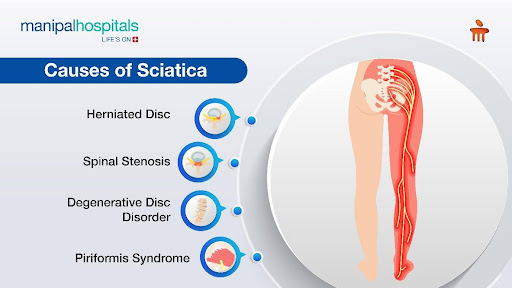
It is important to remember that sciatica is not the diagnosis, and it is often a result of an underlying condition. Some common conditions that cause sciatica include:
-
Herniated disc: Almost 90% of the sciatica cases are caused by a herniated disc. Between each vertebra or spinal joint bone, a cartilage disc is present, which acts as a cushion and enables the movement of the spine. Routine pressure on the lower back (due to work or lack of activity) can cause the outer layers of the cartilage to rip. Now, the inner part of the cartilage bulges out and compresses or inflames the sciatic nerve, resulting in lower back pain.
-
Cauda equina syndrome: It is a rare progressive disorder that occurs when a herniated disc presses on not just one but many nerves in the lower back. In this syndrome, there are other more extreme symptoms such as tingling in the groin area, incontinence, reduced sexual sensations, and in the long term, paralysis.
-
Spinal stenosis: Here, there is an abnormal narrowing of the lower spinal canal, which puts pressure on the nerves, including the sciatic nerve of the spinal cord.
-
Spondylolisthesis: A degenerative disc disorder, spondylolisthesis is when the spinal bone or vertebra inches forward causing the extended bone to pinch the sciatic nerve.
-
Piriformis syndrome: The piriformis muscle is present towards the lower back, and it connects the lower portion of the spine to the thighbones. Piriformis syndrome is a neuromuscular disorder where this muscle involuntarily contracts and the random tightening of this muscle puts pressure on the sciatic nerve.
Risk Factors for Sciatica
Certain situations put people at the risk of getting sciatica. Some of those include:
-
Ageing (where parts of the body like muscles wear down)
-
Occupations like construction that involve lifting and moving around heavy objects
-
Diabetes which increases the risk of nerve damage
-
Smoking can weaken the cartilage
-
Obesity as there is a lot of body weight on the lower back
Diagnosing Sciatica
Sciatica diagnosis varies from one person to another, depending on the symptom severity. Doctors do a full medical examination, where they make the patients perform certain exercises to check muscle strength and mobility. They may also perform nerve conduction tests to catch any abnormalities. The doctor may also visualise the spine using MRI, CT, or X-ray, which could show either the disc or bony protrusions that could be compressing the nerve.
Treating Sciatica
Sciatica pain treatment can be managed surgically or non-surgically. Some of the non-surgical methods that can be practices as sciatica treatment at home include:
-
Avoiding sedentary behaviour: Being active is extremely crucial for people who have sciatica as prolonged periods of inactivity worsen sciatica by putting pressure on the discs. Walking short distances and taking shorter rests can help manage the backpain.
-
Exercising: Physical therapy, which should be under the guidance of an expert, includes components of strengthening, stretching, and aerobic conditioning. These exercises strengthen and stretch the back, abdomen, hip and glute muscles surrounding the sciatic nerve.
-
Massage: Massages like deep tissue massage improves blood circulation, which aids the healing response. It also relaxes tight muscles, which could be causing the pain.
-
Manual manipulation or chiropractic medicine can improve spinal alignment which helps address the underlying conditions that compress the sciatic nerve.
-
Medication: Many doctors prescribe medication like anticonvulsants, steroids, painkillers, antidepressants, and opioid analgesics, to help temporarily manage the pain.
Doctors recommend surgery if there are complications such as tumours, cauda equina syndrome, infections, or bilateral sciatica (where there is sciatica in both legs due to multiple disc herniations). One common procedure for sciatica is discectomy, a minimally invasive technique, where the part of the disc compressing the nerve is removed. Several other lumbar decompression surgeries help attain immediate relief for sciatica pain.
Conclusion
Sciatica that happens when the sciatic nerve is irritated. If you have sciatica, you may feel moderate to severe pain along with numbness in your lower back, and buttocks, and nerve discomfort in leg. If the pain is excruciating along with numbness or muscle weakness and an inability to control bladder or bowel movements, consider visiting our Orthopaedics Hospital in Goa. Our diverse team of experts will accurately diagnose the reasons behind sciatica and assist you in managing the pain.
Frequently Asked Questions
The most common causes are a herniated or bulging disk in the spine pressing on the nerve or narrowing of the spine (spinal stenosis) compressing the nerve. Other causes include tumours, injuries or piriformis syndrome
Diagnosis usually starts with a physical exam to check for movement limitations and positions that cause symptoms. Imaging tests like X-rays, CT scans or MRI can help identify structural causes.
Treatment depends on the cause but usually starts with medications for inflammation/pain, physical therapy, being active, and avoiding aggravating movements. If symptoms don't improve, epidural steroid injections or surgery may be recommended.
For many people, sciatica resolves with time and conservative treatment, though it can take several weeks or months. Severe or worsening cases may require more aggressive treatment.
Maintaining good posture, exercising regularly to strengthen core muscles, following proper lifting techniques and avoiding prolonged inactivity can help prevent sciatica.
Share this Article


Recent Blogs

Postpartum Haemorrhage: Causes, Symptoms & Emergency Signs
29 Jun 20267 Min Read
Delivering a baby is a major physical event that puts a lot of demand on a woman's body. While the focus is often on the arrival of the baby, the management of the third stage of labour—delivering the placenta and controlling blood loss—is just as crucial to a safe delivery. Understanding the risks during this window, including excessive bleeding or postpartum haemorrhage, is a vital part of maternal care.
Read NowDislocated Elbow: Signs, First Aid & Recovery Time
26 Jun 20267 Min Read
An elbow dislocation can be a frightening and painful experience, often occurring unexpectedly due to falls or sports injuries. While it's a serious injury, understanding the signs, knowing the correct first aid, and following a structured recovery plan can significantly improve outcomes.
Read NowUnderstanding Chronic Diarrhoea: More Than Just a Temporary Stomach Upset
26 Jun 20266 Min Read
Chronic diarrhoea, characterised by loose, watery stools occurring three or more times a day for a period exceeding four weeks, is a common and often debilitating condition affecting millions worldwide. While acute diarrhoea is usually short-lived and often caused by infections, chronic diarrhoea points towards a more persistent underlying issue that requires careful investigation.
Read NowSoothing the Itch: Expert Solutions for Itchy Inner Thighs
22 Jun 20267 Min Read
Experiencing persistent itching in your inner thighs can be incredibly uncomfortable, disruptive, and even embarrassing. While often a common annoyance, it can sometimes signal an underlying skin condition that requires attention. Understanding the common causes of itchy inner thighs will help explore effective remedies and adapt practical prevention tips to keep your skin healthy and comfortable.
Read NowCan an ECG Detect a Heart Attack? What the Test Really Shows
15 Jun 20268 Min Read
In moments of chest pain or suspected cardiac distress, an Electrocardiogram (ECG or EKG) is often the first diagnostic test performed. It's a quick, non-invasive procedure that provides a snapshot of your heart's electrical activity. But can an ECG detect a heart attack definitively? While an ECG is an indispensable tool in emergency cardiac care, its ability to pinpoint a heart attack is nuanced.
Read NowDemystifying AVM: Symptoms, Diagnosis, and What to Expect
12 Jun 20267 Min Read
An arteriovenous malformation (AVM) is an abnormal tangle of blood vessels where arteries connect directly to veins, bypassing the capillaries. Capillaries normally slow down blood flow, allowing oxygen and nutrients to be delivered to tissues. In an AVM, this crucial network is missing, leading to high-pressure blood flowing from arteries directly into weaker veins. This can cause the veins to enlarge and potentially rupture, leading to bleeding (haemorrhage) in the brain or other parts of the body.
Read NowKnee Pain When Bending: Causes, Symptoms, and Treatment Options
12 Jun 20266 Min Read
Knee pain is a common ailment, but when it specifically flares up while bending, it can be particularly debilitating, affecting daily activities from walking to climbing stairs. The knee is a complex joint, crucial for movement and supporting body weight. When you experience knee pain when bending, it signals an issue within its bones, ligaments, tendons, and cartilage. This discomfort can range from a dull ache to sharp, intense pain, often accompanied by other symptoms.
Read NowWhat are Bilateral Polycystic Ovaries?
05 Jun 202610 Min Read
The term bilateral polycystic ovaries often raises concerns and questions for many women. It refers to the presence of multiple small cysts on both ovaries, a characteristic feature often associated with Polyendocrine Metabolic Ovarian Syndrome (PMOS). While the name can sound alarming, understanding what bilateral polycystic ovaries are and its implications is the first step towards effective management. While it is a condition that requires attention and management, it is generally not life-threatening and many women lead full, healthy lives with proper care.
Read NowWhy Do I Feel Weak All the Time? Causes Explained
27 May 20267 Min Read
There are times when the “I am just tired” becomes “why do I feel weak all the time?” This persistent feeling of low energy, muscle fatigue, or an overall lack of strength can significantly affect daily life, making even routine tasks feel Herculean. While often used interchangeably, "weakness" and "fatigue" are distinct. Fatigue is a feeling of tiredness or lack of energy, whereas weakness (or asthenia) is a specific reduction in physical strength. When you experience true weakness, it means you can't exert the same force as before, or your muscles tire out much faster. This isn't just about feeling sleepy; it's about a noticeable decrease in your physical capacity. Studies find that a major portion of the adult population experiences unexplained persistent weakness at some point, highlighting the common nature of this weakness and the importance of seeking professional guidance. Persistent weakness should be evaluated by specialists in the Department of Internal Medicine to identify underlying health conditions and provide appropriate treatment.
Read NowInflammatory Breast Cancer: Early Signs You Shouldn’t Ignore
27 May 20266 Min Read
While many associate breast cancer with a palpable lump, some forms present differently. One such form is inflammatory breast cancer, a rare yet aggressive type that often doesn't start with a lump. Because its signs can be subtle and mimic common skin conditions, it's frequently misunderstood, leading to delayed diagnosis. Despite its rarity, the rapid progression of inflammatory breast cancer makes early detection vital. Understanding its unique presentation is your first line of defence. With timely intervention, significant strides have been made in improving outcomes. Specialists in the Department of Oncology play a crucial role in the early diagnosis, evaluation, and personalised treatment of inflammatory breast cancer.
Read Now