


Understanding Mouth Cancer: Symptoms, Risk Factors, and Treatment Approaches
Reviewed by: Dr. Shekhar Salkar
Posted on
5 Min Read

Not sure what you’re looking for?
Get in touch with our representatives for help!
Contact UsDid You Know that India Leads the World in Mouth Cancer Cases?
India reports the highest number of oral cancer cases globally. This condition affects different parts of the oral cavity, such as the lips, tongue, cheeks, gums, and throat. Major risk factors include smoking or chewing tobacco as well as betel quid, excessive alcohol intake, poor oral hygiene, and infections like human papillomavirus (HPV).
In 2020 alone, India documented around 135,929 new cases of oral cancer. Alarmingly, between 60% and 80% of these are identified at later stages. This data underscores the necessity for increased awareness as well as prompt diagnosis and interventions for oral cancer.
Understanding Mouth/Oral Cancer
Mouth cancer is one of the most common types of head and neck cancers. It typically affects people over the age of 40. Men are more likely to develop it than women. The disease can appear in various areas, including the lips, tongue, tonsils, roof of the mouth, the floor of the mouth, and the throat.
Oral cancer begins in the squamous cells that line the mouth. When these cells undergo genetic mutations, they begin to grow abnormally and uncontrollably, forming malignant tumours.
What Can Increase the Risk of Mouth Cancer?
Several everyday habits and health factors can raise the chances of developing mouth or oral cancer. Here are some of the most common ones:
- Tobacco Use
Whether it's smoking cigarettes, using cigars, or chewing tobacco, all forms can be harmful. Cigarettes and tobacco usually have chemicals like nicotine and other carcinogens. These harmful agents significantly contribute to health issues, including mouth cancer.
- Alcohol Consumption
Drinking alcohol, especially heavily or regularly, can irritate the tissues inside your mouth. When combined with tobacco, the risk becomes much higher, as the two substances can work together to harm healthy cells.
- HPV Infection
The human papillomavirus (HPV) can affect parts of the mouth and throat, especially the area at the back, like the base of the tongue and the tonsils. Certain types of HPV, particularly HPV-16, are now known to cause oropharyngeal cancers
- Too Much Sun Exposure
Spending a lot of time in the sun without lip protection can increase the risk of lip cancer, particularly in people with lighter skin. This type of cancer is usually related to long-term sun damage.
- Poor Oral Hygiene
Not taking care of your teeth and gums doesn’t just lead to dental problems. It can also make the mouth more vulnerable to cancer, especially if combined with smoking or drinking.
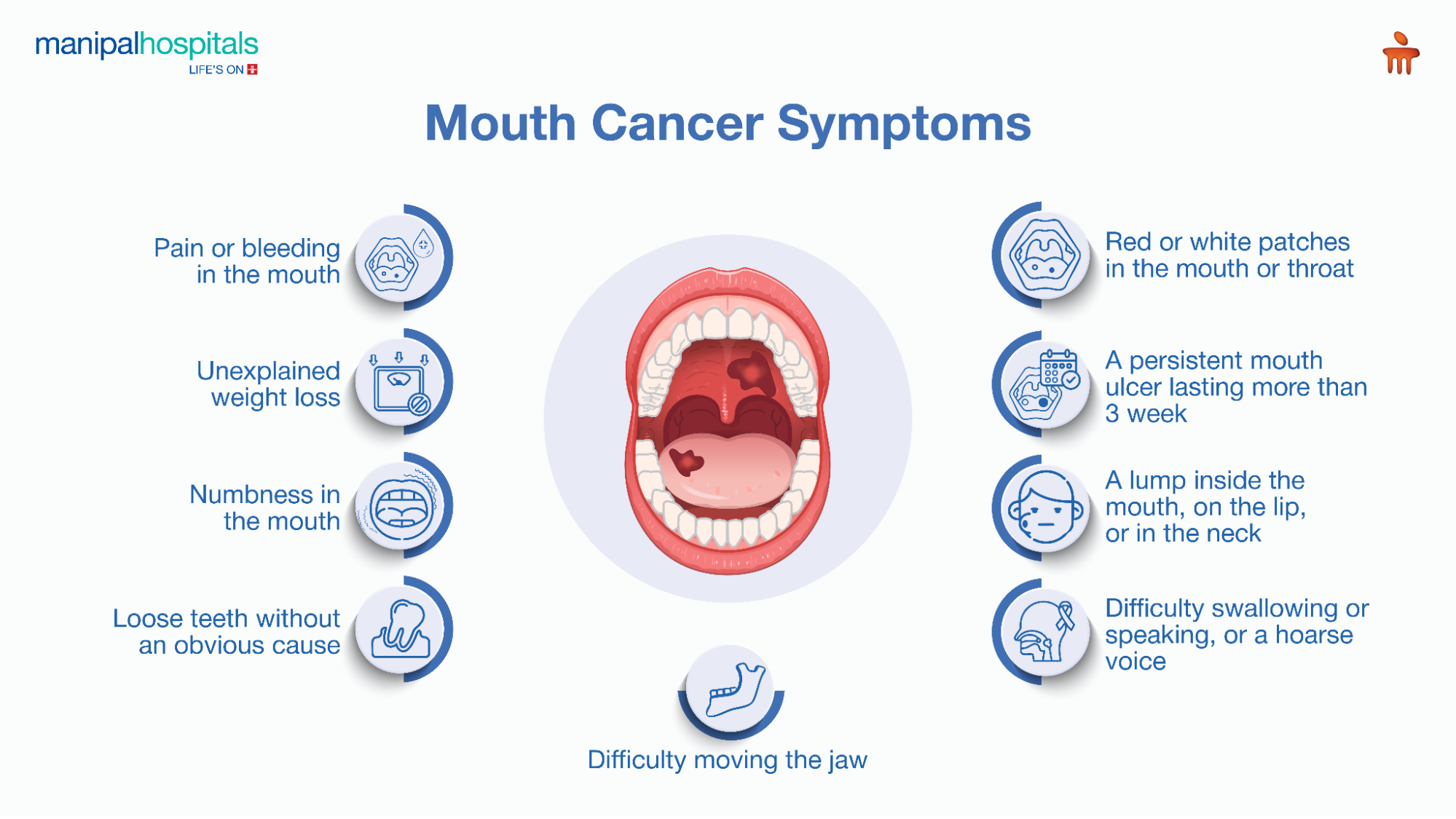
Signs and Symptoms of Mouth Cancer
-
White or red patches inside the mouth or throat.
-
Non-healing mouth ulcers for more than 3 weeks.
-
Lumps in the mouth, neck, or lips.
-
Bleeding or pain in the mouth.
-
Trouble swallowing or speaking.
-
Hoarseness of voice
-
Sudden, unexplained weight loss.
-
Numbness in the mouth.
-
Loosening of teeth without a dental cause.
-
Restricted jaw movement
Diagnosis of Mouth Cancer
The doctor will start by checking your mouth, throat, tongue, and neck to look for suspicious areas. Biopsy is advised in case any suspicious growths or lesions are found. This is done to determine if the cancer is present. Once detected, imaging or screening tests are done to determine the extent and stage of cancer. Some of these tests are X-rays, CT scans, MRIs, PET scans, or Endoscopy.
Staging of Mouth Cancer
Oral cancer is classified into four stages:
Stage 1: The tumour is 2 cm or smaller and hasn’t spread to nearby lymph nodes.
Stage 2: Tumour size is between 2 cm and 4 cm, without lymph node involvement.
Stage 3: Tumour may be larger than 4 cm, or it may have reached one nearby lymph node but not distant sites.
Stage 4: The cancer has spread extensively, possibly to surrounding tissue, involving multiple lymph nodes, or other organs.
Mouth Cancer Treatment
The treatment plan depends on the size, location, stage, and type of cancer, as well as the patient’s overall health. Common treatments include:
-
Surgery: For early-stage cancers, removing the tumour and possibly affected lymph nodes can be effective.
-
Chemotherapy: Uses anti-cancer drugs. These drugs target and kill cancer cells throughout the body. These may be used before surgery or radiotherapy (to shrink the tumour and make it easy to treat), after surgery, alongside radiotherapy, or in recurrent cancer cases.
-
Radiation Therapy: High-energy radiation beams destroy cancer cells. This is often used for precise targeting in head and neck cancers, minimising the damage to adjacent tissues.
-
Targeted Therapy: These drugs block specific molecules that cancer cells rely on to grow and survive. They may also make cancer cells more responsive to radiation.
-
Immunotherapy: By strengthening the immune system’s response, this newer treatment helps the body fight cancer more effectively, particularly in advanced or resistant cases.
Conclusion
Mouth cancer can affect different regions of the oral cavity, such as the lips, tongue, gums, and throat. If you notice warning signs like non-healing mouth ulcers, unusual patches, lumps, difficulty speaking or swallowing, or unexpected weight loss, don’t delay seeking medical help. Early detection significantly improves the chances of successful treatment.
At Manipal Hospitals, Goa, our team of skilled oncologists and head and neck specialists are equipped to provide accurate diagnoses and advanced treatments for mouth cancer.
Frequently Asked Questions
Yes, particularly when diagnosed early. Early-stage treatment often leads to complete recovery. Advanced cases are harder to treat, but therapies can still help manage the disease and improve the patient's quality of life.
Most mouth cancers are squamous cell carcinomas. They tend to progress at a moderate to fast pace. The progression depends on the tumour location and type.
You can lower your risk by avoiding tobacco, limiting alcohol, getting vaccinated for HPV, protecting your lips from excessive sun exposure, and visiting your dentist regularly for checkups.
Usually, pain is not an early symptom. Pain tends to develop as the cancer progresses. However, persistent discomfort should never be ignored. Consult your doctor or dentist if symptoms arise.
You can schedule your visit by calling us or heading to our official website.
Visit: https://www.manipalhospitals.com/goa
Contact:1800 102 5555
Share this Article


Recent Blogs

Postpartum Haemorrhage: Causes, Symptoms & Emergency Signs
29 Jun 20267 Min Read
Delivering a baby is a major physical event that puts a lot of demand on a woman's body. While the focus is often on the arrival of the baby, the management of the third stage of labour—delivering the placenta and controlling blood loss—is just as crucial to a safe delivery. Understanding the risks during this window, including excessive bleeding or postpartum haemorrhage, is a vital part of maternal care.
Read NowDislocated Elbow: Signs, First Aid & Recovery Time
26 Jun 20267 Min Read
An elbow dislocation can be a frightening and painful experience, often occurring unexpectedly due to falls or sports injuries. While it's a serious injury, understanding the signs, knowing the correct first aid, and following a structured recovery plan can significantly improve outcomes.
Read NowUnderstanding Chronic Diarrhoea: More Than Just a Temporary Stomach Upset
26 Jun 20266 Min Read
Chronic diarrhoea, characterised by loose, watery stools occurring three or more times a day for a period exceeding four weeks, is a common and often debilitating condition affecting millions worldwide. While acute diarrhoea is usually short-lived and often caused by infections, chronic diarrhoea points towards a more persistent underlying issue that requires careful investigation.
Read NowSoothing the Itch: Expert Solutions for Itchy Inner Thighs
22 Jun 20267 Min Read
Experiencing persistent itching in your inner thighs can be incredibly uncomfortable, disruptive, and even embarrassing. While often a common annoyance, it can sometimes signal an underlying skin condition that requires attention. Understanding the common causes of itchy inner thighs will help explore effective remedies and adapt practical prevention tips to keep your skin healthy and comfortable.
Read NowCan an ECG Detect a Heart Attack? What the Test Really Shows
15 Jun 20268 Min Read
In moments of chest pain or suspected cardiac distress, an Electrocardiogram (ECG or EKG) is often the first diagnostic test performed. It's a quick, non-invasive procedure that provides a snapshot of your heart's electrical activity. But can an ECG detect a heart attack definitively? While an ECG is an indispensable tool in emergency cardiac care, its ability to pinpoint a heart attack is nuanced.
Read NowDemystifying AVM: Symptoms, Diagnosis, and What to Expect
12 Jun 20267 Min Read
An arteriovenous malformation (AVM) is an abnormal tangle of blood vessels where arteries connect directly to veins, bypassing the capillaries. Capillaries normally slow down blood flow, allowing oxygen and nutrients to be delivered to tissues. In an AVM, this crucial network is missing, leading to high-pressure blood flowing from arteries directly into weaker veins. This can cause the veins to enlarge and potentially rupture, leading to bleeding (haemorrhage) in the brain or other parts of the body.
Read NowKnee Pain When Bending: Causes, Symptoms, and Treatment Options
12 Jun 20266 Min Read
Knee pain is a common ailment, but when it specifically flares up while bending, it can be particularly debilitating, affecting daily activities from walking to climbing stairs. The knee is a complex joint, crucial for movement and supporting body weight. When you experience knee pain when bending, it signals an issue within its bones, ligaments, tendons, and cartilage. This discomfort can range from a dull ache to sharp, intense pain, often accompanied by other symptoms.
Read NowWhat are Bilateral Polycystic Ovaries?
05 Jun 202610 Min Read
The term bilateral polycystic ovaries often raises concerns and questions for many women. It refers to the presence of multiple small cysts on both ovaries, a characteristic feature often associated with Polyendocrine Metabolic Ovarian Syndrome (PMOS). While the name can sound alarming, understanding what bilateral polycystic ovaries are and its implications is the first step towards effective management. While it is a condition that requires attention and management, it is generally not life-threatening and many women lead full, healthy lives with proper care.
Read NowWhy Do I Feel Weak All the Time? Causes Explained
27 May 20267 Min Read
There are times when the “I am just tired” becomes “why do I feel weak all the time?” This persistent feeling of low energy, muscle fatigue, or an overall lack of strength can significantly affect daily life, making even routine tasks feel Herculean. While often used interchangeably, "weakness" and "fatigue" are distinct. Fatigue is a feeling of tiredness or lack of energy, whereas weakness (or asthenia) is a specific reduction in physical strength. When you experience true weakness, it means you can't exert the same force as before, or your muscles tire out much faster. This isn't just about feeling sleepy; it's about a noticeable decrease in your physical capacity. Studies find that a major portion of the adult population experiences unexplained persistent weakness at some point, highlighting the common nature of this weakness and the importance of seeking professional guidance. Persistent weakness should be evaluated by specialists in the Department of Internal Medicine to identify underlying health conditions and provide appropriate treatment.
Read NowInflammatory Breast Cancer: Early Signs You Shouldn’t Ignore
27 May 20266 Min Read
While many associate breast cancer with a palpable lump, some forms present differently. One such form is inflammatory breast cancer, a rare yet aggressive type that often doesn't start with a lump. Because its signs can be subtle and mimic common skin conditions, it's frequently misunderstood, leading to delayed diagnosis. Despite its rarity, the rapid progression of inflammatory breast cancer makes early detection vital. Understanding its unique presentation is your first line of defence. With timely intervention, significant strides have been made in improving outcomes. Specialists in the Department of Oncology play a crucial role in the early diagnosis, evaluation, and personalised treatment of inflammatory breast cancer.
Read Now