


Immunisations Among Babies: Understanding The Vaccination And Its Schedule
Reviewed by: Manipal Hospitals
Posted on
5 Min Read

Not sure what you’re looking for?
Get in touch with our representatives for help!
Contact UsBabies are born with immunity as they are born with antibodies (proteins created by the body to fight disease) from their mothers before birth. Babies continue to get antibodies from breast milk through breastfeeding after their birth. However, immunity is only present in these two situations for a limited time. Hence, babies are immunised through vaccination to protect them from any disease that could affect their growth.
It is a known fact that vaccines are effective in providing immunity against some specific diseases. One might be confused as to why babies require immunisations against some diseases that they have never heard of. In India, several diseases that immunisation helps prevent once infected have killed a lot of children. After being vaccinated, most children are no longer exposed to such diseases. Hence, immunisations provide a shield for children from illness and eliminate the spread of disease to others.
Visit a top hospital for paediatric treatment in Goa in case your child is already suffering from the below conditions before vaccinations.
Importance of Immunisation in Babies
Immunity is the process of protecting the body by preventing various diseases. As the babies do not have a fully developed immune system during birth, they may develop a higher risk of infection, which may result in severe illness. Vaccines help the immune system by providing defence mechanisms against certain viruses. Hence, vaccines are considered to provide protection to babies by helping them build their natural defences.
Therefore, one of the best things that parents can do for their child's health is to vaccinate them. Immune systems are responsible for combating life-threatening infections through vaccinations. Antibodies that fight against weakened or inactivated viruses and bacteria (known as antigens) are produced by the immune system in response to the vaccines. If the body is exposed to those viruses or bacteria again in the future, these antibodies are ready to attack.
Types of Vaccinations that a Baby Requires
The baby usually receives many immunisations during the first two years of life to help with disease prevention. The immunisation is scheduled for each shot that the child receives for up to 6 years. It details the timing and number of vaccination shots given to the baby. It is based on the Centres for Disease Control and Prevention's (CDC's) schedule. To ensure that immunisation regimens are safe for babies, the CDC has conducted an extensive study.
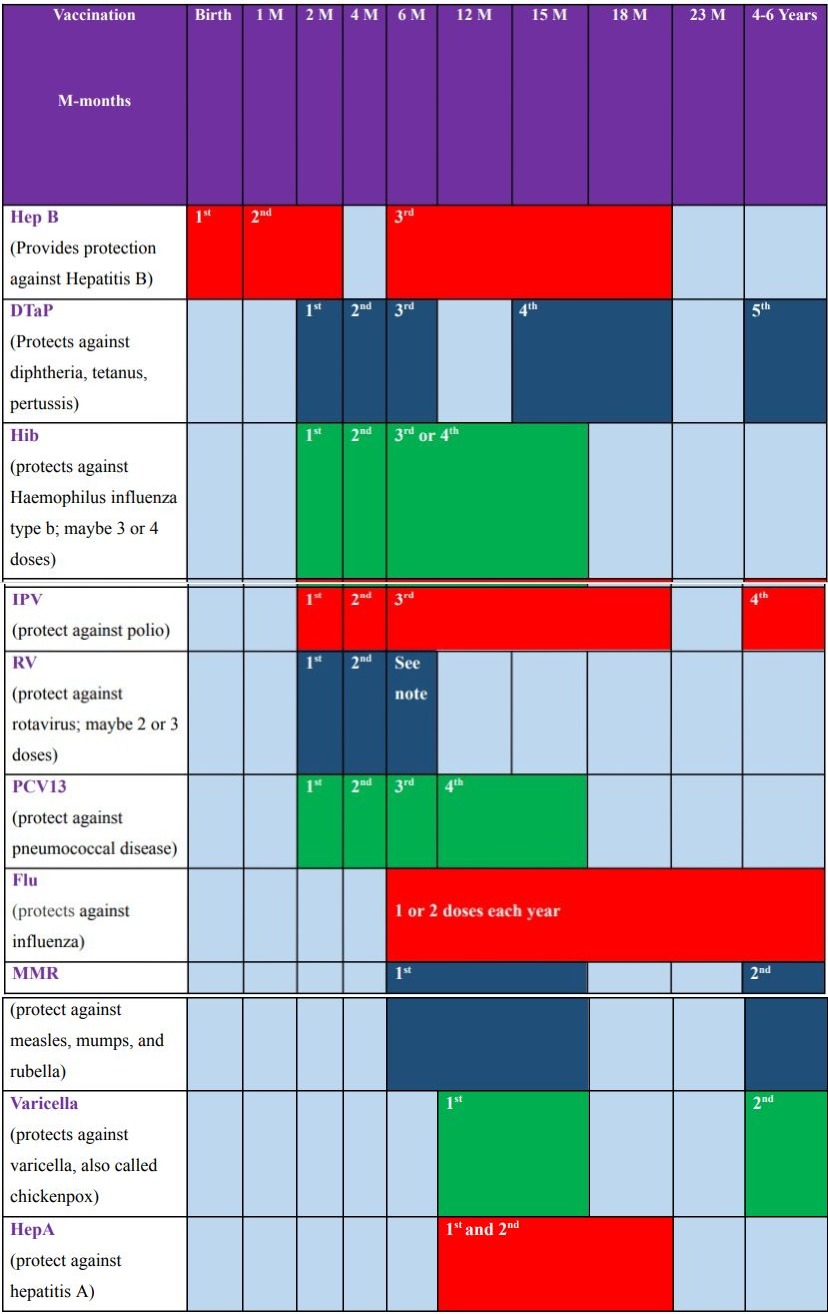
Given below is the typical schedule for vaccinations for babies up to age 6. Every doctor’s perception varies, as they may recommend different schedules for different babies. The table below shows the monthly doses of vaccinations. Parents should communicate with the doctor to understand the different dosages of vaccines their child receives if the timetable calls for more than one month between doses.
Important Notes
Hib
Parents should communicate with the doctor to ensure whether the baby requires a dose at 6 months.
RV
Parents should communicate with the doctor to ensure whether the baby requires the third dose.
Flu
If receiving the flu vaccine for the first time, children between the ages of 6 months and 8 years old require two doses. There must be a 4-week gap between each dose.
MMR
Parents should ask the doctor whether their baby needs to get the MMR vaccine in case they are travelling out of the country.
Hep A
Parents should ask the doctor whether their baby needs to get the Hep A vaccine in case they are travelling out of the country.
All babies, even those who are admitted to the newborn critical care unit (commonly known as the NICU), require vaccines. The same CDC immunisation regimen is used for preterm and low-birth-weight infants. Before 37 weeks of pregnancy, a baby is considered preterm. Babies with low birth weights are born weighing less than 2.2 kg. Because preterm infants are more likely to experience health issues from diseases than babies born at term, vaccinations are important for them. Only the hepatitis B shot may be postponed for premature babies. The majority of newborn babies receive this shot within 24 hours of delivery. Babies might receive this vaccination later if they don't weigh enough or are healthy.
Consult our paediatrician in Goa if you require vaccination for your child at an affordable cost.
Immunity is the process of protecting the body by preventing various diseases. As the babies do not have a fully developed immune system during birth, they may develop a higher risk of infection, which may result in severe illness. Vaccines help the immune system by providing defence mechanisms against certain viruses. Hence, vaccines are considered to provide protection to babies by helping them build their natural defences.
Therefore, one of the best things that parents can do for their child's health is to vaccinate them. Immune systems are responsible for combating life-threatening infections through vaccinations. Antibodies that fight against weakened or inactivated viruses and bacteria (known as antigens) are produced by the immune system in response to the vaccines. If the body is exposed to those viruses or bacteria again in the future, these antibodies are ready to attack.
The baby usually receives many immunisations during the first two years of life to help with disease prevention. The immunisation is scheduled for each shot that the child receives for up to 6 years. It details the timing and number of vaccination shots given to the baby. It is based on the Centres for Disease Control and Prevention's (CDC's) schedule. To ensure that immunisation regimens are safe for babies, the CDC has conducted an extensive study.
Given below is the typical schedule for vaccinations for babies up to age 6. Every doctor’s perception varies, as they may recommend different schedules for different babies. The table below shows the monthly doses of vaccinations. Parents should communicate with the doctor to understand the different dosages of vaccines their child receives if the timetable calls for more than one month between doses.
Parents should communicate with the doctor to ensure whether the baby requires a dose at 6 months.
Parents should communicate with the doctor to ensure whether the baby requires the third dose.
If receiving the flu vaccine for the first time, children between the ages of 6 months and 8 years old require two doses. There must be a 4-week gap between each dose.
Parents should ask the doctor whether their baby needs to get the MMR vaccine in case they are travelling out of the country.
Parents should ask the doctor whether their baby needs to get the Hep A vaccine in case they are travelling out of the country.
All babies, even those who are admitted to the newborn critical care unit (commonly known as the NICU), require vaccines. The same CDC immunisation regimen is used for preterm and low-birth-weight infants. Before 37 weeks of pregnancy, a baby is considered preterm. Babies with low birth weights are born weighing less than 2.2 kg. Because preterm infants are more likely to experience health issues from diseases than babies born at term, vaccinations are important for them. Only the hepatitis B shot may be postponed for premature babies. The majority of newborn babies receive this shot within 24 hours of delivery. Babies might receive this vaccination later if they don't weigh enough or are healthy.
Consult our paediatrician in Goa if you require vaccination for your child at an affordable cost.
Share this Article


Similar Blogs

Development of kids in Early Age
1 Min Read
Investing in the early years is one of the wisest things a country can do to end extreme poverty, increase shared prosperity, and create the human capital required for economies to diversify and grow. Early childhood experiences have a significant impact on brain development, influencing learning, health, behavior, and, eventually, productivity and income. Hence, parents should be careful about their child’s developmental phase, ensuring their children’s strong foundation for a better future. Early childhood development programmes have been established to help parents, caregivers, practitioners, and policymakers understand the importance of early childhood development and learn how to support children and families during this critical stage. However, millions of young children are not reaching their full potential today due to poor nutrition, a lack of early stimulation, learning, and nurturing care, and stress exposure. Challenges for kids in their Developmental Phase The development of kids at an early age is quite challenging, and some of those challenges are discussed below: Poverty and stunting threaten the development of 250 million children under the age of five in low-and middle-income countries across the globe (or low height for their age). Only 60% of all three-to six-year-olds across the globe have access to pre-primary education. Only one out of every five children in low-income countries has access to preschool. The displacement of one in every 200 children in the world exposes them to stress that can stunt their development. Nearly 350 million children under the age of five across the globe, or more than 40% of all children, lack access to childcare. Why is the development of kids at an early age considered important? It has been demonstrated that a child's early experiences have a big influence on how they develop later in life. Because of this, it's crucial for parents and other adults who work with kids to comprehend precisely what happens throughout these formative years. This enables them to efficiently satisfy a child's requirements and make sure they have the best start in life. Even though children are still in this time when they start school, research has found that only 25% of parents understand the significance of the first five years. In addition, teacher preparation does not fully address the early years. Due to both parties' ignorance, it may be difficult to give kids the ideal settings, which could hinder their development. Guidance on the stages of child development, milestones children attain within each stage, and how to stimulate development are regarded as crucial in order to comprehend the early years. Consult with our Paediatrist in Goa to know more about the development of your child. How does the development of kids at an early age take place? The term "development" refers to how a child evolves, grows, and acquires abilities—not just physically but also socially, emotionally, cognitively, and communicatively. Five stages of a child's development can be identified: Newborn (0-3 months) Infant (3-12 months) Toddler (1-3 years) Preschool age (3-4 years) School-age (4-5 years) Milestones are a crucial indicator that is frequently utilized in relation to physical development. The skills that most kids can execute at a specific age are known as developmental milestones. The physical development of a baby throughout the first year of life is focused on helping the child learn how to move independently, hold things, and perfect their hand-to-mouth coordination. Before the age of one, children grow rapidly, so milestones are measured in months. By the time a child reaches the age of five, 85% of their brain has already formed. These early years of life are therefore essential for healthy early childhood development. Similar to physical growth, a child's cognitive, social, and emotional milestones signify significant advancements in their development. Parents must nurture, communicate with, and support their children, especially throughout the first five years of life. Future mental health issues start to manifest when parents don't provide for their child's emotional, physical, and mental needs during these developmental phases. Visit Manipal Hospitals for Paediatric treatment in Goa. Resources to help the kids development an early age Supporting children and families begins with recognizing the significance of early relationships and experiences for lifelong development. The resource for assisting children's early development is to apply that understanding to current practices and rules. In order to strengthen this and enhance outcomes for children and families, concrete suggestions for practitioners and policymakers can be offered. To put young children on the path to greater prosperity and to help nations be more productive and compete more successfully in a rapidly changing global economy, wise investments in their physical, cognitive, linguistic, and socio-emotional development are essential from before birth until they enter primary school. Investing in high-quality programs that support children's health, nutrition, and early learning can improve learning outcomes and, as a result, adult wages and productivity. Dr. Nathaniel John Pinto Consultant - Paediatrics Manipal Hospitals, Goa
Read NowPostpartum Haemorrhage: Causes, Symptoms & Emergency Signs
29 Jun 20267 Min Read
Delivering a baby is a major physical event that puts a lot of demand on a woman's body. While the focus is often on the arrival of the baby, the management of the third stage of labour—delivering the placenta and controlling blood loss—is just as crucial to a safe delivery. Understanding the risks during this window, including excessive bleeding or postpartum haemorrhage, is a vital part of maternal care.
Read NowUnderstanding Chronic Diarrhoea: More Than Just a Temporary Stomach Upset
26 Jun 20266 Min Read
Chronic diarrhoea, characterised by loose, watery stools occurring three or more times a day for a period exceeding four weeks, is a common and often debilitating condition affecting millions worldwide. While acute diarrhoea is usually short-lived and often caused by infections, chronic diarrhoea points towards a more persistent underlying issue that requires careful investigation.
Read NowWhat are Bilateral Polycystic Ovaries?
05 Jun 202610 Min Read
The term bilateral polycystic ovaries often raises concerns and questions for many women. It refers to the presence of multiple small cysts on both ovaries, a characteristic feature often associated with Polyendocrine Metabolic Ovarian Syndrome (PMOS). While the name can sound alarming, understanding what bilateral polycystic ovaries are and its implications is the first step towards effective management. While it is a condition that requires attention and management, it is generally not life-threatening and many women lead full, healthy lives with proper care.
Read NowWhy Do I Feel Weak All the Time? Causes Explained
27 May 20267 Min Read
There are times when the “I am just tired” becomes “why do I feel weak all the time?” This persistent feeling of low energy, muscle fatigue, or an overall lack of strength can significantly affect daily life, making even routine tasks feel Herculean. While often used interchangeably, "weakness" and "fatigue" are distinct. Fatigue is a feeling of tiredness or lack of energy, whereas weakness (or asthenia) is a specific reduction in physical strength. When you experience true weakness, it means you can't exert the same force as before, or your muscles tire out much faster. This isn't just about feeling sleepy; it's about a noticeable decrease in your physical capacity. Studies find that a major portion of the adult population experiences unexplained persistent weakness at some point, highlighting the common nature of this weakness and the importance of seeking professional guidance. Persistent weakness should be evaluated by specialists in the Department of Internal Medicine to identify underlying health conditions and provide appropriate treatment.
Read NowInflammatory Breast Cancer: Early Signs You Shouldn’t Ignore
27 May 20266 Min Read
While many associate breast cancer with a palpable lump, some forms present differently. One such form is inflammatory breast cancer, a rare yet aggressive type that often doesn't start with a lump. Because its signs can be subtle and mimic common skin conditions, it's frequently misunderstood, leading to delayed diagnosis. Despite its rarity, the rapid progression of inflammatory breast cancer makes early detection vital. Understanding its unique presentation is your first line of defence. With timely intervention, significant strides have been made in improving outcomes. Specialists in the Department of Oncology play a crucial role in the early diagnosis, evaluation, and personalised treatment of inflammatory breast cancer.
Read NowBrachytherapy for Cervical Cancer: How It Works & Benefits
29 Apr 20265 Min Read
Cervical cancer remains a significant health concern for women globally, but advancements in medical science offer powerful and precise treatment options. One of the newer approaches to cervical cancer treatment is brachytherapy. This highly effective form of radiation therapy delivers targeted precision, offering renewed hope and improved patient outcomes.
Read NowSchizophrenia: Early Signs and Long-Term Management
08 Apr 20266 Min Read
Schizophrenia is a complex, chronic mental health condition that affects how a person thinks, feels, and behaves. While often misunderstood, it is a manageable condition, and with early detection and consistent support, individuals can lead fulfilling lives. Understanding the early signs and embracing effective long-term management strategies are crucial steps toward recovery and improved quality of life. Early intervention strategies have shown remarkable promise, with studies indicating that timely and appropriate treatment can improve long-term outcomes for many patients. This underscores the profound impact of prompt diagnosis and sustained therapeutic efforts.
Read Nowगर्दीचे दात : कारणे, लक्षणे आणि उपचार
11 Mar 20264 Min Read
तुम्हाला माहिती आहे का की जगभरात आढळणाऱ्या दातांच्या समस्यांपैकी एक अशी समस्या आहे, ज्याची जाणीव अनेकांना नसते? जेव्हा जबड्यात दात नीट रेषेत बसण्यासाठी पुरेशी जागा नसते, तेव्हा ते एकमेकांवर चढतात, वाकडे-तिकडे वळतात किंवा आपली जागा बदलतात. या स्थितीला सर्वसाधारणपणे वाकडे दात किंवा गर्दीचे दात असे म्हटले जाते. वाकडे दात किंवा गर्दीचे दात ही जगभरातील दातांच्या चुकीच्या रचनेच्या (माल-ऑक्लूजन) सर्वाधिक आढळणाऱ्या प्रकारांपैकी एक आहे. अभ्यासांनुसार, काही गटांमध्ये त्याचे प्रमाण तब्बल ८४% पर्यंत आढळले आहे. भारतातील संशोधनात महिलांमध्ये सुमारे ५७% आणि पुरुषांमध्ये ६७% पर्यंत हे प्रमाण नोंदवले गेले आहे. फक्त देखाव्यापुरते मर्यादित न राहता, दातांची गर्दी तोंडाच्या स्वच्छतेवर, आरामावर आणि सामाजिक व्यवहारातील आत्मविश्वासावरही परिणाम करू शकते. दंतआरोग्य तसेच आत्मसन्मान या दोन्हींवर त्याचा प्रभाव पडत असल्यामुळे, त्याची लक्षणे, कारणे आणि उपचार पर्याय समजून घेणे अत्यंत महत्त्वाचे आहे.
Read NowTop 5 Causes of Lower Belly Pain and Stomach Cramps
12 Dec 20258 Min Read
Painful stomach cramps are an extremely universal experience. They can manifest as a dull, nagging ache due to bloating or as sharp, debilitating spasms caused by menstrual cramps, an IBS flare-up, or a stomach infection. Often, this pain can be felt in both the upper and lower belly. If your lower belly pain is persistent and affects your daily life, that is when you should consider visiting a doctor to understand the underlying causes of stomachache. Understanding the causes of stomachaches that localise in the lower belly is the first step toward finding relief and ensuring that a minor issue isn't masking something more serious. In this blog, we examine five primary causes of lower belly pain and stomach cramps and discuss potential remedies and treatments.
Read NowRecent Blogs
Postpartum Haemorrhage: Causes, Symptoms & Emergency Signs
29 Jun 20267 Min Read
Delivering a baby is a major physical event that puts a lot of demand on a woman's body. While the focus is often on the arrival of the baby, the management of the third stage of labour—delivering the placenta and controlling blood loss—is just as crucial to a safe delivery. Understanding the risks during this window, including excessive bleeding or postpartum haemorrhage, is a vital part of maternal care.
Read NowDislocated Elbow: Signs, First Aid & Recovery Time
26 Jun 20267 Min Read
An elbow dislocation can be a frightening and painful experience, often occurring unexpectedly due to falls or sports injuries. While it's a serious injury, understanding the signs, knowing the correct first aid, and following a structured recovery plan can significantly improve outcomes.
Read NowUnderstanding Chronic Diarrhoea: More Than Just a Temporary Stomach Upset
26 Jun 20266 Min Read
Chronic diarrhoea, characterised by loose, watery stools occurring three or more times a day for a period exceeding four weeks, is a common and often debilitating condition affecting millions worldwide. While acute diarrhoea is usually short-lived and often caused by infections, chronic diarrhoea points towards a more persistent underlying issue that requires careful investigation.
Read NowSoothing the Itch: Expert Solutions for Itchy Inner Thighs
22 Jun 20267 Min Read
Experiencing persistent itching in your inner thighs can be incredibly uncomfortable, disruptive, and even embarrassing. While often a common annoyance, it can sometimes signal an underlying skin condition that requires attention. Understanding the common causes of itchy inner thighs will help explore effective remedies and adapt practical prevention tips to keep your skin healthy and comfortable.
Read NowCan an ECG Detect a Heart Attack? What the Test Really Shows
15 Jun 20268 Min Read
In moments of chest pain or suspected cardiac distress, an Electrocardiogram (ECG or EKG) is often the first diagnostic test performed. It's a quick, non-invasive procedure that provides a snapshot of your heart's electrical activity. But can an ECG detect a heart attack definitively? While an ECG is an indispensable tool in emergency cardiac care, its ability to pinpoint a heart attack is nuanced.
Read NowDemystifying AVM: Symptoms, Diagnosis, and What to Expect
12 Jun 20267 Min Read
An arteriovenous malformation (AVM) is an abnormal tangle of blood vessels where arteries connect directly to veins, bypassing the capillaries. Capillaries normally slow down blood flow, allowing oxygen and nutrients to be delivered to tissues. In an AVM, this crucial network is missing, leading to high-pressure blood flowing from arteries directly into weaker veins. This can cause the veins to enlarge and potentially rupture, leading to bleeding (haemorrhage) in the brain or other parts of the body.
Read NowKnee Pain When Bending: Causes, Symptoms, and Treatment Options
12 Jun 20266 Min Read
Knee pain is a common ailment, but when it specifically flares up while bending, it can be particularly debilitating, affecting daily activities from walking to climbing stairs. The knee is a complex joint, crucial for movement and supporting body weight. When you experience knee pain when bending, it signals an issue within its bones, ligaments, tendons, and cartilage. This discomfort can range from a dull ache to sharp, intense pain, often accompanied by other symptoms.
Read NowWhat are Bilateral Polycystic Ovaries?
05 Jun 202610 Min Read
The term bilateral polycystic ovaries often raises concerns and questions for many women. It refers to the presence of multiple small cysts on both ovaries, a characteristic feature often associated with Polyendocrine Metabolic Ovarian Syndrome (PMOS). While the name can sound alarming, understanding what bilateral polycystic ovaries are and its implications is the first step towards effective management. While it is a condition that requires attention and management, it is generally not life-threatening and many women lead full, healthy lives with proper care.
Read NowWhy Do I Feel Weak All the Time? Causes Explained
27 May 20267 Min Read
There are times when the “I am just tired” becomes “why do I feel weak all the time?” This persistent feeling of low energy, muscle fatigue, or an overall lack of strength can significantly affect daily life, making even routine tasks feel Herculean. While often used interchangeably, "weakness" and "fatigue" are distinct. Fatigue is a feeling of tiredness or lack of energy, whereas weakness (or asthenia) is a specific reduction in physical strength. When you experience true weakness, it means you can't exert the same force as before, or your muscles tire out much faster. This isn't just about feeling sleepy; it's about a noticeable decrease in your physical capacity. Studies find that a major portion of the adult population experiences unexplained persistent weakness at some point, highlighting the common nature of this weakness and the importance of seeking professional guidance. Persistent weakness should be evaluated by specialists in the Department of Internal Medicine to identify underlying health conditions and provide appropriate treatment.
Read NowInflammatory Breast Cancer: Early Signs You Shouldn’t Ignore
27 May 20266 Min Read
While many associate breast cancer with a palpable lump, some forms present differently. One such form is inflammatory breast cancer, a rare yet aggressive type that often doesn't start with a lump. Because its signs can be subtle and mimic common skin conditions, it's frequently misunderstood, leading to delayed diagnosis. Despite its rarity, the rapid progression of inflammatory breast cancer makes early detection vital. Understanding its unique presentation is your first line of defence. With timely intervention, significant strides have been made in improving outcomes. Specialists in the Department of Oncology play a crucial role in the early diagnosis, evaluation, and personalised treatment of inflammatory breast cancer.
Read Now