


Understanding the Dialysis Process: A Patient’s Guide to Kidney Care and Management
Reviewed by: Manipal Hospitals
Posted on
8 Min Read

Not sure what you’re looking for?
Get in touch with our representatives for help!
Contact UsWhen the kidneys begin to lose their ability to filter waste, excess fluid, and toxins from the blood, the effects can build up quietly at first and then become increasingly difficult to ignore. Fatigue, swelling, breathlessness, nausea, poor appetite, and changes in urine output may all signal that the kidneys are no longer doing enough of their job. In some situations, medicines and lifestyle changes help slow the problem. In more advanced kidney disease, however, dialysis becomes an important treatment option.
Many people hear the word "dialysis" and immediately think of a major life disruption. While it does require planning and commitment, it is also a life-sustaining treatment that helps people feel better and stay medically stable when kidney function is severely reduced. Understanding the dialysis process can reduce fear and make it easier to prepare for treatment.
This blog, by nephrology experts from a leading hospital for dialysis in Doddaballapur, breaks down how the procedure works, clarifies the differences between haemodialysis vs peritoneal dialysis, outlines potential dialysis side effects, and prepares you for what to expect during your care journey.
Understanding the Kidneys and the Need for Dialysis
Healthy kidneys function as your body's internal filtration system. Every single day, they filter roughly 180 liters of blood to remove waste products, toxins, and excess fluids, which are then excreted as urine. They also play a crucial role in regulating blood pressure and balancing key minerals like potassium and sodium.
When the kidneys lose about 85% to 90% of their functional capacity, a stage known as end-stage renal disease (ESRD) or chronic kidney failure, they can no longer clear these dangerous toxins. This leads to a harmful build-up of waste materials in the blood. When this stage occurs, medical intervention in the form of kidney dialysis or a kidney transplant becomes essential to sustain life.
When is dialysis necessary?
The decision to begin the dialysis process is never based on a single blood test. A nephrologist (kidney specialist) evaluates a combination of laboratory results, overall physical health, and noticeable physical symptoms.
Common signs that indicate your body requires filtration support include:
-
Uremia: A buildup of nitrogenous waste that causes severe nausea, vomiting, loss of appetite, and a metallic taste in the mouth.
-
Fluid Overload: Severe swelling (oedema) in the legs, ankles, or hands and fluid accumulation in the lungs that causes shortness of breath.
-
Hyperkalemia: High potassium levels in the blood that can dangerously disrupt normal heart rhythms.
-
Persistent Fatigue: Extreme exhaustion caused by a combination of toxin buildup and anaemia (low red blood cell count).
If these symptoms are affecting your quality of life and medication is no longer controlling them, your nephrologist will discuss starting dialysis. The goal is never to rush but to start the treatment electively, before an emergency arises.
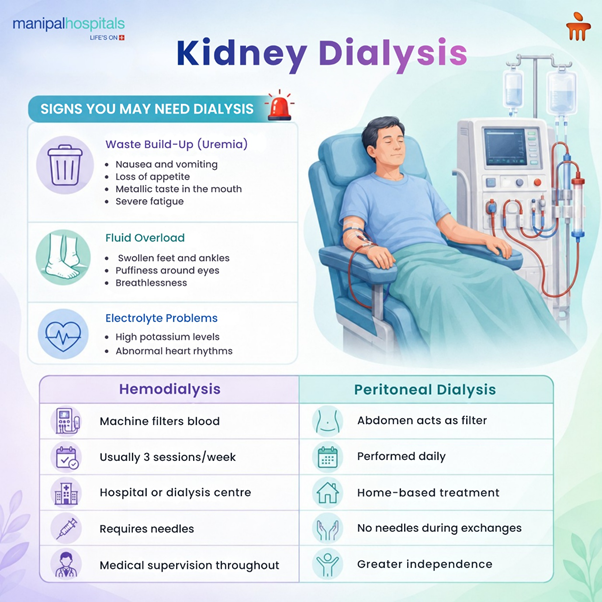
Haemodialysis vs Peritoneal Dialysis
There are two primary methods used to filter the blood, each with its own procedural framework, equipment requirements, and lifestyle implications. Understanding haemodialysis vs peritoneal dialysis helps patients choose the method that best aligns with their medical needs and daily routines.
|
Feature |
Haemodialysis |
Peritoneal Dialysis |
| How It Works |
An external machine (dialyser) filters the blood outside the body. |
The lining of your abdomen (peritoneum) acts as the natural filter inside the body. |
| Access Type |
Requires a vascular access point, usually an AV fistula or graft in the arm. |
Requires a permanent, soft silicone catheter inserted into the abdomen. |
| Treatment Location |
Primarily performed in a specialised hospital or dialysis centre. |
Performed at home, at work, or while travelling. |
|
Typical Dialysis Frequency |
Usually 3 times per week, with each clinical session lasting 3 to 4 hours. |
Performed daily, either continuously throughout the day or overnight using an automated cycler machine. |
| Primary Advantage |
Supervised entirely by trained medical professionals; requires fewer days of treatment per week. |
Offers greater lifestyle flexibility, no needles, and less restrictive dietary limitations. |
What to Expect During the Dialysis Process
The dialysis process differs depending on whether you are in a clinical setting or managing treatment at home. Here is what to expect from each approach:
Haemodialysis: In-Center Care
This method is highly structured and overseen by a clinical team to ensure your safety throughout the session.
-
Setup: Staff first check your weight and vitals to determine exactly how much fluid needs to be removed.
-
Connection: Using your established vascular access (the fistula or graft), a nurse inserts two needles—one to pull blood into the dialyser and one to return it to your body.
-
During Treatment: While you may feel a brief pinch at the start, the process is generally quiet and painless. During the four-hour session, you are free to nap, read, or use a tablet.
-
Active Monitoring: The equipment and staff constantly track your blood pressure. Should you feel any dialysis side effects, such as cramping or dizziness, the team can adjust the machine’s settings in real-time to keep you comfortable.
Peritoneal Dialysis (PD): Home-Based Independence
PD uses the natural lining of your abdomen to filter blood. Once you complete your initial training, you gain significant flexibility.
-
The Exchange: You manually drain used fluid through your catheter and replace it with a fresh, sterile solution. This process typically takes about 30 to 40 minutes.
-
Daily Freedom: Once the "dwell" begins, you are disconnected from any machinery, allowing you to move around and continue your normal daily routine.
-
Overnight Automation: Many patients use a "cycler" machine that handles these fluid exchanges automatically while they sleep, which can be an excellent way to maintain a busy schedule.
Note: Because the procedure involves permanent access to your bloodstream or abdomen, always follow your team’s specific hygiene instructions to keep your access site clean and infection-free.
Managing Potential Dialysis Side Effects
While dialysis is highly effective at cleansing the bloodstream, the rapid shifts in fluid levels and chemical balance can sometimes cause temporary physical symptoms. Being aware of these dialysis side effects allows you to manage them proactively alongside your clinical team.
-
Low Blood Pressure (Hypotension): The rapid removal of fluid during sessions can cause a drop in blood pressure, leading to dizziness, nausea, or blurred vision.
-
Muscle Cramps: Sudden fluid and electrolyte shifts often trigger painful cramping in the calves or abdominal muscles during treatment.
-
Post-Dialysis Fatigue: Many patients experience a temporary "washed out" feeling or extreme exhaustion immediately following a hemodialysis session.
-
Dry or Itchy Skin: Mineral imbalances and high phosphorus levels can cause persistent skin irritation. This can often be managed with specialised medical moisturisers and dietary adjustments.
Life After Starting Dialysis: Adjusting and Thriving
Beginning kidney dialysis is a big life adjustment, but it is the start of a new normal rather than a full stop. Many people continue working, travel with some planning, exercise in moderation, and enjoy family life. A key part of thriving is actively participating in your care: taking medicines as prescribed, following the fluid and diet guidance from your renal dietitian, and communicating openly with your team when something doesn’t feel right.
Emotional health matters just as much. It is normal to feel anger, grief, or sadness. Speaking with a counsellor, joining a patient support group, or simply expressing these feelings to a trusted doctor can lighten the emotional load. The dialysis process, when embraced as a tool that keeps you alive and capable, gradually loses its initial fear and becomes part of a routine that leaves room for joy.
Conclusion
Navigating advanced kidney care requires a reliable clinical partnership and personalised medical attention. The ideal treatment plan depends on your unique health status, your daily lifestyle priorities, and your long-term health goals. If you require specialised chronic kidney disease management or a personalised dialysis procedure in Doddaballapur, consult the experienced nephrology specialists at Manipal Hospital Doddaballapur for comprehensive care, state-of-the-art filtration facilities, and dedicated rehabilitation support.
Frequently Asked Questions
In some cases, especially with acute kidney injury, dialysis is temporary, and kidney function can improve enough to stop treatment. With chronic end-stage kidney disease, recovery is unlikely, but dialysis sustains life and can serve as a bridge to transplant.
Yes, with planning. Haemodialysis patients can arrange sessions at a centre at their destination. Peritoneal dialysis supplies can be delivered to your travel location. Always talk to your care team well in advance to organise safe travel.
The procedure is generally not painful. Some people feel mild discomfort during the initial drain and fill, or a sensation of fullness. Pain should be reported, as it could signal an infection or catheter issue.
Many people continue working, especially on peritoneal dialysis or home haemodialysis with flexible schedules. In-centre haemodialysis may require adjustments to your work routine, but it’s not automatically disabling.
A nephrologist determines your specific dialysis frequency by calculating your residual kidney function, your body size, your fluid retention levels, and your dietary intake. For standard haemodialysis, the baseline standard is three times per week to ensure metabolic wastes do not rise to toxic levels between sessions.
Share this Article


Recent Blogs

Cracking Sound in Joints: Causes, Warning Signs, and When to Seek Treatment
26 Jun 20267 Min Read
It happens when you stand up after sitting for a while, when you reach down to pick something up, or when you simply roll your shoulders after a long day at the desk. A sudden pop, snap, or crackle that makes you pause. For a moment, you wonder if something just went wrong inside your body. Joints make noise and almost everyone hears a cracking sound in joints at some point in life. For most people, the sound is harmless, but the mind often races to worst-case scenarios: arthritis, worn bones, or a torn ligament. The truth is more nuanced. While many joint sounds are just part of moving through the world, some deserve closer attention. This blog discusses clinical insights from experts from a top orthopaedic hospital in Doddaballapur, Bengaluru, that help you understand the common reasons for cracking sounds in joints, and most importantly, when it is time to seek help.
Read NowSevere Period Pain or Dysmenorrhea? Understanding Menstrual Cramps and When to Seek Help
26 Jun 20267 Min Read
For a significant number of women and individuals who menstruate, the monthly cycle brings more than just mild discomfort. While society frequently normalizes menstrual cramps as an annoying but expected part of life, there is a clear distinction between manageable lower abdominal aches and pain that completely disrupts your ability to function. When pelvic pain forces you to miss work, skip school, or remain bedridden for days at a time, it ceases to be a routine inconvenience. It becomes a clinical concern. Defined as painful menstrual cramps of sufficient severity to interfere with daily activities, dysmenorrhea is one of the most common gynaecological complaints worldwide, yet it remains widely normalised and undertreated. Through this blog experts from a top obstetrics and gynaecology hospital in Dodddaballapur help you understand what dysmenorrhea is, recognizing the dysmenorrhea symptoms that go beyond typical discomfort, and exploring the full spectrum of treatment can transform the way you experience your cycle.
Read NowUnderstanding How Circadian Rhythms Govern Sleep and Health
26 Jun 20267 Min Read
You go to bed exhausted, yet your mind stays wide awake. You drag yourself through the afternoon with a heaviness that coffee cannot lift. Perhaps your work schedule has shifted, or you spent one too many nights scrolling, and now your body feels like it belongs to a different time zone altogether. It is easy to blame stress, age, or a bad mattress, but often the real culprit is an invisible conductor inside you that has lost its rhythm. That conductor is your circadian rhythm, the internal 24-hour clock that orchestrates nearly every biological process, from when you feel alert to when your cells repair themselves. When it runs smoothly, you wake naturally, feel hungry at predictable times, and slip into deep sleep with ease. When it is thrown off, the effects ripple far beyond a few tired mornings. Understanding the mechanisms behind your circadian rhythms is the first step toward improving sleep quality, restoring energy levels, and supporting long-term neurological health. Specialists at the best neurology hospital in Doddaballapur often evaluate sleep-wake disturbances to identify underlying neurological or lifestyle-related factors that may be affecting overall well-being.
Read NowUnderstanding the Dialysis Process: A Patient’s Guide to Kidney Care and Management
26 Jun 20268 Min Read
When the kidneys begin to lose their ability to filter waste, excess fluid, and toxins from the blood, the effects can build up quietly at first and then become increasingly difficult to ignore. Fatigue, swelling, breathlessness, nausea, poor appetite, and changes in urine output may all signal that the kidneys are no longer doing enough of their job. In some situations, medicines and lifestyle changes help slow the problem. In more advanced kidney disease, however, dialysis becomes an important treatment option. Many people hear the word "dialysis" and immediately think of a major life disruption. While it does require planning and commitment, it is also a life-sustaining treatment that helps people feel better and stay medically stable when kidney function is severely reduced. Understanding the dialysis process can reduce fear and make it easier to prepare for treatment. This blog, by nephrology experts from a leading hospital for dialysis in Doddaballapur, breaks down how the procedure works, clarifies the differences between haemodialysis vs peritoneal dialysis, outlines potential dialysis side effects, and prepares you for what to expect during your care journey.
Read NowWhat Is Gastric Sleeve Surgery? Understanding the Operation, Recovery, and Long-Term Results
26 Jun 20267 Min Read
Managing severe, long-term obesity is often a complex and frustrating reality. For many individuals, traditional methods like calorie-restrictive diets, intensive exercise plans, and behavioural changes offer limited or temporary success. When weight-related health conditions, such as type 2 diabetes, severe sleep apnea, or cardiovascular disease, begin to compromise longevity and daily well-being, lifestyle adjustments alone may no longer be sufficient. In these circumstances, metabolic and bariatric interventions offer a highly effective, evidence-based path forward to reclaim metabolic health. Among these surgical options, gastric sleeve surgery has become one of the most frequently performed and widely accepted choices worldwide. It provides a structured, physiological approach to weight reduction that addresses both the physical capacity of the stomach and the hormonal signals that govern hunger. Understanding the procedural mechanics, expected health benefits, potential medical challenges, and the realities of life after the procedure can help individuals approach this medical turning point with clarity and confidence. This blog from a top gastroenterology hospital in Doddaballapur, Bengaluru walks you through the entire journey: from what a gastric sleeve operation is and how it works, to the benefits you can realistically expect.
Read NowHeat Exhaustion and Heat Stroke: Signs, Differences, and What to Do
29 May 20268 Min Read
Hot weather can affect your body a lot quicker than you can expect, and cases of heat-related illness go up during the summer months. Heat exhaustion and heat stroke are related, but they have plenty of differences. Heat exhaustion starts when your body loses too much water and salt through sweating. Heat stroke happens when your body stops controlling its temperature, and that can turn serious very fast. Many people mix up the two because the early signs can feel similar. That confusion often delays the right care. Both problems come from staying in the heat for too long and not drinking enough fluids. If you catch the early signs, the condition can be managed. If it progresses, it needs urgent medical care. This blog features expert insights from experienced physicians in Doddaballapur, Bangalore, to help you understand the difference between heat exhaustion and heat stroke, recognise early warning signs, and know when to seek medical attention.
Read NowTonsillectomy: When It’s Needed, How It’s Done, and What Recovery Feels Like
29 May 20267 Min Read
Most of us don't think about our tonsils until they start causing trouble. Located at the back of the throat, these two small pads of tissue are part of the body’s immune system. However, for some, they become more of a liability than a defence. You might find yourself in a cycle of recurring sore throats, high fevers, and that sharp, localised pain that makes every swallow a challenge. Over time, repeated tonsil infections can start to affect daily life, not just during episodes but in between as well. Doctors look at how often they occur and how severe they are. If the problem continues, tonsillectomy surgery may be considered. The surgery is also recommended if the tonsils become enlarged to a point where the patient has difficulty breathing because of snoring, obstructed airways, or difficulty swallowing. In this blog, we explain when tonsillectomy surgery may be recommended, the symptoms and complications associated with recurring tonsil problems, and what patients can expect before, during, and after the procedure, with expert insights from top ENT specialists in Doddaballapur, Bangalore, so you can make informed decisions about your care.
Read NowAlcoholic Liver Disease Explained: Diet, Care, and Daily Changes
29 May 20267 Min Read
Most people associate alcohol with short-term effects, but the long-term impact on the liver is often overlooked. The liver quietly handles toxins every day, including alcohol, until it simply cannot keep up. That is usually when problems begin to show. Alcoholic liver disease develops over time. It does not appear overnight, and that is what makes it tricky. Early stages may not cause much discomfort, so people continue their routine without realising damage is building. By the time liver cirrhosis symptoms start appearing, the condition may already have advanced. This is why awareness matters. Understanding how the disease progresses, recognising changes in the body, and adjusting early can change outcomes. In this blog, we bring you clinical insights from top gastroenterologists in Doddaballapur, Bangalore, liver cirrhosis stages, available liver cirrhosis treatment options, and how diet and lifestyle actually influence recovery in day-to-day life.
Read NowCan Adenomyosis Be Cured? Symptoms, Treatment & Diet Guide
28 May 20267 Min Read
Many women grow up thinking painful periods are "just part of life." They put up with the pain, change their routines, and keep going. But what if that pain is your body telling you to pay attention? If you've just heard about the condition of "adenomyosis," the first thing that comes to mind is, "Can it be cured?" The honest answer is that it depends. But the most important thing is that it can be handled. But there is no denying that many women are relieved to receive proper treatment. This blog features expert insights from experienced obstetrics and gynaecology experts in Doddaballapur, Bangalore, who understand the signs and symptoms and the corresponding treatment. It will help you understand the relationship between diet, behaviour, and proper medication, which can help you maintain good health by following the adenomyosis diet plan near Doddaballapur.
Read NowWeight Loss Diet Plan for Beginners: Foods, Easy Tips & Workout Guide
28 May 20268 Min Read
Have you ever tried to lose weight and found yourself overwhelmed by conflicting advice like “eat less", “cut carbs", or “avoid certain foods”? If so, you’re not alone. Many people start with motivation but lose track when the approach doesn’t fit their daily routine. Successful weight loss is not about extreme restrictions. It is about building a routine that fits your daily life and can be sustained over time. Healthy eating plans are different from fad diets because they help you maintain results over time. Crash diets might help you lose weight fast, but they usually leave you feeling tired and hungry, and the weight often comes back. If you're new to dieting, this blog offers you practical guidance and useful diet tips from top gastroenterology doctors in Doddaballapur, Bangalore. It will show you how to build a routine using foods you already eat, including weight loss foods that are easy to find in Doddaballapur.
Read Now