


Understanding How Circadian Rhythms Govern Sleep and Health
Reviewed by: Manipal Hospitals
Posted on
7 Min Read

Not sure what you’re looking for?
Get in touch with our representatives for help!
Contact UsYou go to bed exhausted, yet your mind stays wide awake. You drag yourself through the afternoon with a heaviness that coffee cannot lift. Perhaps your work schedule has shifted, or you spent one too many nights scrolling, and now your body feels like it belongs to a different time zone altogether. It is easy to blame stress, age, or a bad mattress, but often the real culprit is an invisible conductor inside you that has lost its rhythm.
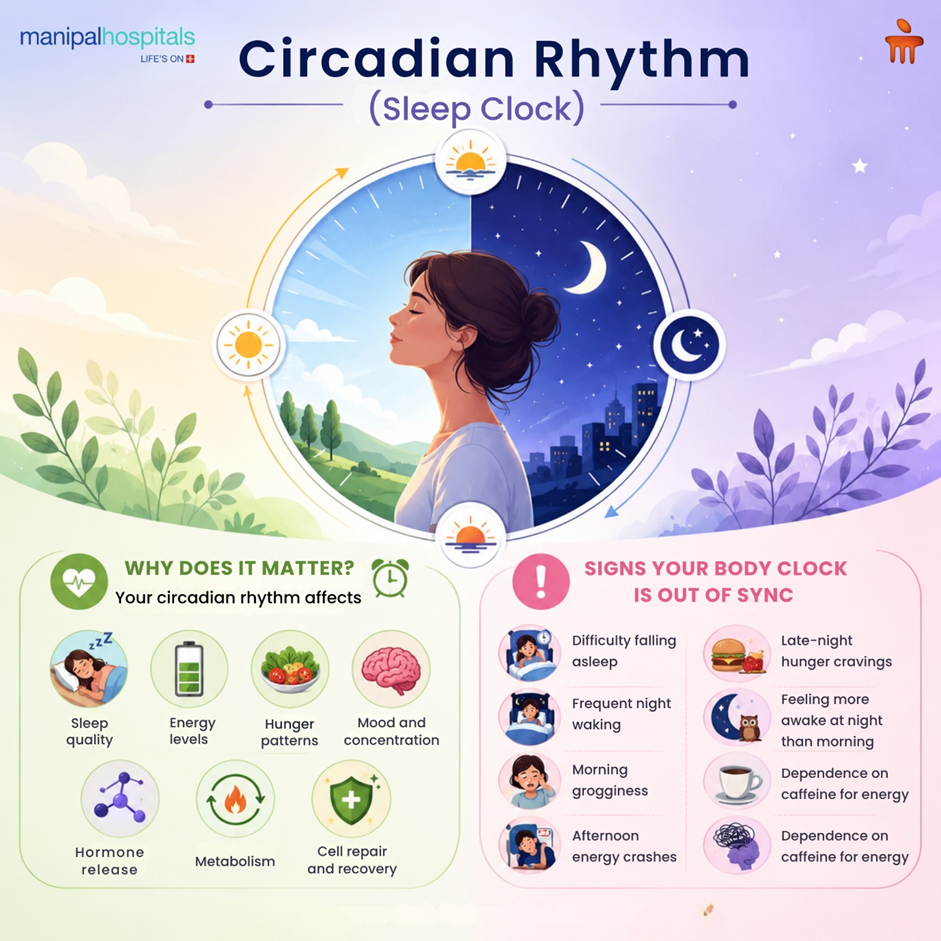
That conductor is your circadian rhythm, the internal 24-hour clock that orchestrates nearly every biological process, from when you feel alert to when your cells repair themselves. When it runs smoothly, you wake naturally, feel hungry at predictable times, and slip into deep sleep with ease. When it is thrown off, the effects ripple far beyond a few tired mornings.
Understanding the mechanisms behind your circadian rhythms is the first step toward improving sleep quality, restoring energy levels, and supporting long-term neurological health. Specialists at the best neurology hospital in Doddaballapur often evaluate sleep-wake disturbances to identify underlying neurological or lifestyle-related factors that may be affecting overall well-being.
What is a circadian rhythm?
The circadian rhythm is a natural, internal process that follows a 24-hour cycle. The term comes from the Latin words "circa" (around) and "diem" (day), describing the daily physical, mental, and behavioral changes that respond primarily to light and darkness.
While it is most visible in our sleep-wake patterns, this internal clock regulates several essential biological processes:
-
Hormone Release: It controls the timing of cortisol (which promotes alertness in the morning) and melatonin (which signals the body to prepare for sleep at night).
-
Body Temperature: Core temperature peaks in the late afternoon and drops to its lowest point in the early morning.
-
Metabolism and Digestion: Metabolic rates and digestive enzymes fluctuate based on the time of day, preparing the body to process food during waking hours.
-
Cell Repair: Essential maintenance, including DNA repair and cell regeneration, occurs primarily during specific phases of rest.
How the Biological Clock Works: The Master Clock and Its Messengers
The phrases "biological clock" and "circadian rhythms" are sometimes used interchangeably, but it is helpful to separate the machinery from the rhythms it creates. The central “biological clock” resides in a tiny cluster of neurons in the brain called the suprachiasmatic nucleus (SCN), located in the hypothalamus just above the optic chiasm. The SCN contains around 20,000 cells, each capable of generating its own near-24-hour rhythm. Together, they form a synchronised pacemaker that acts as the body’s master timekeeper.
Left in complete darkness, most humans exhibit a cycle slightly longer than 24 hours, typically around 24.2 hours. Without daily correction, the rhythm would drift, delaying sleep onset a little more each day. That daily resetting is where environmental cues, called zeitgebers (time-givers), are important.
Circadian Rhythm Is Controlled by Light, Genes, and Lifestyle Cues
The circadian rhythm is controlled by light. When light, especially blue-wavelength light, hits specialised cells in the retina, signals travel directly to the SCN, telling it that it is daytime. This light input suppresses melatonin production and raises cortisol, promoting alertness. As evening falls and light dims, the pineal gland releases melatonin, body temperature drops, and sleep-readiness builds.
Yet circadian rhythm is controlled by more than light alone. A set of “clock genes” (including CLOCK, BMAL1, PER, and CRY) drive the molecular machinery inside every cell. These genes produce proteins that accumulate over roughly 24 hours and then degrade, creating an auto-regulatory feedback loop that constitutes the biological tick. Variations in these genes can make some people naturally morning larks while others are night owls.
Other zeitgebers fine-tune the rhythm:
-
Meal timing: The liver and gut clocks respond strongly to when you eat. Consistently eating late at night can shift peripheral clocks out of sync with the brain clock.
-
Physical activity: Exercise at consistent times reinforces muscular and metabolic rhythms, while late-night intense workouts can delay melatonin onset.
-
Social interaction and routine: Regular sleep-wake schedules, even on weekends, stabilise the SCN.
When these cues are aligned, the circadian rhythm hums in harmony. When they conflict, such as exposure to bright screens at midnight while the brain expects darkness, the rhythm begins to fracture.
When the Rhythm Breaks: Circadian Rhythm Disruption
Modern life is not kind to our internal clocks. Circadian rhythm disruption occurs when there is a mismatch between the internal biological clock and the external environment. This misalignment can be acute, like a single night of shift work, or chronic, like years of staying up late and sleeping in on weekends.
Common causes of circadian rhythm disruption include:
-
Shift work or rotating schedules
-
Frequent travel across time zones (jet lag)
-
Inconsistent sleep-wake timings
-
Excessive screen time before bed
-
Lack of morning light exposure
-
Ageing, as the SCN naturally loses some precision
When the rhythm is disrupted, you may not only feel tired. Over time, circadian rhythm disruption has been linked to an increased risk of metabolic disorders like obesity and type 2 diabetes; cardiovascular problems; mood disorders, including depression and anxiety; digestive issues; and impaired immune function.
Signs That Your Circadian Rhythm May Be Out of Sync
Sometimes the symptoms are subtle, and you may have blamed them on stress or a busy schedule. Watch for these indicators that your circadian rhythm needs attention:
-
Difficulty falling asleep at a reasonable hour
-
Waking frequently during the night
-
Severe morning grogginess that lasts for hours
-
Energy crashes at unusual times of day
-
Craving junk food late at night
-
Feeling more alert in the evening than in the morning
-
Digestive complaints like bloating or irregular bowel movements
-
Relying on caffeine or sleeping pills to function
If several of these sound familiar, your biological clock might be out of tune. The good news is that the clock can be reset.
How to Fix Circadian Rhythm: Practical, Evidence-Based Steps
Adjusting a biological clock takes time; your body cannot reset its schedule instantly. If your sleep patterns are out of alignment, you can use specific daily habits to prompt your internal clock to shift back into place.
-
Keep your wake-up time consistent - Wake up at the same hour every day, even on weekends. This regularity provides your body with a reliable daily anchor point. Sleeping in on days off often delays your clock, making the following week more difficult to start.
-
Get daylight early in the day. Spend 15 to 20 minutes outside in natural sunlight within half an hour of waking up. If you must wake up before sunrise or lack access to natural light, using a 10,000-lux light therapy box can provide a similar biological signal.
-
Dim your environment in the evening. Two hours before you plan to sleep, turn off bright overhead lights and use low-wattage lamps instead. It is also practical to limit screen use or wear blue-light-blocking lenses during this period to avoid suppressing sleep hormones.
-
Eat meals at regular intervals. Having breakfast shortly after rising and finishing your final meal at least three hours before sleeping stabilises the metabolic clocks in your digestive organs, which coordinate closely with your brain.
-
Watch the timing of your workouts. Physical activity in the morning or afternoon reinforces daytime alertness. Try to complete intense exercise at least two hours before you intend to sleep so your heart rate and core temperature can normalise.
-
Build a winding-down routine. Reading a physical book, light stretching, or taking a warm bath can signal to your system that it is time to rest. The natural drop in body temperature that occurs after a warm bath helps induce drowsiness.
-
Be mindful of caffeine and alcohol. Consuming caffeine after 2:00 PM interferes with the chemicals that make you feel tired. While alcohol might cause initial drowsiness, it tends to disrupt and fragment your sleep patterns later in the night.
-
Keep your bedroom cool. Your core temperature needs to drop slightly to initiate sleep. Setting your room temperature between 18°C and 22°C assists this natural process.
Conclusion
Your body functions best when your daily habits align with the natural rhythms of day and night. If persistent fatigue or sleep disturbances are affecting your quality of life, making simple adjustments to your sleep environment and routine is often the first step toward improvement. However, if symptoms continue despite these changes, seeking expert medical evaluation is important. At Manipal Hospital Doddaballapur, the best nephrology hospital in Doddaballapur, Bangalore, patients have access to comprehensive care and specialist consultations to identify underlying health concerns and develop personalised treatment plans that support overall well-being.
Frequently Asked Questions
Caffeine blocks adenosine, the chemical that builds up in your brain throughout the day to create sleep pressure. While it does not change your clock genes directly, it masks your fatigue and delays the time you feel tired, which can push your entire sleep cycle later. It is best to avoid caffeine for at least 8 to 10 hours before bed.
Not in a way that helps your rhythm. Sleeping late on Saturday and Sunday creates a shift that confuses the master clock in your brain. This makes waking up early on Monday morning significantly harder. Keeping a steady schedule all week is far more effective than trying to compensate on your days off.
Melatonin works as a biological signal to tell your brain that it is nighttime, rather than acting as a direct sedative. It can be useful for overcoming jet lag or correcting a shifted schedule, but it is best used as a temporary tool under a doctor's guidance rather than a long-term solution for poor sleep habits.
Yes, it naturally shifts over time. Older adults frequently experience an advanced sleep phase, meaning they naturally feel tired earlier in the evening and wake up earlier in the morning. Recognising this shift can help you adjust your daily routines without feeling like something is wrong.
For most individuals, sticking to a strict light and sleep schedule for two to three weeks is long enough to see a clear improvement. Your internal systems need this time to stabilise and coordinate with your new habits.
Share this Article


Recent Blogs

Cracking Sound in Joints: Causes, Warning Signs, and When to Seek Treatment
26 Jun 20267 Min Read
It happens when you stand up after sitting for a while, when you reach down to pick something up, or when you simply roll your shoulders after a long day at the desk. A sudden pop, snap, or crackle that makes you pause. For a moment, you wonder if something just went wrong inside your body. Joints make noise and almost everyone hears a cracking sound in joints at some point in life. For most people, the sound is harmless, but the mind often races to worst-case scenarios: arthritis, worn bones, or a torn ligament. The truth is more nuanced. While many joint sounds are just part of moving through the world, some deserve closer attention. This blog discusses clinical insights from experts from a top orthopaedic hospital in Doddaballapur, Bengaluru, that help you understand the common reasons for cracking sounds in joints, and most importantly, when it is time to seek help.
Read NowSevere Period Pain or Dysmenorrhea? Understanding Menstrual Cramps and When to Seek Help
26 Jun 20267 Min Read
For a significant number of women and individuals who menstruate, the monthly cycle brings more than just mild discomfort. While society frequently normalizes menstrual cramps as an annoying but expected part of life, there is a clear distinction between manageable lower abdominal aches and pain that completely disrupts your ability to function. When pelvic pain forces you to miss work, skip school, or remain bedridden for days at a time, it ceases to be a routine inconvenience. It becomes a clinical concern. Defined as painful menstrual cramps of sufficient severity to interfere with daily activities, dysmenorrhea is one of the most common gynaecological complaints worldwide, yet it remains widely normalised and undertreated. Through this blog experts from a top obstetrics and gynaecology hospital in Dodddaballapur help you understand what dysmenorrhea is, recognizing the dysmenorrhea symptoms that go beyond typical discomfort, and exploring the full spectrum of treatment can transform the way you experience your cycle.
Read NowUnderstanding How Circadian Rhythms Govern Sleep and Health
26 Jun 20267 Min Read
You go to bed exhausted, yet your mind stays wide awake. You drag yourself through the afternoon with a heaviness that coffee cannot lift. Perhaps your work schedule has shifted, or you spent one too many nights scrolling, and now your body feels like it belongs to a different time zone altogether. It is easy to blame stress, age, or a bad mattress, but often the real culprit is an invisible conductor inside you that has lost its rhythm. That conductor is your circadian rhythm, the internal 24-hour clock that orchestrates nearly every biological process, from when you feel alert to when your cells repair themselves. When it runs smoothly, you wake naturally, feel hungry at predictable times, and slip into deep sleep with ease. When it is thrown off, the effects ripple far beyond a few tired mornings. Understanding the mechanisms behind your circadian rhythms is the first step toward improving sleep quality, restoring energy levels, and supporting long-term neurological health. Specialists at the best neurology hospital in Doddaballapur often evaluate sleep-wake disturbances to identify underlying neurological or lifestyle-related factors that may be affecting overall well-being.
Read NowUnderstanding the Dialysis Process: A Patient’s Guide to Kidney Care and Management
26 Jun 20268 Min Read
When the kidneys begin to lose their ability to filter waste, excess fluid, and toxins from the blood, the effects can build up quietly at first and then become increasingly difficult to ignore. Fatigue, swelling, breathlessness, nausea, poor appetite, and changes in urine output may all signal that the kidneys are no longer doing enough of their job. In some situations, medicines and lifestyle changes help slow the problem. In more advanced kidney disease, however, dialysis becomes an important treatment option. Many people hear the word "dialysis" and immediately think of a major life disruption. While it does require planning and commitment, it is also a life-sustaining treatment that helps people feel better and stay medically stable when kidney function is severely reduced. Understanding the dialysis process can reduce fear and make it easier to prepare for treatment. This blog, by nephrology experts from a leading hospital for dialysis in Doddaballapur, breaks down how the procedure works, clarifies the differences between haemodialysis vs peritoneal dialysis, outlines potential dialysis side effects, and prepares you for what to expect during your care journey.
Read NowWhat Is Gastric Sleeve Surgery? Understanding the Operation, Recovery, and Long-Term Results
26 Jun 20267 Min Read
Managing severe, long-term obesity is often a complex and frustrating reality. For many individuals, traditional methods like calorie-restrictive diets, intensive exercise plans, and behavioural changes offer limited or temporary success. When weight-related health conditions, such as type 2 diabetes, severe sleep apnea, or cardiovascular disease, begin to compromise longevity and daily well-being, lifestyle adjustments alone may no longer be sufficient. In these circumstances, metabolic and bariatric interventions offer a highly effective, evidence-based path forward to reclaim metabolic health. Among these surgical options, gastric sleeve surgery has become one of the most frequently performed and widely accepted choices worldwide. It provides a structured, physiological approach to weight reduction that addresses both the physical capacity of the stomach and the hormonal signals that govern hunger. Understanding the procedural mechanics, expected health benefits, potential medical challenges, and the realities of life after the procedure can help individuals approach this medical turning point with clarity and confidence. This blog from a top gastroenterology hospital in Doddaballapur, Bengaluru walks you through the entire journey: from what a gastric sleeve operation is and how it works, to the benefits you can realistically expect.
Read NowHeat Exhaustion and Heat Stroke: Signs, Differences, and What to Do
29 May 20268 Min Read
Hot weather can affect your body a lot quicker than you can expect, and cases of heat-related illness go up during the summer months. Heat exhaustion and heat stroke are related, but they have plenty of differences. Heat exhaustion starts when your body loses too much water and salt through sweating. Heat stroke happens when your body stops controlling its temperature, and that can turn serious very fast. Many people mix up the two because the early signs can feel similar. That confusion often delays the right care. Both problems come from staying in the heat for too long and not drinking enough fluids. If you catch the early signs, the condition can be managed. If it progresses, it needs urgent medical care. This blog features expert insights from experienced physicians in Doddaballapur, Bangalore, to help you understand the difference between heat exhaustion and heat stroke, recognise early warning signs, and know when to seek medical attention.
Read NowTonsillectomy: When It’s Needed, How It’s Done, and What Recovery Feels Like
29 May 20267 Min Read
Most of us don't think about our tonsils until they start causing trouble. Located at the back of the throat, these two small pads of tissue are part of the body’s immune system. However, for some, they become more of a liability than a defence. You might find yourself in a cycle of recurring sore throats, high fevers, and that sharp, localised pain that makes every swallow a challenge. Over time, repeated tonsil infections can start to affect daily life, not just during episodes but in between as well. Doctors look at how often they occur and how severe they are. If the problem continues, tonsillectomy surgery may be considered. The surgery is also recommended if the tonsils become enlarged to a point where the patient has difficulty breathing because of snoring, obstructed airways, or difficulty swallowing. In this blog, we explain when tonsillectomy surgery may be recommended, the symptoms and complications associated with recurring tonsil problems, and what patients can expect before, during, and after the procedure, with expert insights from top ENT specialists in Doddaballapur, Bangalore, so you can make informed decisions about your care.
Read NowAlcoholic Liver Disease Explained: Diet, Care, and Daily Changes
29 May 20267 Min Read
Most people associate alcohol with short-term effects, but the long-term impact on the liver is often overlooked. The liver quietly handles toxins every day, including alcohol, until it simply cannot keep up. That is usually when problems begin to show. Alcoholic liver disease develops over time. It does not appear overnight, and that is what makes it tricky. Early stages may not cause much discomfort, so people continue their routine without realising damage is building. By the time liver cirrhosis symptoms start appearing, the condition may already have advanced. This is why awareness matters. Understanding how the disease progresses, recognising changes in the body, and adjusting early can change outcomes. In this blog, we bring you clinical insights from top gastroenterologists in Doddaballapur, Bangalore, liver cirrhosis stages, available liver cirrhosis treatment options, and how diet and lifestyle actually influence recovery in day-to-day life.
Read NowCan Adenomyosis Be Cured? Symptoms, Treatment & Diet Guide
28 May 20267 Min Read
Many women grow up thinking painful periods are "just part of life." They put up with the pain, change their routines, and keep going. But what if that pain is your body telling you to pay attention? If you've just heard about the condition of "adenomyosis," the first thing that comes to mind is, "Can it be cured?" The honest answer is that it depends. But the most important thing is that it can be handled. But there is no denying that many women are relieved to receive proper treatment. This blog features expert insights from experienced obstetrics and gynaecology experts in Doddaballapur, Bangalore, who understand the signs and symptoms and the corresponding treatment. It will help you understand the relationship between diet, behaviour, and proper medication, which can help you maintain good health by following the adenomyosis diet plan near Doddaballapur.
Read NowWeight Loss Diet Plan for Beginners: Foods, Easy Tips & Workout Guide
28 May 20268 Min Read
Have you ever tried to lose weight and found yourself overwhelmed by conflicting advice like “eat less", “cut carbs", or “avoid certain foods”? If so, you’re not alone. Many people start with motivation but lose track when the approach doesn’t fit their daily routine. Successful weight loss is not about extreme restrictions. It is about building a routine that fits your daily life and can be sustained over time. Healthy eating plans are different from fad diets because they help you maintain results over time. Crash diets might help you lose weight fast, but they usually leave you feeling tired and hungry, and the weight often comes back. If you're new to dieting, this blog offers you practical guidance and useful diet tips from top gastroenterology doctors in Doddaballapur, Bangalore. It will show you how to build a routine using foods you already eat, including weight loss foods that are easy to find in Doddaballapur.
Read Now