


What Is An Electroencephalogram (EEG)? Procedure, Uses & Results
Reviewed by: Manipal Hospitals
Posted on
8 Min Read

Not sure what you’re looking for?
Get in touch with our representatives for help!
Contact UsHave you ever wondered how doctors can “see” what’s happening inside your brain without any surgery? If you have been advised by your doctor to undergo an electroencephalogram, it is natural to feel a bit unsure or curious about what the test involves. An EEG is simply a test that records the brain’s electrical activity. Small sensors are placed on the scalp to pick up these signals, helping doctors understand how the brain is working.
This blog will walk you through the EEG test procedure, the reasons why it may be recommended, and how to understand your EEG test results.
What Is an EEG Test
An EEG test is used to record the brain’s electrical activity produced by brain cells. During the test, electrodes are placed on the scalp to record this activity.
Your brain continues to function all the time, even when you sleep. This information can reveal a lot to physicians about the condition of your brain. Getting to know more about the EEG procedure can make you feel better about taking the test.
An interesting fact is that your brain has billions of neurons that keep firing every second, and an electroencephalogram records these signals in real time.
Why Is an Electroencephalogram Done
There are several reasons why doctors might order an EEG. Some patients only realise they need an EEG after experiencing unexplained fainting episodes. It is important in the diagnosis and monitoring of neurological diseases.
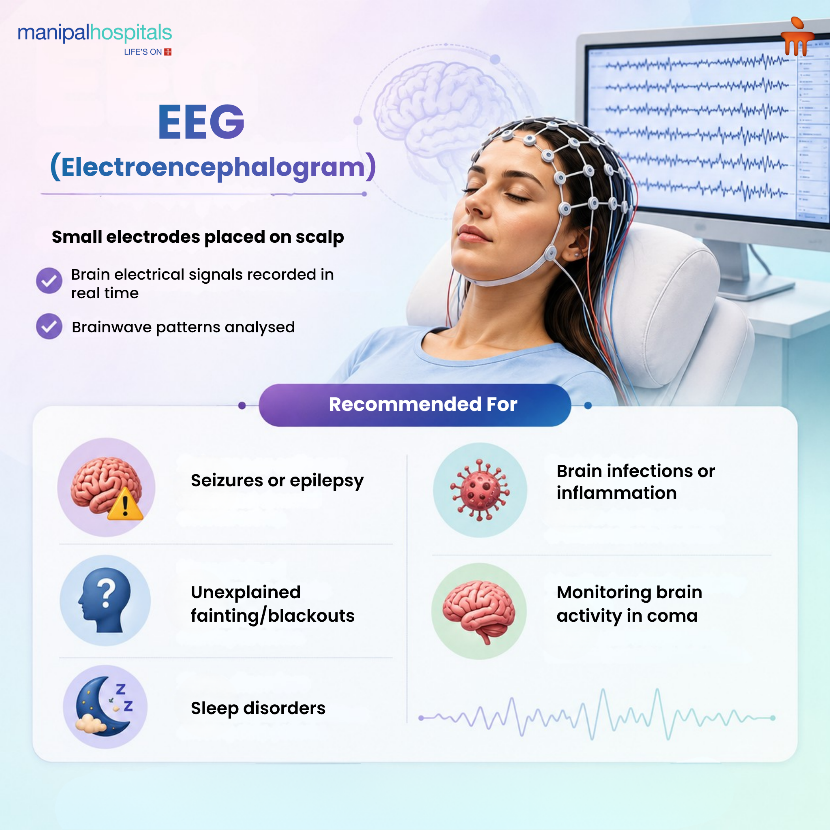
Common reasons include:
-
Seizures and epilepsy: an evaluation
-
Assessing unexplained fainting or blackouts
-
Diagnosing sleep disorders
-
Monitoring brain function in coma
-
Helping evaluate brain infections or inflammation
In many instances, EEG monitoring can provide essential information that other scans cannot. Patients with unexplained fainting may undergo an EEG to rule out seizure-related causes.
When Do You Need EEG Monitoring
Now that we understand what the test is, it also helps to know when doctors may recommend it.
An EEG is usually not used on its own and is interpreted along with clinical findings and imaging tests. Continuous or repeated EEG monitoring may be advised in situations such as:
-
When seizures are frequent or not clearly understood
-
To observe brain activity over a longer period
-
When symptoms come and go and need closer monitoring
-
When there is a concern about sleep-related disorders
EEG monitoring helps identify patterns over time, which will give physicians a better idea than one-time testing. If you are experiencing such symptoms, consult the best neurologists at Old Airport Road for timely evaluation and accurate EEG diagnosis.
What Happens During the EEG Procedure
But don’t worry if you’re nervous – the procedure is simple and painless.
Step-by-step process:
You will be told to lie down and relax while tiny electrodes are attached to your head. It is a painless procedure that only lasts an hour.
Let’s learn about the procedure in easy terms:
Step 1: Preparation
The scalp is cleaned, and electrodes are placed; this ensures clear signals for accurate brain recording.
Step 2: Recording
Brain activity is recorded while resting; it captures natural brainwave patterns in a calm state.
Step 3: Stimulation
You may be asked to breathe deeply or see flashing lights, which may reveal patterns not seen while resting.
Step 4: Completion
Electrodes are removed, and no recovery time is needed; you can return to normal activities immediately.
The whole test generally lasts 30 to 60 minutes. If you know what an EEG test is beforehand, it’s much less stressful.
Types of EEG Tests
EEG tests are not all the same. Depending on your symptoms, your doctor may recommend the following:
|
EEG Type |
What It Involves |
Why It’s Used |
|
Routine EEG |
Short recording (20–30 minutes) in the clinic |
Detects general brainwave patterns, screens for seizures |
|
Sleep EEG |
Done while you sleep or after sleep deprivation |
Reveals abnormalities that appear only during sleep |
|
Video EEG |
Continuous EEG with video monitoring |
Links electrical activity to visible events like seizures |
|
Ambulatory EEG |
Portable device worn at home for 1–3 days |
Captures brain activity during daily routines |
Each type provides different information on brain function.
Understanding EEG Test Results
Once the test is done, your doctor will look closely at the results. An EEG can show:
-
Normal brainwave patterns: It means your brain’s electrical activity looks healthy.
-
Abnormal activity: It means some signals look different from what is expected.
-
Seizure patterns: They help to show if seizures are happening in one area or across the whole brain.
-
Brain function changes: Could be related to things like injury, sleep, or other health conditions.
EEG is a common technique used for diagnosing various disorders in patients. Your physician will review these findings, together with other factors, including your condition and your past medical history.
What Do Abnormal EEG Results Mean
An EEG measures the brain’s electrical activity. If the results are called “abnormal,” it just means the brain waves look different from the usual pattern. This does not always mean something serious; it simply gives doctors a clue.
Abnormal EEGs may be linked to:
-
Epilepsy: irregular bursts of brain activity that can lead to seizures.
-
Traumatic brain injury: changes in brain signals that happen after a head injury.
-
Brain infections: swelling or irritation that affects brain waves.
-
Sleep disorders: unusual patterns that show up during sleep cycles.
-
Tumours: Brain tumours may sometimes affect electrical activity, although imaging tests are usually needed to detect them.
Doctors do not rely on EEG results alone. A normal EEG does not always rule out neurological conditions like epilepsy. They look at your symptoms, medical history, and other tests to get a full understanding. An EEG is just one part of the overall picture.
Is EEG Safe
Yes, an EEG (electroencephalogram) is one of the safest tests available. It does not use radiation or needles, and it does not cause any pain. Small sensors are simply placed on your scalp to record brain activity. The test is non-invasive, comfortable, and safe for people of all ages. Even if you need to have EEGs more than once, they remain completely safe, so it is a reliable way to monitor your brain health over time.
How Should You Prepare for an EEG Test
Many people feel nervous before the test, but most are surprised by how simple it actually is. Adequate preparation contributes to increasing the accuracy of your EEG test results.
-
Wash your hair before the test
-
Avoid caffeine before the procedure
-
Follow sleep instructions if required
-
Inform your doctor about medications
When you know what an EEG test is and how to prepare for it, the process becomes smooth.
Post-test procedures:
Once the procedure is over, the following will occur:
-
You can resume your normal routine immediately.
-
Your doctor will review your EEG test reports and discuss what to do next if needed.
-
If the results show unusual brain activity, further evaluation or management may be advised.
Conclusion
The EEG procedure is easy and effective in helping your doctor get insight into how your brain functions and potential issues you may have. Interpreting the findings from an EEG test will help determine the next step for you. For those considering an EEG test in Old Airport Road, it is important to choose a centre with proper equipment and experienced specialists. At Manipal Hospital Old Airport Road, Bangalore, EEG testing is carried out with advanced technology, experienced neurologists, and careful interpretation of results.electroencephalogram (4), EEG monitoring (5), EEG test results (4), abnormal EEG results (1), EEG test in Old Airport Road
Frequently Asked Questions
No. The EEG test is absolutely painless. Electrodes are attached to your scalp to record the activity of your brain. You may only notice mild discomfort while the electrodes are attached.
It can last from 30 minutes to several days, depending on the type. This allows the doctors to record patterns of brain activity over time and accurately diagnose.
No. The EEG mostly picks up abnormalities in the electrical activity. It’s good for the brain and seizures, but it can’t find structural problems like tumours unless you have imaging tests.
Are EEG tests safe for children? Yes. They are routinely used to diagnose seizures, developmental problems, and sleep disorders in children and carry no risk.
A normal EEG indicates that your brain’s activity is normal. However, if you still have symptoms, you might need additional testing, because an EEG cannot detect all disorders.
Share this Article


Recent Blogs

dummy blog data
26 Sept 20260 Min Read
Dr. Himanshu Shukla is a distinguished surgical oncologist with over 15 years of experience. He is renowned for his surgical techniques and dedicated commitment to delivering cancer care to the highest standards. His expertise spans the treatment of cancers in the head and neck, breast, thoracic, gastrointestinal.
Read NowTest 3: Bulging Disc Symptoms and Treatment: What You Need to Know
02 Sept 20262 Min Read
When to Seek Medical Help? Many cases of minor spinal strain improve with basic posture corrections, rest, and short-term activity modifications. However, you should arrange a consultation with a spine specialist if your symptoms do not change after a few weeks or if they steadily interfere with your basic daily movements. You should seek prompt clinical evaluation if your spinal symptoms include: Pain that continuously wakes you up in the middle of the night Progressive weakness in your leg or foot, making it difficult to lift your toes when walking Sharp, electric pain that radiates past your knee down into your foot Any sudden numbness in your groin or saddle area
Read NowBest Home Remedies for Cough and Cold During Monsoon
22 Jul 20266 Min Read
The arrival of the monsoon brings welcome relief from the summer heat, but it also creates the perfect environment for viral infections that cause coughs, colds, sore throats, and nasal congestion. Increased humidity, fluctuating temperatures, and exposure to rain can weaken the body's natural defence mechanisms, making respiratory infections more common during this season. While most colds are mild and resolve within a week, they can cause significant discomfort and interfere with daily activities. Fortunately, several simple home remedies can help relieve symptoms, support recovery, and keep you comfortable. However, it is equally important to recognise when medical attention is necessary, especially if symptoms persist or worsen. In this blog, we explore some of the most effective home remedies for cold and cough, along with tips to ease nasal congestion and soothe a sore throat during the monsoon.
Read NowSubserosal Uterine Fibroid Treatment Options: From Laser Therapy to Natural Remedies
13 Jul 20266 Min Read
Uterine fibroids are among the most common non-cancerous growths affecting women during their reproductive years. While some fibroids remain small and symptom-free, others can cause discomfort, pain, and impact quality of life. One particular type, known as a subserosal fibroid, develops on the outer surface of the uterus and can grow outward into the pelvic cavity. The good news is that several effective treatment options are available today, ranging from careful monitoring and lifestyle modifications to advanced minimally invasive procedures. Understanding the available subserosal uterine fibroid treatment options can help women make informed decisions about their health and seek timely medical care when needed.
Read NowWhat is Ovarian Cancer? Symptoms, Risk Factors & Diagnosis
13 Jul 20268 Min Read
Ovarian cancer is one of the most common gynaecological cancers affecting women worldwide. It develops when abnormal cells in the ovaries begin to grow uncontrollably, forming a tumour that can spread to nearby tissues and other parts of the body if left untreated. Although ovarian cancer can occur at any age, it is more frequently diagnosed in women after menopause.
Read NowWhat Causes High Triglycerides and How to Manage Them Effectively
26 Jun 20267 Min Read
When discussing heart health, most people are familiar with cholesterol. However, another important factor that often goes unnoticed is triglycerides. These are a type of fat found in the blood that the body uses as a source of energy. While triglycerides are essential for normal functioning, having high levels can increase the risk of cardiovascular diseases, stroke, and pancreatitis. The challenge with high triglycerides is that they rarely cause obvious symptoms in the early stages. Many individuals discover the condition only during routine blood tests. With changing lifestyles, sedentary habits, increased consumption of processed foods, and rising rates of obesity and diabetes, elevated triglycerides have become increasingly common. Understanding what causes high triglycerides and learning how to manage them effectively can help reduce long-term health risks and improve overall well-being.
Read NowUnderstanding PMOS Weight Gain and Practical Treatment Approaches
03 Jun 20268 Min Read
Many women find themselves trapped in a frustrating cycle: they eat mindfully and work out regularly, and yet the numbers on the scale refuse to budge, or worse, they keep climbing. It can feel like your body is actively working against you. If this scenario sounds familiar, it is crucial to know that this isn't a failure of willpower or a matter of "trying harder." Medical science has evolved to recognize that what was long called Polycystic Ovary Syndrome (PCOS) is actually a much broader, systemic condition now officially classified as Polyendocrine Metabolic Ovarian Syndrome (PMOS). Globally, PMOS affects 1 in 8 women, amounting to over 170 million individuals. Yet, because the old name focused narrowly on the ovaries, up to 70% of individuals remain undiagnosed. PMOS alters your body's hormonal and metabolic environment, making it incredibly easy to store fat and significantly harder to lose it. The condition frequently manifests as stubborn weight gain concentrated around the abdomen, often referred to as "PMOS belly." To manage this condition effectively, we need to understand its underlying causes. This blog explains the reasons behind weight gain in PMOS, its consequences, and medically sound advice on achieving weight loss with PMOS.
Read NowUnderstanding Urinary Tract Infection (UTI): Everything Patients Should Know
01 Jun 20267 Min Read
A burning feeling while urinating, needing to use the toilet more often, or discomfort in the lower abdomen are symptoms many people tend to ignore at first. However, these can sometimes point to a urinary tract infection (UTI), one of the most common infections affecting the urinary system. If left untreated, it can affect the bladder, urethra, or even the kidneys. Knowing what causes UTIs and understanding UTI symptoms and when to get care can make a huge difference in recovery. Through this blog, we will help you learn about urinary tract infections, what they are, what causes them, what they feel like, and what effective UTI treatment looks like in real life.
Read NowWhat Is An Electroencephalogram (EEG)? Procedure, Uses & Results
01 Jun 20268 Min Read
Have you ever wondered how doctors can “see” what’s happening inside your brain without any surgery? If you have been advised by your doctor to undergo an electroencephalogram, it is natural to feel a bit unsure or curious about what the test involves. An EEG is simply a test that records the brain’s electrical activity. Small sensors are placed on the scalp to pick up these signals, helping doctors understand how the brain is working. This blog will walk you through the EEG test procedure, the reasons why it may be recommended, and how to understand your EEG test results.
Read NowWhat Is a TMT Test? Procedure, Benefits & Results Explained
27 May 20268 Min Read
Most people assume that if the heart feels fine at rest, it must be healthy overall. But some heart problems only show up when the body is under strain, otherwise lying dormant and undetected while your body is at rest. That’s why doctors use a heart stress test to understand how the heart works during activity. If you’ve been advised to take a treadmill test, it’s natural to wonder what it measures and why it matters. Understanding what is TMT test is can help clear that doubt. It’s not just a routine test but a way to spot early signs of heart-related issues. In this blog, we’ll walk through how the test works, what to expect during the procedure, how results are interpreted, and what is considered a TMT test normal range.
Read Now