


Living With Bipolar Disorder: Recognising The Signs and Finding The Right Treatment
Reviewed by: Dr. Poonam Santhosh
Posted on
6 Min Read

Not sure what you’re looking for?
Get in touch with our representatives for help!
Contact UsBipolar disorder is a severe mental illness that causes radical shifts in mood from euphoric highs (mania or hypomania) that last for days to a state of deep, prolonged lows (depression) that lasts for weeks. According to the World Health Organisation, an estimated 40 million people live with bipolar disorder; however, misdiagnosis or lack of treatment coverage is a major hurdle for effectively managing this disease. 1, 2 As a result, this can impact an individual’s psychosocial functioning, with impairments in work, family, and social relationships. In this blog post, we will explore what bipolar disorder is, its causes, symptoms, and treatments of bipolar disorder to help you recognise and manage this condition effectively.
What Is Bipolar Disorder?
Bipolar disorder, formerly known as manic depression, is a chronic mental health condition that causes unpredictable changes in an individual's mood, behaviour, activity, concentration, and energy levels, significantly disrupting everyday life. Many people with bipolar disorder also have other mental illnesses, such as anxiety disorders, substance abuse, eating disorders, or psychosis.
Bipolar disorder can affect anyone, but the average age of onset is 25 years. Some types of bipolar disorder can also occur in children. In women, there is a rapid tendency for mood changes and depression development.
Types of Bipolar Disorder
Bipolar Disorder I
An individual who has had one or more manic episodes (an abnormally elevated mood) in their life that last for more than a week, or whose symptoms are so severe that they need hospitalisation. The depressive episodes (low mood) last for more than two weeks. There is also a tendency to develop hallucinations or delusions.
Bipolar Disorder II
Defined by at least one hypomanic episode (a milder form of mania) that does not significantly disrupt daily functioning, along with episodes of chronic depression, which tend to be more severe than in bipolar I.
Cyclothymia (cyclothymic disorder)
These individuals experience chronic, unstable moods. Hypomania and depression last for at least two years, but there can be brief periods of normal mood (euthymia) that last for less than 8 weeks, or the symptoms may not be intense enough to qualify as type I or II bipolar disorder.
What Are the Symptoms of Bipolar Mood Disorder?
Most people with bipolar disorder experience both manic/hypomanic and depressive episodes, but the frequency and pattern of mood shifts vary.
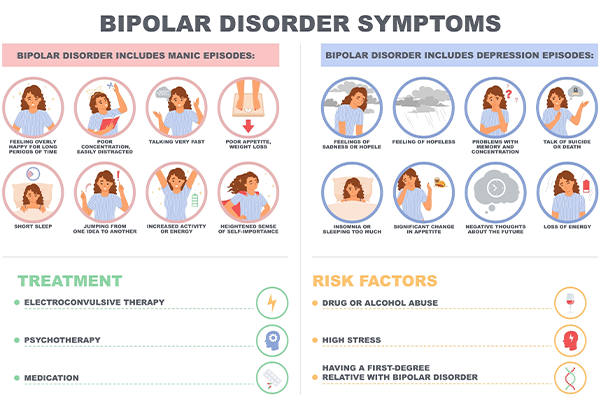
Symptoms of a manic episode:
-
Elevated mood or irritability.
-
Increased activity and energy.
-
Reduced need for sleep.
-
Racing thoughts and rapid speech.
-
Overconfidence or feeling powerful.
-
Engages in risky activities like excessive spending and substance abuse.
Hypomanic Symptoms: Hypomanic episodes are similar but less severe than manic episodes. The individual may feel more productive and energetic but still function normally in daily life. However, if left untreated, hypomania can progress to more severe mania or depression.
Symptoms of a depressive episode.
-
Persistent feelings of sadness or anxiety.
-
Restlessness and irritability.
-
Difficulty concentrating or making decisions.
-
Trouble sleeping or oversleeping.
-
Loss of interest in activities.
-
Fatigue and inability to complete simple tasks.
-
Feelings of hopelessness and thoughts of death or suicide.
In a mixed episode, symptoms of mania and depression occur simultaneously. For example, an individual may feel deeply sad but also energised and restless, which increases the risk of suicide.
What Causes Bipolar Disorder?
Bipolar disorder is complex, and its exact causes are not fully understood, but several factors may contribute to its development:
1. Brain Structure and Function: Research shows that individuals with bipolar disorder may have differences in brain structure and activity compared to those without the condition. These changes can affect how moods are regulated.
2. Genetic Factors: Bipolar disorder often runs in families. Individuals with a close relative (such as a parent or sibling) who has the disorder are at a higher risk.
How to Treat Bipolar Disorder?
Bipolar disorder is a chronic illness, and an effective treatment involves a combination of Medication and Psychotherapy for life.
-
Medication: Mood stabilisers and atypical antipsychotics are often prescribed to stabilise the mood and reduce the intensity of the bipolar symptoms.
-
Psychotherapy (Talk Therapy): Cognitive Behavioural Therapy, Interpersonal and Social Rhythm Therapy, and Family-focused Therapy may be employed to identify and change troubling emotions, thoughts, and behaviours.
Other approaches
-
Electroconvulsive Therapy: A brain stimulation procedure that helps relieve severe symptoms of bipolar disorder.
-
Repetitive Transcranial Magnetic Stimulation (rTMS): It uses magnetic waves to stimulate the brain and relieve symptoms of depression.
-
Light Therapy: This evidence-based method is used to address the seasonal worsening of bipolar disorder.
Conclusion
Bipolar disorder can cause significant difficulties and disruptions in many areas of an individual’s life. Due to the discrimination and stigma surrounding the condition, the treatment coverage for bipolar disorder is low. Since it is the leading cause of disability, understanding what bipolar disorder is and how to cure bipolar disorder is crucial for early diagnosis and timely intervention. If you or your loved one is dealing with bipolar disorder, seek timely and confidential care at KMC Hospitals Psychiatry department, Mangaluru. Book a consultation with an expert today!
Frequently Asked Questions
Currently, the diagnosis of bipolar disorder is based on the patient’s symptoms, course of illness, or family history. The types of bipolar disorder are diagnosed by the pattern and severity of manic and depressive episodes.
Lack of sleep and inconsistent routine can trigger a mood episode; therefore, adequate rest and a consistent routine are necessary for overall well-being. Avoid indulging in alcohol or non-prescribed medications to keep your mood stable.
Stopping medications when you feel better can lead to a resurgence of mood episodes that were being managed. This leads individuals with bipolar disorder to greater emotional distress.
Treatment of bipolar disorder can help control symptoms and control how often episodes of mania/hypomania and depressive episodes occur. However, this is not a complete cure. Usually, the treatment helps shorten or prevent the occurrence of symptoms.
You can schedule an appointment at Manipal Hospitals by contacting us or visiting our website.
Visit: [https://www.manipalhospitals.com/mangalore/hospitals/]
Contact no: [18001025555]
Share this Article


Recent Blogs

Understanding Open Fractures: Types, Treatment, and What to Expect
29 Jun 20267 Min Read
An open fracture is one of the most urgent injuries an orthopaedic surgeon sees. Unlike a broken bone that stays hidden beneath intact skin, an open fracture breaks through the skin’s protective barrier, leaving the bone exposed to the outside environment. The moment that barrier is lost, the risk shifts from a straightforward bone healing process to one complicated by potential infection, soft tissue damage, and the need for precise surgical reconstruction. While the thought of a bone piercing the skin is frightening, it is important to know that modern orthopedic care has transformed the outlook for these injuries. With early, systematic open fracture management, most patients go on to heal successfully and return to daily life. In this article, expert insights from a top orthopaedic hospital in Mangaluru help you learn about what is an open fracture, the common types, the potential open fracture complications, and what to expect during recovery.
Read NowIs Circumcision Painful? What to Expect Before and After the Procedure
17 Apr 20266 Min Read
Circumcision is a surgical procedure to remove the foreskin, the fold of skin that covers the head (glans) of the penis. While often performed on infants for religious or cultural reasons, it is also a safe and common procedure for adults, typically for medical reasons or personal preference. Modern surgical techniques, coupled with effective pain management, have significantly evolved to prioritise patient comfort, so that you don’t have to wonder: “is circumcision painful?”
Read NowHow to Relieve Nerve Pain in Your Leg: Tips and Treatments That Work
13 Apr 20265 Min Read
Leg nerve pain or neuropathy, often described as a burning sensation, tingling, numbness, or shooting pain, can be debilitating, affecting daily activities and overall quality of life. Conditions like sciatica, peripheral neuropathy, and nerve compression can cause this discomfort, originating from various points along the nerve pathways. While nerve pain can be challenging, studies show that conservative treatments, including physiotherapy and targeted exercises, successfully alleviate symptoms within a few weeks to months, helping individuals reclaim their comfort and mobility.
Read NowHow to Reduce Hyperpigmentation in Skin: Achieve Brighter, Even-Toned Skin
08 Apr 20264 Min Read
Melanin, the natural pigment that gives our skin, hair, and eyes their colour, plays a crucial role in protecting us from the sun's harmful ultraviolet (UV) rays. However, sometimes an overproduction or uneven distribution of melanin can lead to conditions like hyperpigmentation, dark spots, or an overall desire for a more even and brighter skin tone. We understand these concerns and offer expert guidance and advanced treatments to help you achieve your skin goals safely and effectively.
Read Nowಮುಟ್ಟಿನ ಸಮಯದಲ್ಲಿ ಕಡಿಮೆ ರಕ್ತಸ್ರಾವ: ಕಾರಣಗಳು, ಲಕ್ಷಣಗಳು ಮತ್ತು ವೈದ್ಯರನ್ನು ಯಾವಾಗ ಸಂಪರ್ಕಿಸಬೇಕು?
30 Mar 20265 Min Read
ಸಾಮಾನ್ಯಕ್ಕಿಂತ ಹಗುರವಾದ ಮುಟ್ಟು ಯಾವುದೇ ಆಂತರಿಕ ಆರೋಗ್ಯ ಸಮಸ್ಯೆಯ ಸೂಚನೆಯಾಗಿರಬಹುದೇ? ಅನೇಕ ಮಹಿಳೆಯರು ಮುಟ್ಟಿನ ಸಮಯದಲ್ಲಿ ಕಡಿಮೆ ರಕ್ತಸ್ರಾವವನ್ನು ಗಮನಿಸದೆ ಬಿಡುತ್ತಾರೆ, ಆದರೆ ಇದು ಕೆಲವೊಮ್ಮೆ ಹಾರ್ಮೋನಲ್ ಅಥವಾ ಸಂತಾನೋತ್ಪತ್ತಿ ಸಂಬಂಧಿತ ಸಮಸ್ಯೆಗಳ ಸೂಚನೆಯಾಗಿರಬಹುದು. ಹಗುರವಾದ ಮುಟ್ಟು ಯಾವಾಗ ಸಾಮಾನ್ಯವಾಗಿರುತ್ತದೆ ಮತ್ತು ಯಾವಾಗ ವೈದ್ಯರ ಸಲಹೆ ಪಡೆಯಬೇಕು ಎಂಬುದನ್ನು ತಿಳಿದುಕೊಳ್ಳುವುದರಿಂದ ನಿಮ್ಮ ದೀರ್ಘಕಾಲದ ಆರೋಗ್ಯವನ್ನು ಕಾಪಾಡಲು ಸಹಾಯ ಮಾಡುತ್ತದೆ. ಈ ಬ್ಲಾಗ್ ಮುಟ್ಟಿನ ಸಮಯದಲ್ಲಿ ಕಡಿಮೆ ರಕ್ತಸ್ರಾವದ ಕಾರಣಗಳು, ಸಂಬಂಧಿತ ಲಕ್ಷಣಗಳು ಮತ್ತು ವೈದ್ಯರನ್ನು ಯಾವಾಗ ಸಂಪರ್ಕಿಸಬೇಕು ಎಂಬುದನ್ನು ವಿವರಿಸುತ್ತದೆ.
Read NowAntenatal Care During Pregnancy: Complete Checklist for Expecting Mothers
13 Mar 20266 Min Read
As you prepare to welcome a new life, ensuring the best possible health for both you and your baby becomes the utmost priority during pregnancy. This is where comprehensive antenatal care becomes important. Effective antenatal care for mothers is not just about medical check-ups; it is a holistic approach that encompasses physical, emotional, and psychological well-being.
Read NowA Comprehensive Guide to Knee Pain – Causes, Diagnosis, and Advanced Relief & Treatment Options
04 Feb 20266 Min Read
Knee pain is not just a common ailment; it is one of the leading musculoskeletal complaints that can significantly affect a person’s quality of life. For people living with knee pain, a casual walk or climbing a simple flight of stairs becomes a dreaded challenge. Whether you're experiencing a sharp, sudden twinge or a persistent, dull knee ache, remedy is needed to live life pain free. Understanding the complexities of this joint and the causes behind its pain is the crucial first step toward lasting knee pain relief.
Read NowUnderstanding Liver Function Tests: Purpose, Types & Interpretation
17 Oct 20255 Min Read
In India, liver disease has become the 11th leading cause of death, with over 2 million deaths annually, accounting for 4% of all deaths — that is, 1 in every 25 deaths worldwide. The mortality rate due to chronic liver diseases is seeing an upward trend. Diagnosing and treating liver diseases early can help increase survival rates. Thus, liver function tests are the most commonly used laboratory tests to assess the functioning of the liver and its overall health. This test measures various substances produced by the liver, giving insights into liver health, making it crucial to undergo this test periodically. This blog will help you understand what is a liver function test is, why it is done, how the liver test is done, and the interpretation of results.
Read NowLiving With Bipolar Disorder: Recognising The Signs and Finding The Right Treatment
01 Aug 20256 Min Read
Bipolar disorder is a severe mental illness that causes radical shifts in mood from euphoric highs (mania or hypomania) that last for days to a state of deep, prolonged lows (depression) that lasts for weeks. According to the World Health Organisation, an estimated 40 million people live with bipolar disorder; however, misdiagnosis or lack of treatment coverage is a major hurdle for effectively managing this disease. 1, 2 As a result, this can impact an individual’s psychosocial functioning, with impairments in work, family, and social relationships. In this blog post, we will explore what bipolar disorder is, its causes, symptoms, and treatments of bipolar disorder to help you recognise and manage this condition effectively.
Read NowEverything You Should Know About Total Hip Replacement (Arthroplasty) Surgery
01 Aug 20256 Min Read
Total Hip Replacement Surgery (THR surgery) is a standard of care for end-stage hip osteoarthritis, providing patients with pain relief and improved joint function. Total Hip Replacement is widely regarded as one of the most cost-effective planned surgeries, in terms of Quality-Adjusted Life Years (QALYs) gained. Hip Replacement Surgery is one of the most frequent and effective surgeries performed worldwide for hip osteoarthritis. In India, the procedure is set to grow at the highest rate in the world from the period 2020 to 2026.1. The surgery is recommended for hip conditions that are getting worse, not improving with other methods, or causing excessive pain or difficulty in moving. This article helps you understand the benefits and limitations of Total Hip Replacement Surgery.
Read Now