


Angioplasty vs Bypass Surgery: How Your Cardiologist Decides Which Heart Procedure Is Right for You
Reviewed by: Dr. Soumya Kanti Dutta
Posted on
7 Min Read

Not sure what you’re looking for?
Get in touch with our representatives for help!
Contact UsHeart disease is a leading health concern globally, and coronary artery disease (CAD) is one of the most common types of heart disease. While risk of heart disease rises with age, there has been a concerning rate of younger people getting affected by heart disease. Heart disease can be prevented or managed by some medications and lifestyle changes, but serious cases may require surgical intervention. This blog is a comprehensive account of the two most common surgical procedures, angioplasty and bypass surgery, and a comparative analysis between them.
What is Coronary Artery Disease?
Coronary Artery Disease or CAD is one the most common types of heart disease and the leading cause of heart attacks. It is characterised by narrowing of blood vessels due to plaque build-up, which reduces flow of blood to the heart. Symptoms may include chest pain, shortness of breath, arrhythmia, and in more severe cases, heart attack.
Understanding Angioplasty and Bypass Surgery
Angioplasty v/s Bypass Surgery has certain key differences, both with the procedure, results and treatment output.
Angioplasty
Angioplasty, which usually involves stent placement, is a minimally invasive procedure utilised for opening blocked coronary arteries. This procedure is formally known as Percutaneous Coronary Intervention (PCI).
The Procedure
-
A catheter is inserted, usually via the wrist or groin.
-
Guided by X-ray, it reaches the blocked artery.
-
A balloon inflates to compress plaque, widening the artery.
-
A stent is typically deployed to keep it open, often a drug-eluting stent to prevent re-narrowing.
Angioplasty is usually performed under local anaesthesia, following which the patient may need to stay at the hospital for 1-2 days. Many patients resume normal activities within a week, making it a preferred option for suitable candidates.
Coronary Artery Bypass Graft (CABG)
Coronary Artery Bypass Graft (CABG) is a more invasive surgical procedure that is used to bypass narrowed or blocked arteries to create a new pathway for improved blood flow.
The Procedure:
-
A healthy blood vessel (graft) is taken from another body part (e.g., leg or chest).
-
This graft is surgically attached to the aorta and the coronary artery below the blockage, rerouting blood flow.
-
One or multiple bypasses may be performed depending on the number of blocked arteries.
CABG requires general anaesthesia, followed by a 5-7 day hospital stay, and recovery may take 6-8 weeks. Despite its invasiveness, it has an excellent track record for improving quality of life and longevity.
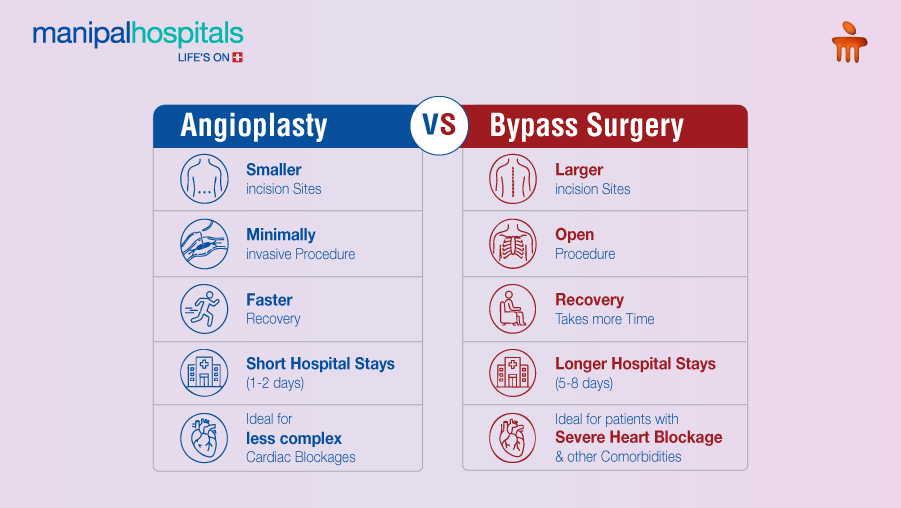
Angioplasty v/s Bypass Surgery: The Determining Factor
Angioplasty is a minimally invasive procedure that involves shorter hospital stay and faster recovery, meanwhile coronary bypass surgery is more invasive, requiring longer hospital stay and more prolonged recovery. However, eligibility for any of these procedures is determined by some key factors:
-
Number & Location of Blockages: Angioplasty is often ideal for single or two-vessel disease. Extensive multi-vessel disease or critical blockages (e.g., left main artery) often favour bypass surgery for more complete revascularization.
-
Overall Health: General health, age, kidney function, and co-existing conditions influence choice. Less invasive angioplasty may suit patients with multiple co-morbidities.
-
Heart Function: Weakened heart muscle may benefit more from CABG due to durable blood flow improvement.
-
Presence of Diabetes: For diabetic patients with multi-vessel disease, CABG has historically shown superior long-term survival.
Determining suitable bypass surgery candidates involves a holistic assessment by a multidisciplinary heart team to tailor treatment plans.
Angioplasty v/s Bypass Surgery: Potential Risks and Complications
Both procedures carry inherent risks, though modern techniques significantly reduce them. Your medical team will thoroughly discuss these risks before you undergo any of these procedures.
Angioplasty Risks:
-
Bleeding/bruising at insertion site.
-
Rarely, artery damage or stent thrombosis.
Bypass Surgery Risks:
-
Infection, bleeding or improper healing of wound site.
-
Rarely, risk of stroke or temporary memory issues.
Angioplasty v/s Bypass Surgery: Recovery and Rehabilitation
Recovery periods differ significantly between these two procedures.
Angioplasty Recovery:
-
Patients are required to stay at the hospital for about 1 to 2 days.
-
Light activity can be resumed in a few days, and full recovery can be achieved in a week.
-
Medications (e.g., antiplatelets), as prescribed by doctor, are critical during this period.
Bypass Surgery Recovery:
-
Patients are required to stay at the hospital for 5-7 days, including ICU.
-
Recovery is more prolonged, about 6-8 weeks for most normal activities.
-
Cardiac rehabilitation programs are strongly recommended for full recovery and improved long-term outcomes.
Conclusion
Coronary artery disease is a leading cause of death across the world, and recognising its early signs is crucial for getting timely treatment. While heart disease may often be managed by medication and adopting a healthy, active lifestyle, serious cases may require surgical intervention. Choosing between angioplasty and bypass surgery is a significant decision requiring expert guidance. At Manipal Hospitals Dhakuria, the Department of Cardiology is powered by expert cardiologists who use advanced diagnostic approaches to make the correct choice between “angioplasty v/s bypass surgery” as per the patient’s needs. If you are concerned about your or your loved ones’ heart health, visit Manipal Hospitals Dhakuria today!
Frequently Asked Questions
Angioplasty opens blocked arteries from within using a balloon and often a stent, while bypass surgery creates new pathways for blood flow around the blockages using grafts.
No, angioplasty is a minimally invasive procedure, typically performed under local anaesthesia, and has a much shorter recovery time compared to open-heart bypass surgery.
Modern drug-eluting stents are designed for long-term effectiveness, with many remaining open for 10-15 years or more, especially with proper medication and lifestyle changes.
While lifestyle changes are crucial for managing CAD and preventing its progression, they generally cannot reverse severe blockages that require intervention. They are, however, vital for long-term heart health after any procedure.
Most patients undergoing bypass surgery can typically return to light, non-strenuous work within 6-8 weeks, with full recovery taking longer.
Share this Article


Recent Blogs

বর্ষাকালে ভাইরাল জ্বর: কখন চিকিৎসকের পরামর্শ নেবেন?
29 Jun 20265 Min Read
বর্ষাকাল মানেই প্রকৃতির এক নতুন সজীবতা, কিন্তু এর সঙ্গেই গুটি গুটি পায়ে চলে আসে সাধারণ কিছু স্বাস্থ্য-ঝুঁকিও। এর মধ্যে অন্যতম হলো ভাইরাল জ্বর। প্রতি বছর বর্ষা এলেই অসংখ্য মানুষ এই জ্বরে আক্রান্ত হন। সাধারণত, ভাইরাল জ্বর আপনা-আপনি ভালো হয়ে যায় এবং বেশিরভাগ ক্ষেত্রেই রোগী বিশ্রাম ও সঠিক যত্নে সেরে ওঠেন। তবে, কোন পরিস্থিতিতে আপনার চিকিৎসকের পরামর্শ নেওয়া উচিত, তা জানা অত্যন্ত জরুরি। সঠিক সময়ে সঠিক পদক্ষেপ আপনাকে গুরুতর জটিলতা থেকে বাঁচাতে পারে এবং দ্রুত আরোগ্যে সহায়ক হতে পারে। গবেষণায় দেখা গেছে, ভাইরাল জ্বরের ক্ষেত্রে সময় মতো চিকিৎসকের পরামর্শ নিলে সুস্থতার হার 95% এর বেশি হয় এবং সুস্থ হতে সময়ও উল্লেখযোগ্যভাবে কম লাগে।
Read NowGERD Acid Reflux: Symptoms, Complications, and Treatment
24 Jun 20267 Min Read
Gastroesophageal Reflux Disease (GERD) is more than just occasional heartburn. It is a chronic digestive condition in which stomach acid frequently flows back into the esophagus, causing irritation and discomfort. Affecting nearly 20% of adults, GERD can significantly impact daily life and overall well-being. While occasional acid reflux is common, persistent or severe episodes occurring two or more times a week may indicate GERD and warrant medical evaluation. Understanding GERD symptoms can help individuals recognise the condition early and seek timely medical care.
Read NowImpact of PCOS on Health and Mind and Effective Management Strategies
24 Jun 20265 Min Read
Polycystic Ovary Syndrome (PCOS) is more than just a reproductive issue; it is a complex endocrine disorder that can affect almost every system of a woman's body, creating a cascade of challenges from metabolic health to mental well-being. Globally affecting approximately 1 in 10 women of reproductive age, PCOS manifests as a hormonal imbalance that can significantly impact quality of life if not properly managed. This blog aims to help you understand the breadth of PCOS symptoms as the first step towards effective management and regaining control.
Read NowTypes of Bladder Cancer and Their Treatment Options
24 Jun 20266 Min Read
Bladder cancer is a condition arising from the uncontrollable growth of inner lining cells of the urinary bladder. With an incidence rate of 5.6 per 100000 population worldwide, it is a significant global health concern. Only a combined team of expert urologists and oncologists can provide comprehensive, patient-centric care, leveraging cutting-edge technology and innovative therapies to combat this disease. Globally, bladder cancer is the tenth most common cancer. However, with early detection and appropriate treatment strategies, the 5-year survival rate for localised bladder cancer can be as high as 96%.
Read NowOvarian Cyst vs Ovarian Cancer: How Doctors Tell Them Apart and What Your Scan Results Actually Mean
29 May 20266 Min Read
Receiving an imaging scan result that mentions an ovarian mass or cyst can be unsettling. Concerns are natural to arise, especially with the thought of ovarian cancer. However, it is crucial to understand that in most cases, ovarian cysts are benign. While experienced radiologists can identify characteristics differentiating a benign cyst from a suspicious mass, a team of expert oncologists can ensure accurate diagnosis and peace of mind. This blog helps you with the clarity in understanding the distinction between common ovarian cysts and the less frequent, but serious, ovarian cancer through scan images.
Read NowACL Recovery from Week 1 to Full Return to Sport: The Complete Rehabilitation Roadmap for Athletes
28 May 20267 Min Read
The anterior cruciate ligament, popularly known as ACL, is a ligament which is situated at the anterior or front of the knee. It crosses over the PCL, or posterior cruciate ligament, and is responsible for stabilising the knee while preventing excess forward movement of the thigh (femur) and shin (tibia) bones. ACL tear is one of the most common types of sports injury, and it is primarily experienced by athletes participating in sports that involve a lot twisting, turning, jumping or sudden changes in movement. Once determined as a devastating blow to an athlete’s career, modern medicine and ACL rehabilitation procedures have now made it possible for athletes to make full recovery from it and return to sport after ACL tear.
Read NowAngioplasty vs Bypass Surgery: How Your Cardiologist Decides Which Heart Procedure Is Right for You
28 May 20267 Min Read
Heart disease is a leading health concern globally, and coronary artery disease (CAD) is one of the most common types of heart disease. While risk of heart disease rises with age, there has been a concerning rate of younger people getting affected by heart disease. Heart disease can be prevented or managed by some medications and lifestyle changes, but serious cases may require surgical intervention. This blog is a comprehensive account of the two most common surgical procedures, angioplasty and bypass surgery, and a comparative analysis between them.
Read NowAcute Kidney Injury: What Causes Sudden Kidney Failure and Why Acting Fast Is the Only Way to Save Your Kidneys
25 May 20267 Min Read
Acute Kidney Injury (AKI), often referred to as ‘sudden kidney failure’, is a critical medical condition demanding immediate medical attention. Unlike chronic kidney disease (CKD), which develops slowly over time, AKI occurs rapidly- sometimes within hours or days- causing your kidneys to lose their ability to filter waste products from your blood in an abrupt manner. This sudden decline can have severe consequences if not treated promptly, making swift action crucial to preventing long-term damage and ensuring kidney recovery. This blog guides you with the essential guidelines.
Read Nowফ্যাটি লিভার ডিজিজ: কেন লক্ষ লক্ষ মানুষ না জেনেই এতে আক্রান্ত এবং এর আসল কারণ কী
22 May 20266 Min Read
আমাদের শরীরের অন্যতম গুরুত্বপূর্ণ অঙ্গ লিভার, যা দেহের শত শত জটিল জৈব রাসায়নিক প্রক্রিয়া নিয়ন্ত্রণ করে। তবে আধুনিক জীবনযাত্রা এবং খাদ্যাভ্যাসের পরিবর্তনের ফলে লিভারের স্বাস্থ্য দ্রুত অবনতির দিকে যাচ্ছে। ফ্যাটি লিভার ডিজিজ এমন একটি অবস্থা যেখানে লিভার কোষে অতিরিক্ত চর্বি জমা হয়, যা ধীরে ধীরে লিভারের কার্যকারিতা ব্যাহত করতে পারে। বিশ্বজুড়ে বহু মানুষ এই রোগে আক্রান্ত, এবং তাঁরা প্রায়শই কোনো সুস্পষ্ট ফ্যাটি লিভারের লক্ষণ ছাড়াই এগিয়ে চলে।
Read NowEarly symptoms of Parkinson’s Disease You Should Not Ignore
04 May 20266 Min Read
Parkinson's disease is a progressive neurological disorder that affects movement. When most people think of Parkinson’s disease, they picture motor symptoms like tremors. Yet, the first symptoms of Parkinson’s disease are often subtle, appearing years before motor issues. Recognising Parkinson’s disease symptoms early is crucial for timely diagnosis and management, to significantly impact quality of life.
Read Now