


Understanding Thyroid Ablation: The Non-Surgical Thyroid Nodule Treatment
Reviewed by: Manipal Hospitals
Posted on
6 Min Read

Not sure what you’re looking for?
Get in touch with our representatives for help!
Contact UsThyroid nodules are a common occurrence, often discovered incidentally during routine medical examinations or imaging for other conditions. While most thyroid nodules are benign and pose no immediate threat, some can grow large enough to cause symptoms like difficulty swallowing, neck pain, or cosmetic concerns.
Historically, surgical removal was the primary approach for symptomatic or suspicious thyroid nodules. However, less invasive and highly effective alternatives have emerged thanks to advancements in medical technology. Among these, thyroid ablation stands out as a preferred non-surgical treatment for thyroid nodules, offering significant relief with minimal downtime.
Through this blog, we present you expert-approved insights from the best interventional radiologist in Yeshwanthpur, Bangalore, covering everything you need to know, including what are thyroid nodules, their causes, treatment options, when treatment is necessary, interventional radiology for thyroid nodule treatment, and its benefits.
What are thyroid nodules?
Thyroid nodules are lumps or growths that form within the thyroid gland, a butterfly-shaped organ located at the base of your neck. They can be solid or fluid-filled (cystic) and vary widely in size. Statistics show that by the age of 60, approximately 50-60% of adults will have detectable thyroid nodules, though only about 5-10% of these are found to be malignant.
Thyroid Nodules Causes
The exact thyroid nodules causes are not always clear, but several factors can contribute to their development:
-
Iodine Deficiency: Insufficient iodine in the diet can lead to thyroid enlargement and nodule formation.
-
Overgrowth of Normal Thyroid Tissue: Sometimes, normal thyroid tissue simply grows into a nodule.
-
Cysts: Fluid-filled cavities can develop in the thyroid.
-
Inflammation (Thyroiditis): Chronic inflammation of the thyroid can lead to nodules.
-
Thyroid Adenoma: A benign tumour of the thyroid gland.
-
Thyroid Cancer: Although rare (as mentioned, only 5-10% of nodules are malignant), it is a serious cause.
When is Thyroid Nodule Treatment Necessary?
Not all thyroid nodules require intervention. Small, asymptomatic, and benign nodules are often monitored with regular check-ups and ultrasound scans. However, thyroid nodule treatment becomes essential in several scenarios:
-
When nodules cause compressive symptoms such as difficulty swallowing, a sensation of choking, or hoarseness.
-
If they cause cosmetic disfigurement due to their size.
-
For autonomously functioning thyroid nodules that produce excess thyroid hormones (hyperthyroidism).
-
If there is a strong suspicion or confirmed diagnosis of malignancy.
Understanding Thyroid Ablation: A Minimally Invasive Solution
Thyroid ablation is a revolutionary, minimally invasive procedure that uses heat or chemical agents to destroy thyroid nodule tissue. This technique avoids the need for traditional surgery, which involves incisions, general anesthesia, and often a longer recovery period. The procedure is typically performed on an outpatient basis, meaning patients can often go home the same day.
The success rate of thyroid ablation in reducing nodule volume is impressive, with studies showing an average volume reduction of 70-90% for benign nodules within 6-12 months. More than 90% of patients experience significant improvement in their compressive and cosmetic symptoms after ablation.
What is Interventional Radiology for Thyroid Nodule Treatment?
Ablation procedures are primarily driven by the field of interventional radiology for thyroid nodule treatment. Interventional radiologists are highly skilled specialists who use advanced imaging guidance (typically ultrasound) to precisely target the thyroid nodule without affecting surrounding healthy tissue. This precision ensures that the procedure is highly effective with complication rates at less than 1%.
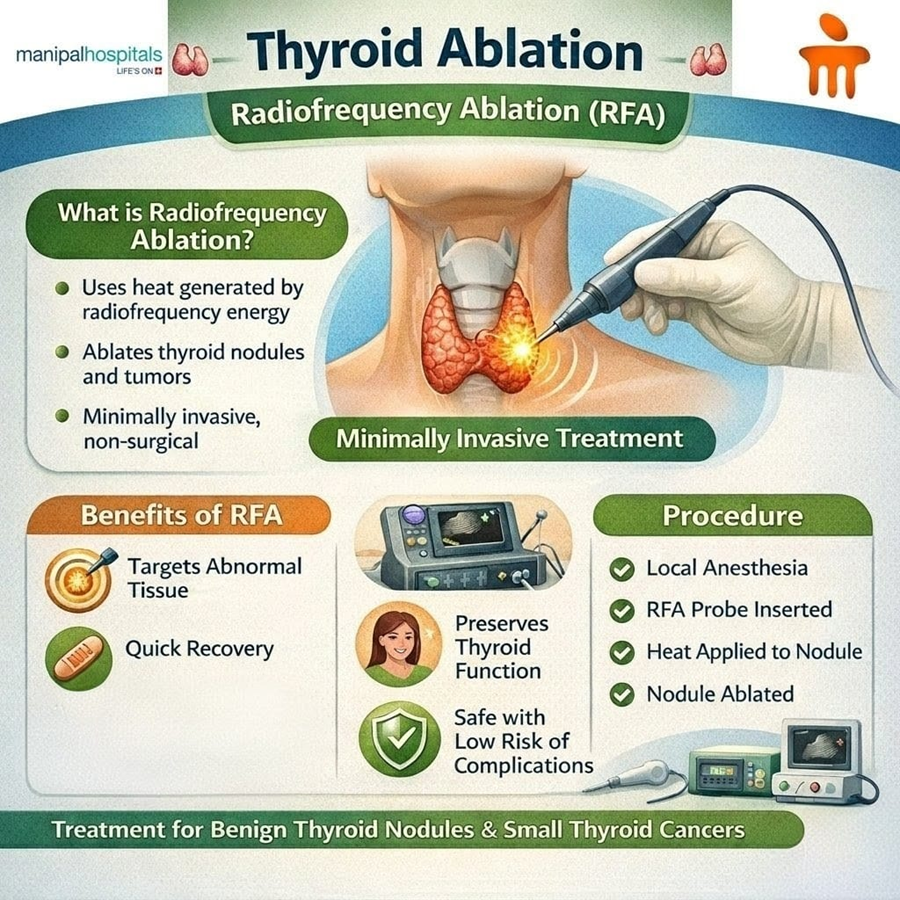
Benefits of Thyroid Ablation for Nodules
Choosing thyroid ablation over conventional surgery offers numerous advantages for patients:
-
Non-Surgical Approach: No incisions, no scars, and no need for general anesthesia, making it ideal for patients who wish to avoid surgery or have co-existing conditions that make the procedure risky.
-
Minimally Invasive: Performed through a tiny puncture in the skin under local anaesthesia, leading to less pain and discomfort compared to surgery.
-
Preservation of Thyroid Function: Unlike surgery, which often results in the removal of part or all of the thyroid gland (leading to lifelong hormone replacement), ablation preserves healthy thyroid tissue, helping maintain normal thyroid function in over 95% of cases.
-
Rapid Recovery: Patients can typically resume their normal activities within a day or two, significantly shorter than surgical recovery.
-
High Efficacy: Proven to be highly effective in reducing nodule size and alleviating symptoms, with patient satisfaction rates often exceeding 95%.
-
Outpatient Procedure: Most ablation procedures are completed in a single outpatient visit, enhancing convenience and reducing hospital stays.
Care Essentials: Do's and Don'ts After Thyroid Ablation
To ensure optimal recovery and results after your thyroid ablation procedure, consider these guidelines:
|
Do’s |
Don’ts |
|
For the first 24–48 hours, allow your body to recover. |
Don’t engage in heavy lifting or strenuous exercise. Avoid intense physical activity for at least a week, or as advised by your doctor. |
|
Gently use cold packs on the neck area during the first few hours to reduce swelling and discomfort. |
Don’t vigorously massage the neck. Avoid putting pressure or rubbing the treated area. |
|
Take your prescribed medication and use pain relief medications as advised |
Don’t ignore new or worsening symptoms. |
|
Monitor symptoms. Watch for unusual swelling, severe pain, or breathing difficulty, and report them immediately. |
|
|
Do attend follow-up appointments. |
|
Conclusion
Thyroid nodules can feel worrying when first discovered, but not all of them need surgery or aggressive treatment. With options like thyroid ablation, patients today have access to a safer, less invasive way to manage symptoms while preserving normal thyroid function. The key lies in timely evaluation and choosing the right approach based on your individual needs.
If you are experiencing symptoms related to thyroid nodules or have concerns about your thyroid health, it's crucial to seek timely medical advice. Consult the best interventional radiologists at Manipal Hospital Yeshwanthpur, Bangalore, for correct guidance and specialised care.
Frequently Asked Questions
Thyroid ablation is performed under local anesthesia, so you should not feel pain during the procedure. You might experience some mild discomfort or pressure, but it is generally well-tolerated. Post-procedure, any pain is typically managed with over-the-counter pain relievers.
For most benign thyroid nodules, a single ablation session is sufficient to achieve significant volume reduction and symptom relief. In some cases, particularly for huge nodules, a second session might be considered after several months if the initial reduction is not deemed satisfactory.
Thyroid ablation is a safe procedure with a very low rate of complications, typically less than 1%. Potential minor side effects include temporary pain, swelling, or bruising at the site. Rare, more serious complications can include temporary voice changes or nerve irritation, but these are extremely uncommon and often transient.
Nodule shrinkage is a gradual process. You may start to notice some reduction in size and improvement in symptoms within a few weeks, but the full effect of the ablation, including maximum volume reduction, is typically observed over 6 to 12 months.
One of the key advantages of thyroid ablation is that it aims to preserve healthy thyroid tissue. In over 95% of cases, thyroid function remains normal after the procedure, meaning you are unlikely to require thyroid hormone replacement medication.
Share this Article


Recent Blogs

Uterine Fibroid Embolization: An Advanced Minimally Invasive treatment for Uterine Fibroid Management
30 Jun 20267 Min Read
For countless women, the discomfort and challenges associated with uterine fibroids can significantly impact their quality of life. These non-cancerous growths in the uterus can lead to heavy bleeding, pain, and other distressing symptoms. While many women learn to live with these symptoms, it is important to know that effective and minimally invasive treatments for uterine fibroids are now available. Today, uterine fibroid management has evolved beyond traditional surgery. The advanced uterine fibroid embolisation, an interventional radiology procedure, offers safer, quicker, and more comfortable recovery with minimal disruption to daily life. In this blog, a top interventional radiology specialist in Yeshwanthpur, Bangalore, discusses in detail uterine fibroids and minimally invasive treatments for uterine fibroids.
Read NowUnderstanding Thyroid Ablation: The Non-Surgical Thyroid Nodule Treatment
30 Jun 20266 Min Read
Thyroid nodules are a common occurrence, often discovered incidentally during routine medical examinations or imaging for other conditions. While most thyroid nodules are benign and pose no immediate threat, some can grow large enough to cause symptoms like difficulty swallowing, neck pain, or cosmetic concerns. Historically, surgical removal was the primary approach for symptomatic or suspicious thyroid nodules. However, less invasive and highly effective alternatives have emerged thanks to advancements in medical technology. Among these, thyroid ablation stands out as a preferred non-surgical treatment for thyroid nodules, offering significant relief with minimal downtime. Through this blog, we present you expert-approved insights from the best interventional radiologist in Yeshwanthpur, Bangalore, covering everything you need to know, including what are thyroid nodules, their causes, treatment options, when treatment is necessary, interventional radiology for thyroid nodule treatment, and its benefits.
Read NowUnderstanding Bone Biopsy: Procedure, Accuracy, and Recovery Timeline
29 Jun 20269 Min Read
Hearing that you need a bone biopsy can bring a surge of anxiety. The word “biopsy” immediately raises thoughts of serious illness, and the idea of a procedure involving your bones can feel especially daunting. However, a bone biopsy is a precise, minimally invasive test that can provide clear answers when other investigations do not. It offers definitive information about abnormal tissue, infection, or bone marrow conditions, helping your medical team plan the most effective treatment. Understanding exactly what the procedure involves, why it is necessary, the level of accuracy it provides, and what recovery truly looks like can ease much of this uncertainty. If your doctor has recommended this investigation, consulting specialists at a top orthopaedic hospital in Yeshwanthpur, Bangalore, can help you receive expert evaluation and personalised care throughout the diagnostic process. In this blog, you will learn the step-by-step bone biopsy procedure, how reliable the bone biopsy test is, and the recovery timeline you can realistically expect.
Read NowUnderstanding Neurological Disorders: Symptoms, Causes and Treatment Options
29 Jun 20267 Min Read
Your nervous system is a complex network that regulates everything from movement to memory and breathing to emotions. When something disrupts this intricate system, it can lead to neurological disorders that affect daily functioning and quality of life. This is a critical public health reality in India, where over 30 million people live with neurological conditions, and the prevalence rate is nearly 2.4%. Between 1990 and 2019, the burden of non-communicable neurological disorders more than doubled, rising from 4.0% to 8.2% of India's total disease load. The key to managing these conditions effectively is recognising neurological disorders' symptoms early, as prompt diagnosis often leads to better outcomes and more effective treatment options. Seeking timely evaluation from experienced specialists at a top neurology hospital in Yeshwanthpur, Bangalore, can help ensure accurate diagnosis and comprehensive care. This blog explores the most common neurological disorders and the neurological disorder symptoms that should prompt a medical visit.
Read NowWhy Does My Stomach Hurt After Meals
26 Jun 20267 Min Read
A satisfying meal should leave you feeling nourished and comfortable. So when eating is regularly followed by pain, bloating, or a troubling sense of unease, it can turn a simple daily pleasure into a source of anxiety. You may find yourself wondering which foods are safe or whether the discomfort is a sign of something more serious. While the term “abdominal pain after eating” can sound alarming, many causes are manageable with the right guidance. The location of your pain, upper, middle, or lower, often provides important clues that help your doctor understand what is happening inside your digestive system. Seeking evaluation at a top gastroenterology hospital in Yeshwanthpur, Bangalore, can help identify the underlying cause and ensure timely treatment. In this blog, you will learn about the common reasons for post-meal discomfort, how to differentiate one type of pain from another, and the treatment options that can help you eat with confidence again.
Read NowEvaluating Chest Pain: Medical Triggers, Anxiety, and Modern Care Paths
26 Jun 20267 Min Read
Have you ever felt an unexpected ache, tightness, or pressure in your chest and wondered whether it was something serious or simply a passing discomfort? It is a question that crosses many minds, often in the middle of an ordinary day, during a brisk walk, after a stressful conversation, or while resting at home. It is a thought that can be difficult to ignore. Even a brief episode of chest pain has a way of capturing our attention, often triggering concern long before we know what is actually causing it. The challenge is that chest pain is not always straightforward. A symptom commonly associated with heart disease can also arise from conditions affecting the lungs, digestive system, muscles, or nerves. In some cases, stress, anxiety, and panic attacks can produce physical sensations that closely resemble those of a cardiac event. This overlap often makes it difficult to distinguish between a medical emergency and a less serious underlying issue. This blog discusses the common causes of chest pain, explains the anatomical structures that may be involved, and highlights how experts at the best cardiology hospital in Yeshwanthpur, Bangalore, use advanced diagnostic approaches to determine the root cause and guide effective treatment
Read NowImmunotherapy for Cancer: Who Is Eligible and How It Works
26 Jun 20267 Min Read
Receiving a cancer diagnosis can bring a wave of overwhelming questions and an immediate desire to find the most effective medical options available. For decades, the standard path forward usually focused on finding ways to physically destroy tumour cells from the outside using tools like surgery, chemotherapy, or radiation. However, a major breakthrough in modern oncology has introduced an entirely different, highly precise biological strategy. For patients exploring innovative therapies such as immunotherapy, consulting specialists at the best hospital for cancer treatment in Yeshwanthpur, Bengaluru, can provide access to advanced treatment options, multidisciplinary expertise, and personalised cancer care. This blog explains exactly what immunotherapy is, how it utilises your body's natural defence systems to combat illness, and who is an ideal candidate for this care.
Read NowHow to Read Your ECG Report Without Confusion
22 Jun 20267 Min Read
Most people do not think much about an ECG until a doctor recommends one. Then suddenly, a sheet filled with spikes, numbers, and medical terms lands in their hands. For many patients, the first reaction is uncertainty. Some immediately search online, trying to understand whether the report is normal or serious. Some are eagerly anticipating the interpretation of the results by the cardiologist. Understanding the basics of reading an ECG report can help alleviate the pressure that accompanies such occasions. While only a professional doctor can do a complete assessment of an individual’s heart condition, understanding some of the commonly used terms in the ECG report can help you have a better conversation. In this blog a leading interventional cardiologist in Yeshwanthpur explains how to read your ECG report without confusion, including what common ECG terms mean, what the different waves and intervals represent, and when certain findings may need further medical attention.
Read NowWhat Is a Kidney Biopsy? A Simple Guide for Patients
22 Jun 20268 Min Read
When doctors suspect a kidney problem that blood tests or scans cannot fully explain, they may recommend a kidney biopsy. For many patients, hearing the word “biopsy” immediately creates anxiety. People often worry about pain, complications, or whether the test has already found something serious. In reality, a kidney biopsy is a common procedure that helps doctors understand how well the kidneys are functioning and identify the type of disease affecting them. The test can provide information that routine tests may not always detect. Knowledge about kidney biopsy meaning may make it easier for patients to have confidence before undergoing the test. Through this blog, a leading nephrologist and kidney transplant specialist in Yeashwanthpur, Bangalore, explains all you need to know about kidney biopsy, including kidney biopsy indications, post-kidney biopsy care, and what will be revealed by the kidney biopsy about the patient’s kidney. Patients looking for a kidney biopsy in Yeshwanthpur may find this article informative too.
Read NowDehydration: Common Signs, Causes, Recovery, and When to Seek Help
19 Jun 20267 Min Read
The human body is made up of around 70% water. It is necessary to manage temperature, be a medium for the movement of nutrients, support muscles, and keep all the organs working properly. Dehydration happens when your body loses more fluids than it takes in. When fluid levels drop, even simple body functions start getting affected as the fluid and electrolyte balance starts to change. Most people first notice dehydration symptoms like thirst, dry lips, tiredness, or dark urine. If ignored, the condition can get worse within a matter of hours. Children and older adults are the most vulnerable, and it’s crucial to look for the signs. People working outdoors in hot weather also face a higher risk. In this blog, a top physician in Yeshwanthpur, Bangalore, discusses what dehydration is, the symptoms, what to do, and when to seek medical help.
Read Now