


What Is Cardiac Tamponade: A Deep Dive into Symptoms, Diagnosis and Treatment
Reviewed by: Dr. Subrahmanya Murti Velamakanni
Posted on
8 Min Read

Not sure what you’re looking for?
Get in touch with our representatives for help!
Contact UsCardiac tamponade is a serious condition in which fluid accumulates within the external covering of the heart, also called the pericardium, affecting its ability to pump blood effectively. Fluid accumulation in the pericardium is referred to as a pericardial effusion. When this collection becomes extreme, it causes a complete inability of the heart to pump blood, leading to cardiac tamponade, which needs emergency treatment. Symptoms can develop suddenly and may worsen rapidly if not treated early.
In this blog, you will know what cardiac tamponade is, how to spot early warning signs, and when to act, which can save a life.
What Is Cardiac Tamponade?
The heart is protected from the nearby organs by a layer of tough tissue called pericardium. Because it does not stretch easily, even a relatively small amount of extra fluid, if it accumulates quickly, can cause the internal pressure to skyrocket.
When the fluid builds up, the accumulated fluid compresses the heart chambers. This compression first affects the right side of the heart because those chambers have thinner walls and lower internal pressure. As the right side collapses under the weight of the surrounding fluid, blood begins to back up into the veins of the body. Eventually, the left side of the heart is also affected, leading to a dangerous drop in blood pressure. Because cardiac tamponade interferes normal blood circulation throughout the body, it is categorised as a high-priority clinical emergency.
Therefore, early detection of this disease is extremely important since it can cause serious effects on the functioning of the heart.
What Causes Cardiac Tamponade
Understanding the causes of cardiac tamponade helps identify patients at higher risk.
Common causes include:
-
Chest trauma or injury: Trauma or injury to the chest wall causes internal bleeding.
-
Pericarditis: Inflammation results in fluid accumulation due to an infection or an autoimmune condition. The most common cause in India is tuberculosis.
-
Tumours: Certain cancers can lead to fluid accumulation within the pericardial sac.
-
Cardiac surgery or catheter-based procedures: This can be caused by complications during heart surgery or catheterisation.
-
Chronic kidney failure: Fluid retention associated with chronic kidney disease can contribute to pericardial effusion.
-
Hypothyroidism: Rarely, extremely low levels of thyroid hormone can also cause pericardial effusion, leading to tamponade.
-
Aortic dissection: Blood accumulates rapidly in the heart’s pericardial space.
Recognising these causes early can help guide timely diagnosis and treatment.
What Are the Signs of Cardiac Tamponade
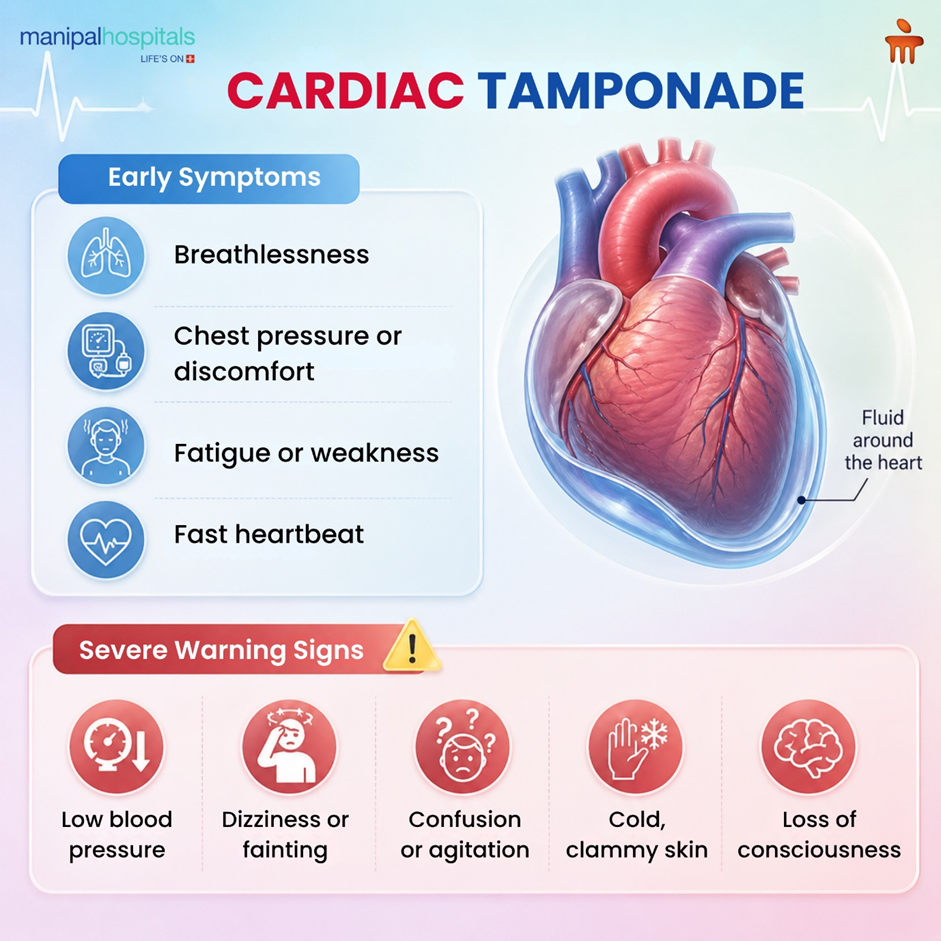
It's important to know the signs early because the condition can get worse very quickly. Common symptoms include:
-
Breathlessness: This happens because the heart fails to pump effectively, resulting in poor circulation and breathing difficulties.
-
Pain or tightness in the chest: You may experience tightness in your chest.
-
Low blood pressure (hypotension): This causes you to feel dizzy or faint.
-
Fast heartbeat: The heart rate increases to compensate for reduced blood circulation.
-
Weakness: Weakness and fatigue may occur due to reduced oxygen delivery to tissues.
-
Swelling of the legs or abdomen: This condition is a result of prolonged development of symptoms.
Important signs to watch for:
-
Confusion or agitation: Can happen due to reduced blood supply to the brain, leading to lower awareness.
-
Clammy skin: Cold, clammy skin may indicate circulatory shock.
-
Loss of consciousness: It usually indicates poor blood circulation.
If you suddenly develop these symptoms, don't ignore them. People with congenital heart conditions, HIV, kidney disease, cancer, TB, or autoimmune diseases are at risk of developing this condition.
How Is Cardiac Tamponade Diagnosed?
A combination of clinical examination and imaging tests is needed to diagnose this cardiac condition.
Diagnostic steps include:
-
Medical history: To identify potential risk factors such as trauma or infections.
-
Physical examination: Doctors may notice low blood pressure, raised neck veins, and muffled heart sounds.
-
Echocardiography: The primary imaging test used to confirm pericardial effusion and cardiac compression.
-
Electrocardiogram (ECG): To evaluate changes in the heart’s electrical activity.
-
Chest X-ray: It can demonstrate an enlarged heart shadow.
-
Computed tomography (CT) scan: Provides detailed imaging of the heart and surrounding structures.
Early diagnosis plays a critical role in selecting the most appropriate treatment approach.
Cardiac Tamponade vs Other Heart Conditions
The table below highlights the differences between cardiac tamponade and other common heart conditions.
|
Feature |
Cardiac Tamponade |
Heart Attack |
Heart Failure |
|
Cause |
Fluid around the heart |
Blocked artery |
Weak heart muscle |
|
Onset |
Sudden or gradual |
Sudden |
Gradual |
|
Pain |
Pressure or discomfort |
Severe chest pain |
Usually mild |
|
Blood Pressure |
Low |
Often high/normal |
Variable |
|
Breathing |
Severe difficulty |
Moderate |
Progressive |
|
Urgency |
Medical emergency |
Medical emergency |
Chronic condition |
Treatment for Cardiac Tamponade
The goal of cardiac tamponade treatment is simple but urgent: the fluid must be removed to take the pressure off the heart. Relieving the pressure around the heart often restores normal cardiac function rapidly.
-
Pericardiocentesis: This is the most common form of cardiac tamponade treatment. A doctor uses a needle and a thin tube (catheter) to drain the fluid from the sac around the heart. This is usually done while the doctor watches an echocardiogram to ensure the needle goes to exactly the right spot.
-
Pericardial Window: In some cases, especially if the fluid keeps coming back, a surgeon may perform a minor operation to cut a small "window" in the sac. This allows the fluid to drain into the chest cavity, where it can be absorbed by the body, preventing another episode of cardiac tamponade.
-
Surgical Repair: If the fluid is actually blood from a tear in the heart or a major artery, an open-heart surgery may be needed to fix the underlying injury.
Once the immediate pressure is gone, the team will continue with cardiac tamponade treatment by addressing the root cause.
Long-term management:
-
Treating the underlying cause, such as infection, kidney disease, or cancer.
-
Follow-up scans to check for fluid build-up again.
-
Managing overall heart health through regular care and lifestyle changes.
Patients requiring specialised cardiac care should seek timely evaluation for cardiac tamponade treatment at Sarjapur Road, a centre equipped to manage cardiac emergencies.
Complications of Cardiac Tamponade
If cardiac tamponade is not treated in time, it can quickly become dangerous. As pressure builds around the heart, it struggles to pump enough blood to the rest of the body. This can start affecting vital organs within a short time.
Some possible complications include:
-
Shock: Blood pressure drops, and the body cannot maintain proper circulation
-
Organ damage: The brain, kidneys, and other organs may not get enough oxygen
-
Cardiac arrest: In severe cases, the heart may stop beating
-
Life-threatening outcomes: Without urgent care, the condition can become fatal
Because of how fast this condition can worsen, getting medical help early makes a real difference.
When Should You Seek Immediate Medical Care
Cardiac tamponade requires urgent medical attention and should never be ignored. If you have a history of chest injury or surgery and have symptoms, you should not ignore them. It’s best not to delay medical attention in such situations.
Get an urgent visit with leading cardiology doctors near Sarjapur Road if you experience the following:
-
Severe breathlessness even while resting
-
Chest pressure along with dizziness
-
Fainting or feeling as if you might faint
-
Symptoms that get worse within a short time
-
Any concerning symptoms after chest injury or surgery
What makes this condition concerning is not just the symptoms, but how quickly they can progress if ignored. Early medical intervention significantly improves outcomes.
Conclusion
Cardiac tamponade may initially present with mild symptoms but can progress rapidly into a life-threatening emergency. The excellent news is that one can get positive outcomes with early diagnosis and appropriate treatment.
Immediate medical evaluation is essential if symptoms are suggestive of cardiac tamponade. Access to advanced cardiology care from Manipal Hospitals, Sarjapur Road, and expert guidance to the appropriate facilities, such as cardiac tamponade treatment from top cardiology doctors at Manipal Hospital, Sarjapur Road, can help healthcare providers detect and treat the condition swiftly.
Immediate medical evaluation is essential if symptoms are suggestive of cardiac tamponade. Access to the appropriate facilities, such as cardiac tamponade treatment in Sarjapur Road, enables healthcare providers to detect and treat issues swiftly.
Frequently Asked Questions
In some cases, fluid accumulates gradually, causing mild symptoms at first. However, slow accumulation can suddenly worsen. To avoid severe complications, it is essential to monitor the condition regularly.
While trauma is a common cause, infections, autoimmune diseases, and kidney conditions can also lead to cardiac tamponade.
There are high risks for relapses since the condition may recur in case the underlying problem remains untreated. Proper monitoring, regular imaging, and timely treatment of the main cause may reduce such risks considerably.
A rapid accumulation will be deadly in minutes or hours. Other instances take time, but once symptoms appear, the patient should begin treatment immediately.
Any fluid collection in the pericardium is termed a pericardial effusion. When this effusion becomes severe enough to compress the heart, reducing its ability to pump, it becomes cardiac tamponade.
Share this Article


Recent Blogs

Hypertensive Crisis Explained: Symptoms, Risks, and Emergency Treatment
13 Jul 20266 Min Read
Uncontrolled high blood pressure can quietly damage the body for years, but there are times when it escalates suddenly into a medical emergency. One of the most serious complications of uncontrolled hypertension is a hypertensive crisis. It is a complication that can affect the brain, heart, kidneys, and blood vessels in a very short time. Even though high blood pressure usually seems like a chronic condition with long-term health implications, a drastic and unexpected increase in blood pressure can cause immediate harm to one’s body. Learning about hypertensive crises will help you avoid organ damage and save your life. However, there are certain hypertensive crisis symptoms that may be confused with other less serious conditions, leading to a delay in the treatment process. In this blog, we explore what the causes of this condition are, its symptoms, the dangers of the crisis, diagnosis options, possible treatment plans, recovery, and how to lower your chances of developing it in the future.
Read NowUnderstanding Kidney Failure: Warning Symptoms and When to Seek Help
10 Jul 20268 Min Read
Acute and chronic renal failure are both critical health conditions that lead to a decreased capacity of the kidneys, including the ability to filter waste from the blood, retain water, and perform other vital bodily functions that help keep the body healthy. Despite the similarity, acute and chronic renal failure are distinct types of disease that have different mechanisms of development and possible consequences. The main difficulty associated with kidney diseases is that the symptoms manifest slowly and can sometimes be confused with signs of other concerning illnesses. Many patients do not suspect any major health issue until considerable damage to the body is caused, and therefore knowledge about symptoms of the condition may help start treatment in time. In this blog, we will discuss the different causes of kidney failure, its symptoms, the difference between acute and chronic renal failure, when prompt medical assistance is needed, the possible treatments, and precautions to take to maintain kidney health in the long run.
Read NowHeadache and Vomiting Sensation: When It Is Harmless and When to Worry
10 Jul 20266 Min Read
Headaches are one of the most commonly reported neurological issues, but if a headache is followed by the feeling of being sick or nausea, the simple ache can quickly become particularly uncomfortable. It becomes challenging to perform your daily routines, concentrate on something else besides the pain, and have concerns about what could cause such symptoms. In many instances, the causes of this issue can be managed with no serious consequences, yet there may be cases when these symptoms are an indicator of a more serious condition that needs professional intervention. There can be several causes why a person experiences a headache with the feeling of vomiting. Among these causes may be migraines, viral infection, or changes in intracranial pressure. It is important to know how to recognise the symptoms, what warning signs you should pay attention to, and when it becomes crucial to visit a doctor. This blog touches upon all such aspects of nauseating headaches.
Read NowBankart Repair Surgery Explained: Treatment, Procedure and Recovery
08 Jun 20268 Min Read
Imagine reaching for a glass on a high shelf or simply tossing a jacket over your shoulder, only to feel that sickening pop or a sudden shift in the joint. For many, a shoulder dislocation isn't a one-time accident; it’s the start of a frustrating cycle where the shoulder feels loose or unreliable during the most basic daily tasks. If you feel like you’re constantly bracing for your shoulder to slip out of place, you aren't just dealing with a weak joint, you likely have a specific structural injury called a Bankart lesion. In such cases, bankart repair is often advised to restore stability and improve function. In this article, we look at how Bankart repair surgery works, when it is needed, and what recovery typically involves.
Read NowUnderstanding Endometrial Hyperplasia: Causes, Symptoms and Treatment
05 Jun 20267 Min Read
Many women notice changes in their periods and brush them off at first. Heavier bleeding, spotting between cycles, or the occasional delayed period can easily be blamed on stress, travel, or a busy routine. However, sometimes they may signal a condition called endometrial hyperplasia. In this condition, the lining of the uterus becomes thicker than is considered healthy. While it is a manageable condition, it is important to address it early because certain types of endometrial hyperplasia can increase the long-term risk of developing uterine cancer. In this blog, we’ll explain what it is, the warning signs to look for, and care tips.
Read NowRenal Diet Chart: What to Eat and Avoid for Better Kidney Patient Care
03 Jun 202610 Min Read
If you have kidney disease, your kidneys may not clear waste like urea and creatinine as well as before. You might notice swelling in the feet or face, or changes in urine. Salts, sodium, potassium, and fluid can start building up in the body. Diet plays an important role in managing kidney disease and reducing stress on the kidneys. Food choices directly affect how much waste, fluid, and minerals the kidneys need to process. Many patients assume a renal diet means avoiding most foods, but the focus is actually on portion control and nutrient balance. A simple renal diet chart helps you stay on track. It gives you a basic structure for meals throughout the day, so you are not guessing what to eat each time. In the next sections, we will go step by step through the changes needed, the foods you can choose, and a weekly plan you can follow at home.
Read NowColposcopy Procedure Explained: Is It Painful and Why Is It Done?
29 May 20269 Min Read
There is a specific kind of sinking feeling that often comes when you get a phone call from your doctor’s office saying your recent Pap smear results were "inconclusive" or "abnormal." You may start wondering what the results mean and whether something serious could be affecting your health. Usually, the next step your doctor suggests is a colposcopy. A colposcopy is actually an incredibly helpful tool that gives your medical team a high-definition view of your cervical health. A colposcopy allows doctors to examine the cervix in greater detail and identify any abnormal cell changes. This blog will look at why a colposcopy procedure is recommended, how it differs from a regular exam, and what you can expect in terms of physical sensation. Understanding the process clearly can help reduce anxiety and make the experience feel more manageable.
Read NowWhat Is Cardiac Tamponade: A Deep Dive into Symptoms, Diagnosis and Treatment
29 May 20268 Min Read
Cardiac tamponade is a serious condition in which fluid accumulates within the external covering of the heart, also called the pericardium, affecting its ability to pump blood effectively. Fluid accumulation in the pericardium is referred to as a pericardial effusion. When this collection becomes extreme, it causes a complete inability of the heart to pump blood, leading to cardiac tamponade, which needs emergency treatment. Symptoms can develop suddenly and may worsen rapidly if not treated early. In this blog, you will know what cardiac tamponade is, how to spot early warning signs, and when to act, which can save a life.
Read NowWhat Is Hepatocellular Carcinoma (HCC): How It Develops, Symptoms and Treatment Options
29 May 20267 Min Read
Hepatocellular carcinoma (HCC) is the most common type of primary liver cancer. It begins in hepatocytes, the main functional cells of the liver that handle metabolism, detoxification, and protein synthesis. To answer the common question of what hepatocellular carcinoma (HCC) is – it is a cancer that develops from hepatocytes, the primary functional cells of the liver. It is a cancer that develops within the liver itself and not one that has spread from another organ. Most cases of HCC are linked to long-standing liver damage. Chronic hepatitis B, hepatitis C, and cirrhosis are the most frequent underlying conditions. Over time, repeated injury to liver cells leads to structural changes that increase cancer risk. Early disease may not produce clear symptoms. Many patients are diagnosed during routine surveillance for liver disease. This article explains how hepatocellular carcinoma develops, the symptoms to watch for, and the treatment options available.
Read NowUnderstanding Seizures & Brain Health: Symptoms, Causes, and Treatment Options
29 May 20268 Min Read
Seizures are one of the most common disorders in the field of neurology, which can occur in anyone without any age constraints. Seizures occur due to the disruption caused by irregular brain electrical activities. Some seizures only last for a few seconds, while others might last for a few minutes; immediate health care services should be availed. Understanding seizures and ensuring proper brain care is of utmost importance. It is always advisable to take note of any signs such as blank stares, twitching body muscles, and lapses in the state of consciousness. The knowledge of the warning signs will help in preventing adverse situations from arising. In terms of the treatment of seizures, neurology has achieved considerable success. Your brain health is deeply tied to daily habits like sleep, stress management, and your overall medical history. When your brain is thriving, everything else follows from your memory and focus to your mood and physical movement. In this guide, we will break down what seizures are, how they impact your body, and the best options available to protect your brain health.
Read Now