


Angioplasty vs. Bypass Surgery: Understanding Your Options for a Healthier Heart
Reviewed by: Manipal Hospitals
Posted on
7 Min Read

Not sure what you’re looking for?
Get in touch with our representatives for help!
Contact UsCoronary Artery Disease (CAD) remains a leading health concern globally, affecting millions and impacting their quality of life. When arteries supplying blood to the heart become narrowed or blocked, it can lead to chest pain (angina), shortness of breath, and even heart attacks.
Fortunately, effective treatment options are available for managing CAD. Angioplasty and heart bypass surgery are two commonly used approaches. Understanding how these procedures differ can help you make an informed decision in consultation with your cardiac specialist.
What is Coronary Artery Disease (CAD)
CAD occurs when the major blood vessels that supply the heart (coronary arteries) become damaged and narrowed. This damage is often due to the buildup of plaque containing cholesterol and other substances, a process known as atherosclerosis. This narrowing reduces blood flow to the heart muscle, leading to various symptoms. Early diagnosis and timely intervention are key to managing CAD effectively and preventing life-threatening events.
Angioplasty: A Minimally Invasive Option
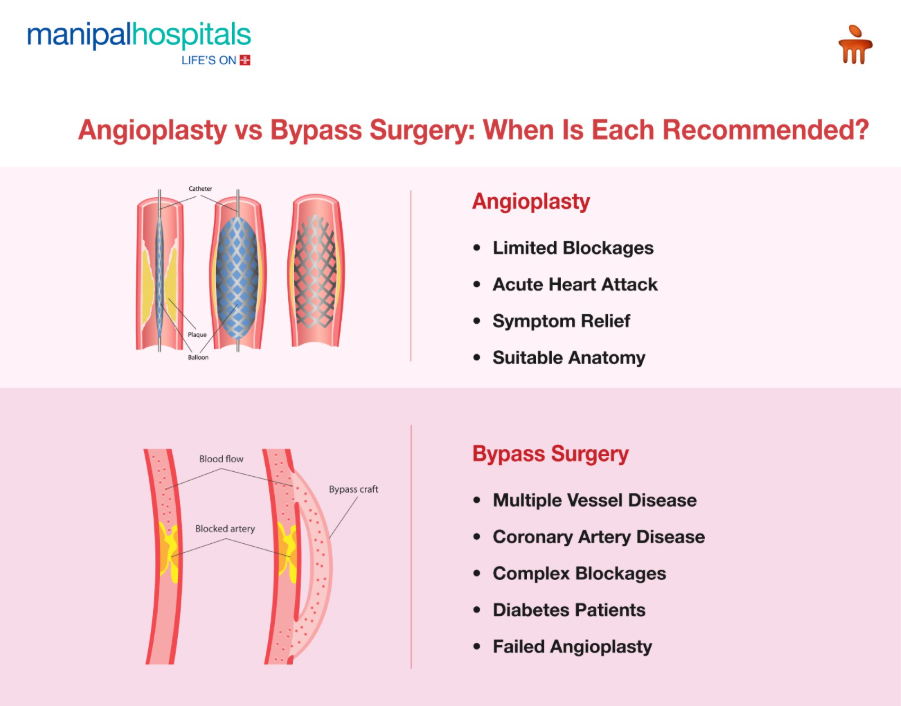
Angioplasty, often referred to as percutaneous coronary intervention (PCI), is a minimally invasive procedure designed to open narrowed or blocked coronary arteries. This procedure has become a cornerstone of modern cardiology due to its effectiveness and quicker recovery times for suitable candidates.
When is Angioplasty Recommended?
-
Single or Limited Blockages: Ideal for patients with one or two significant blockages in easily accessible coronary arteries.
-
Acute Heart Attack: Often performed as an emergency procedure during a heart attack to restore blood flow quickly and minimize heart muscle damage.
-
Symptom Relief: For patients experiencing angina (chest pain) despite medication, to improve blood flow and reduce symptoms.
-
Suitable Anatomy: When the location and nature of the blockages are amenable to stent placement.
What to Expect during the Angioplasty Procedure
A coronary angioplasty procedure typically involves the following steps:
-
Access Point: A small incision is made, usually in the groin or wrist, to insert a catheter into a blood vessel.
-
Guidance: Using X-ray imaging, the cardiologist guides the catheter to the blocked coronary artery.
-
Balloon Inflation: A balloon at the tip of the catheter is inflated at the blockage site, compressing plaque and widening the artery.
-
Stent Placement: Often, a stent is deployed to keep the artery open and prevent re-narrowing. Drug-eluting stents release medication to prevent scar tissue.
-
Completion: The balloon is deflated, and the catheter is removed. The access point is closed, and pressure is applied to prevent bleeding.
Angioplasty boasts impressive success rates, with procedures successfully opening blocked arteries and improving blood flow. Patients often experience significant symptom relief and improved quality of life very quickly.
Heart Bypass Surgery: A Comprehensive Approach
Coronary Artery Bypass Grafting (CABG), commonly known as heart bypass surgery, is a more invasive but highly effective surgical procedure that redirects blood flow around blocked sections of coronary arteries. It creates new pathways for blood to reach the heart muscle.
When is Bypass Surgery Recommended?
-
Multiple Vessel Disease: For patients with severe blockages in multiple coronary arteries (e.g., triple-vessel disease).
-
Left Main Coronary Artery Disease: Blockage in the left main artery, which supplies a large portion of the heart muscle, often necessitates bypass surgery.
-
Complex Blockages: When blockages are extensive, difficult to reach with a catheter, or involve a large amount of calcification.
-
Diabetes Patients: Often preferred for diabetic patients with extensive CAD due to potentially better long-term outcomes.
-
Failed Angioplasty: In cases where angioplasty was unsuccessful or not a viable long-term solution.
What to Expect in the Heart Bypass Procedure
A typical heart bypass operation involves:
-
Anesthesia: The patient is given general anesthesia and will be unconscious throughout the procedure.
-
Incision: An incision is made (often a sternotomy) to access the heart. Minimally invasive approaches are also used.
-
Graft Harvesting: Healthy blood vessels (grafts) are harvested, typically from the leg or chest wall.
-
Bypass Creation: One end of the graft is connected to the aorta, and the other to the coronary artery below the blockage, bypassing the obstruction.
-
Heart-Lung Machine: Often, a heart-lung machine supports circulation during surgery. Off-pump (beating heart) bypass is also performed.
-
Closure: Once the bypass grafts are in place, the heart is restarted, and the chest incision is closed.
Heart bypass surgery has an excellent track record for improving blood flow and reducing symptoms. It offers durable, long-term benefits, especially for patients with complex CAD.
Angioplasty vs. Bypass Surgery: The Decision-Making Process
Deciding between coronary angioplasty and heart bypass surgery is a complex process that depends on several factors, including the number and location of blockages, the patient's overall health, presence of other conditions (like diabetes), and the urgency of the situation. Your cardiac team at Manipal Hospitals will meticulously evaluate your case.
Key Factors Considered:
-
Number and location of blockages
-
Overall health and existing conditions
-
Heart function
-
Presence of diabetes
-
Patient preference
-
Expert opinion from a multidisciplinary team
Risks and Recovery
Angioplasty Risks
While generally safe, potential risks of angioplasty and coronary angioplasty include:
-
Bleeding or bruising at the catheter insertion site.
-
Damage to the blood vessel (rare).
-
Allergic reaction to contrast dye.
-
Heart attack (very rare).
-
Stroke (extremely rare).
-
Kidney problems from the dye.
Recovery from angioplasty is typically quick. Most patients are discharged within a couple of days and can resume normal activities within a week, often experiencing immediate symptom relief.
Bypass Surgery Risks
As a major surgery, heart bypass carries more potential risks, though serious complications are rare:
-
Bleeding or infection at the incision site.
-
Heart rhythm problems.
-
Kidney failure.
-
Stroke.
-
Heart attack (rare).
-
Memory problems or confusion (sometimes temporary).
Recovery from heart bypass surgery is more extensive. Patients typically stay in the hospital for about a week, with full recovery taking several weeks. Cardiac rehabilitation is highly beneficial for a smooth recovery.
Recovery and Rehabilitation
Regardless of the procedure, post-treatment care and rehabilitation are vital for long-term heart health. Both angioplasty and heart bypass patients benefit immensely from lifestyle modifications, including a heart-healthy diet, regular exercise, stress management, and medication adherence. Manipal Hospitals offers comprehensive cardiac rehabilitation programs designed to help patients regain strength, improve cardiovascular fitness, and reduce the risk of future heart problems. Engaging in these programs can improve recovery outcomes and significantly enhance overall well-being.
Post-Treatment Care: Do’s and Don’ts
|
Do’s |
Don’ts |
|
Attend all follow-up visits |
Ignore warning symptoms |
|
Join a cardiac rehabilitation programme |
Stop medicines without advice |
|
Eat a heart-healthy diet |
Overexert yourself early in recovery |
|
Stay physically active as advised |
Eat unhealthy foods regularly |
|
Monitor symptoms closely |
Skip rehabilitation sessions |
|
Manage stress effectively and quit smokin |
Lift heavy weights too soon |
Conclusion
The choice between angioplasty and bypass surgery depends on your specific condition. Both treatments are effective when used appropriately.
At Manipal Hospitals, Kolkata, we are equipped with leading cardiac specialists, advanced technology, and a patient-first approach to ensure you receive the most appropriate and effective care for your heart condition. If you have symptoms or a diagnosis of coronary artery disease, consult our experts to explore your treatment options.
Frequently Asked Questions
An angioplasty procedure typically takes about 30 minutes to a few hours, depending on the complexity of the blockages. In emergency situations like a heart attack, it's done as quickly as possible.
Patients undergoing heart bypass surgery usually stay in the hospital for 5 to 7 days, including a period in the intensive care unit (ICU) immediately after the operation.
Yes, a healthy lifestyle including a balanced diet, regular exercise, maintaining a healthy weight, and not smoking can significantly reduce your risk of developing CAD and potentially delay or prevent the need for interventions.
Yes, once placed during an angioplasty, stents are permanent and remain in the artery to keep it open. They are designed to integrate with the artery wall over time.
Both procedures offer excellent long-term outcomes for improving quality of life and reducing symptoms. For single-vessel disease, outcomes are often similar. For complex, multi-vessel disease, particularly in diabetics, bypass surgery may offer superior long-term survival and fewer repeat procedures.
Share this Article


Recent Blogs

হৃদয়ের জন্য জন্য উপকারী খাদ্যাভ্যাস: যেসব খাবার প্রাকৃতিকভাবে কোলেস্টেরল কমায়
29 Jun 20264 Min Read
উচ্চ কোলেস্টেরল বর্তমান জীবনযাত্রার একটি সাধারণ সমস্যা, যা বিশ্বজুড়ে লক্ষ লক্ষ মানুষকে প্রভাবিত করে। এটি হৃদরোগের ঝুঁকি বাড়ায় এবং সুস্থ জীবনযাত্রার পথে বাধা সৃষ্টি করে। তবে আশার কথা হলো, সঠিক খাদ্যাভ্যাস এবং জীবনযাত্রার পরিবর্তনের মাধ্যমে এই সমস্যার মোকাবিলা করা সম্ভব। কোলেস্টেরল কমানোর খাবার খেয়ে যেমন আপনি আপনার হৃদয়কে সুস্থ রাখতে পারেন, তেমনই প্রাকৃতিকভাবে রক্তে কোলেস্টেরল-এর মাত্রাও কমাতে পারেন। এমনই কিছু তথ্য দিয়ে আপনার হৃদয়ের সুস্বাস্থ্যকে সুনিশ্চিত করবে এই ব্লগ।
Read NowProteinuria explained: what protein in urine means and what to do
26 Jun 20267 Min Read
Proteinuria, commonly known as ‘protein in urine’, is an important indicator of kidney health. While a small amount of protein in urine may be normal, persistently high levels can signal underlying kidney problems or other health conditions. Understanding the damage that is caused by protein in urine, early symptoms, contributing factors and management strategies can help support early detection and protect overall kidney function.
Read NowExercises to strengthen knees and prevent joint pain
26 Jun 20267 Min Read
Our knees are vital for everyday movement, often overlooked until pain or discomfort strikes. Many knee issues and joint pain can be managed and improved through targeted knee strengthening exercises. Incorporating these routines enhances knee stability, reduces strain, and promotes free movement. Since healthy knees can have a profound impact on your quality of life, investing in knee health today can mean a more active, pain-free tomorrow. This blog explores key knee strengthening exercises that not only offer relief from knee pain but also build resilience against future issues.
Read NowHeart Failure vs Heart Attack: Two Very Different Conditions That Constantly Confuse
10 Jun 20269 Min Read
Heart conditions are often misunderstood because many symptoms overlap. Two of the most commonly confused conditions are heart failure and heart attack. Although both affect the heart and can become life-threatening, they are not the same. Understanding the difference between heart attack and heart failure can help people recognise symptoms early and seek timely medical care. A heart attack happens suddenly when blood flow to the heart muscle gets blocked. Heart failure, on the other hand, is usually a long-term condition where the heart cannot pump blood effectively. Both conditions need medical attention, but the causes, symptoms, treatment, and outcomes are different. Knowing these differences can help reduce delays in diagnosis and treatment.
Read NowMigraine vs Severe Headache vs Brain Tumour: How to Know When Your Head Pain Needs Urgent Attention
01 Jun 20267 Min Read
Headaches are a common experience, affecting nearly everyone. While 99% of them are benign and resolve with rest, some can signal underlying conditions that require immediate medical attention. Distinguishing between a common headache, a migraine attack, or something more serious like a brain tumour can be challenging. This blog will help you understand different headaches and recognise when urgent attention is needed.
Read NowRoad Accident Emergencies and Role of Ambulance Services in Kolkata
11 May 20265 Min Read
Road accidents are a serious concern in Kolkata. Heavy traffic, crowded junctions, and unpredictable road conditions increase the risk every day. In such emergencies, quick medical intervention is critical. A dependable ambulance service in Kolkata plays a key role in saving lives during these situations. Ambulance services today go beyond transport. They provide immediate medical care, stabilise patients, and ensure safe transfer to the hospital. Their role is most important during the golden hour, when timely treatment can significantly improve survival.
Read NowBlood in Urine (Hematuria): Causes and Treatment
04 May 20267 Min Read
Discovering blood in urine (medically known as ‘hematuria’) can be an alarming and distressing experience, often prompting immediate concern about your health. While it may indicate an underlying medical condition that requires timely evaluation and care, it is important to understand that many of these causes are manageable and treatable with the right approach. In fact, with early detection, accurate diagnosis, and appropriate intervention, more than 90% of cases can be effectively treated, leading to positive outcomes and peace of mind.
Read NowConstipation: Causes, Home Remedies and Medical Treatment
29 Apr 20266 Min Read
It starts with a missed bowel movement. Then comes discomfort, heaviness, and bloating. Constipation is more common than most people realise, yet many delay addressing it. Over time, it can affect your appetite, energy levels, and overall well-being. However, most cases can be managed with simple lifestyle changes and effective home remedies for constipation. With the right approach, you can achieve fast constipation relief and improve your digestive health. In this blog, we explain what causes constipation, the best constipation remedies, and when medical treatment may be needed.
Read Nowপিসিওডির সম্পূর্ণ নির্দেশিকা: উন্নত স্বাস্থ্য ও সুস্থতার জন্য লক্ষণ, পার্শ্ব প্রতিক্রিয়া এবং চিকিৎসা
29 Apr 20265 Min Read
পলি সিস্টিক ওভারিয়ান সিন্ড্রোম (PCOS) এবং পলি সিস্টিক ওভারিয়ান ডিজিজ (PCOD) হল দুই প্রকারের হরমোনজনিত সমস্যা যা থেকে বহু মহিলা বর্তমানে ভুগছেন। যখন ডিম্বাশয় থেকে অপরিণত ডিম্বাণু বের হয় না, তখন সেটি সিস্ট অথবা ছোট ছোট থলি আকারে ডিম্বাশয়ে জমা হতে শুরু করে। এর ফলে শরীরে হরমোনের ভারসাম্যহীনতা দেখা দেয়, যা বিভিন্ন শারীরিক ও মানসিক সমস্যা সৃষ্টি করে। এই নির্দেশিকাতে আমরা পিসিওডির লক্ষণ, কারণ, এবং কার্যকর পিসিওডি সমস্যার চিকিৎসা নিয়ে বিস্তারিত আলোচনা করব, যাতে আপনি একটি সুস্থ ও স্বাভাবিক জীবনযাপন করতে পারেন।
Read NowBlurred Vision: Symptoms, Causes, Treatment and Natural Remedies Guide
29 Apr 20267 Min Read
Blurred vision often begins subtly. You may find it difficult to focus, or notice that words on a screen appear unclear. In some cases, distant objects may look hazy. These early signs are often ignored and mistaken for simple tiredness. However, blurred vision can sometimes be an early warning of an underlying condition that needs attention. While occasional blurring may not be serious, frequent or sudden changes should not be overlooked. Recognising blurred vision symptoms, understanding possible causes, and exploring the right treatment options can help you take timely action and protect your eye health.
Read Now