


Can You Achieve Pregnancy After 40? Facts Every Woman Should Know
Reviewed by: Dr. Amulya K G
Posted on
6 Min Read

Not sure what you’re looking for?
Get in touch with our representatives for help!
Contact UsPlanning on having a baby, but are you worried if pregnancy is safe after 40? Is it realistic? The answer is yes, conception is possible, but the path often looks different than in your twenties or thirties. This blog brings realistic insights from experts from a leading fertility hospital in Mysore. They explain how your body changes biologically, what factors affect the chances of pregnancy after 40, tests and treatments that help, and practical steps for how to have a healthy pregnancy at 40.
What Changes Biologically After 40
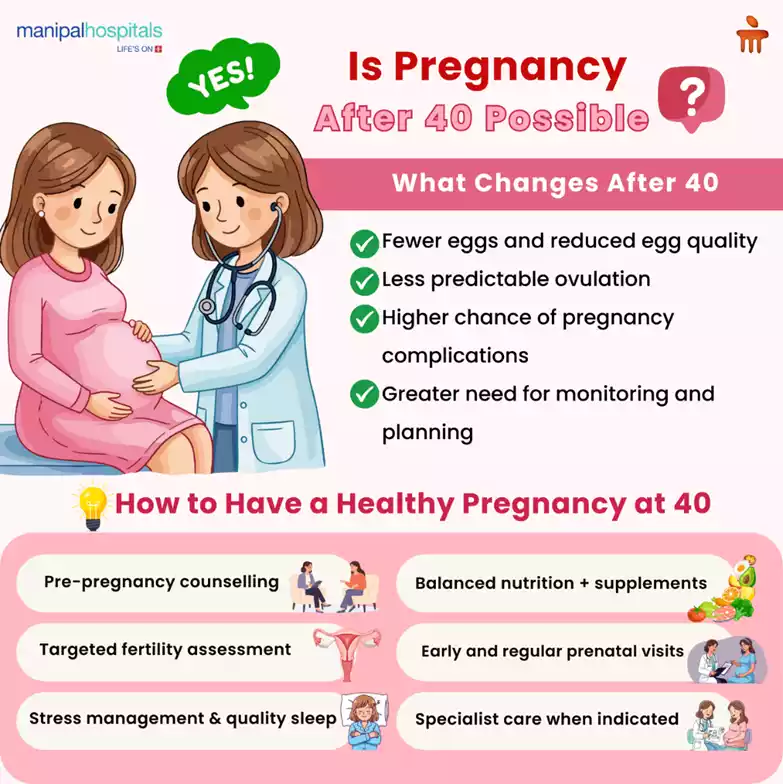
Fertility declines with age because the number and quality of eggs reduce over time. Ovarian reserve falls gradually and accelerates in the late thirties. The menstrual cycle may get more irregular as ovulation patterns shift. These are normal, expected changes and not a reflection of lifestyle or womanhood. They just change the timeline and strategies you and your doctor may use when planning for pregnancy after 40 years.
With increased age comes a heightened risk for complications in pregnancy, such as gestational diabetes, high blood pressure while pregnant, and certain chromosomal abnormalities in the foetus. Knowing this will help you to be prepared and to choose monitoring that reduces the risks for you and your baby.
Understanding the Chances: Realistic Expectations
It provides realistic expectations of the chances of pregnancy after 40. The chances of natural conception decrease as ovarian reserve declines. Rates of conception per menstrual cycle are lower than in younger years. It does not mean it is impossible; it does mean it might take more time, planning, and often medical support.
If you are wondering about pregnancy after 40, remember that individual factors such as previous pregnancies, overall health, body weight, smoking status, and underlying medical conditions all influence outcomes. A frank conversation with a fertility specialist will give you the clearest picture of your situation.
How to Assess Fertility After 40
If you are planning for pregnancy after 40, start with a few straightforward assessments:
-
Medical history and review of prior pregnancies or fertility attempts.
-
A blood test called AMH is used to estimate ovarian reserve.
-
Day-3 hormone levels, including FSH and estradiol, when appropriate.
-
A pelvic ultrasound to look at antral follicle count and reproductive anatomy.
-
Screening for thyroid and metabolic conditions that affect fertility.
These tests do not predict everything, but they guide realistic planning and help advise whether to try naturally, proceed with fertility treatment, or consider other options.
Fertility Options that Improve Success
When natural attempts do not succeed in the time frame you and your doctor set, several fertility options can help. Assisted reproduction, such as in vitro fertilisation, can increase the chances of pregnancy after 40, especially when timed and tailored correctly. In some cases, using donor eggs offers the highest success rates because egg quality plays a major role in implantation and a healthy pregnancy.
Other supportive options include ovarian stimulation protocols, IVI, IVF with careful embryo selection, and preimplantation genetic testing when appropriate. Your fertility team will explain benefits, risks, and likely success rates so you can make informed choices.
Preparing Your Body: Steps for Success
Preparing well improves outcomes and supports how to have a healthy pregnancy at 40. Consider the following practical steps:
-
Optimise your weight: even modest weight loss improves fertility and reduces pregnancy complications.
-
Stop smoking and limit alcohol. Both lower fertility and raise complication risks.
-
Control chronic conditions: effective control of diabetes, blood pressure, and thyroid disorders matters.
-
Start folic acid and review other supplements with your clinician. Some vitamins and minerals support early pregnancy development.
-
Move regularly and build strength gently; exercise improves metabolic health and reduces stress.
-
Check immunisations and address infections before conception when possible.
-
Change the medications accordingly while planning pregnancy.
These measures raise your overall health and create a stronger foundation for conception and pregnancy.
Emotional and Practical Support
Trying for pregnancy after forty can bring a mix of hope, frustration, and practical concerns. Talking with a counsellor or joining a support group helps many women maintain resilience. Practical planning, such as workplace discussions, childcare arrangements, and family support, can ease stress and let you focus on health and treatment if needed.
Common Tests, Timeline and What They Tell You
Testing for fertility may involve several tests that must occur at different stages in a bid to gather a comprehensive overview of fertility status. The below will clarify when these tests and stages must occur and what insight they give to guide further actions and decision-making based on fertility status.
|
Test / Step |
When To Do It |
What It Shows |
|
AMH (blood) |
Before trying or early in assessment |
Estimate of ovarian reserve |
|
Day 3 FSH/Estradiol |
Early cycle if AMH unclear |
Ovarian response indicator |
|
Pelvic ultrasound (antral follicle count) |
During assessment |
Number of recruitable follicles |
|
Thyroid and metabolic screen |
At baseline |
Conditions that affect fertility and pregnancy |
|
Semen analysis (partner) |
With initial workup |
Male factor fertility information |
|
Fertility treatment (IVF/IVI) |
After natural attempts or per plan |
Directly increases chances; may use own or donor eggs |
Pregnancy Risks and How They are Managed
With pregnancy after 40 years, some risks increase, but modern prenatal care mitigates many concerns:
-
Gestational diabetes is more common and is managed with monitoring, diet, and medication when needed.
-
High blood pressure disorders receive close surveillance and timely treatment.
-
Chromosomal screening and diagnostic testing are offered for informed choices.
-
Careful fetal surveillance, including growth scans, helps catch and manage problems early.
A proactive team approach at a top fertility hospital in Mysuru with experience in higher-risk pregnancies improves safety for mother and baby.
Labour, Delivery and Postnatal Considerations
Delivery plans for pregnancy after 40 depend on obstetric history, current pregnancy course, and fetal well-being. Many women have straightforward vaginal births. Others may need a planned cesarean delivery for specific indications. Postnatal care includes monitoring recovery, breastfeeding support, and attention to emotional health. Older birthing parents sometimes need extra time for recovery, and planning ahead helps ensure support is in place.
How To Have A Healthy Pregnancy At 40: Clear Steps
-
Get preconception counseling and optimise chronic conditions.
-
Ensure proper nutrition and start taking folic acid before conception.
-
Follow the recommended screening and diagnostic testing when advised.
-
Maintain regular prenatal visits and ask for a specialist referral if needed.
-
Prioritise sleep, stress reduction, and moderate exercise during pregnancy.
Following these steps improves outcomes and makes pregnancy safer and more manageable.
Conclusion
Yes, it is possible to become pregnant at 40. While it may involve some planning, many women do have healthy pregnancies. Successful planning, proper assessment, and professional consultation are crucial factors. Schedule an appointment with our reproduction medicine experts at Manipal Hospital Mysore for counselling on your plans and strategy for a successful pregnancy at 40 or after 40.
Frequently Asked Questions
Yes. Spontaneous conception can occur, although the probability per cycle is decreased. Collaborate with a provider to evaluate ovarian reserve and plan appropriately.
If you are under 35, the normal advice is one year; after 40, seek evaluation after 3 to 6 months of attempts or sooner based on your individual factors.
Genetic screening and diagnostic testing are available options to consider. Both can provide an idea about chromosomal risks and pregnancy choices.
It is considered a higher risk compared with younger ages, but with monitoring and management, most pregnancies can be safely handled.
Stopping smoking, optimizing weight, managing chronic conditions, and reducing alcohol intake improve fertility and pregnancy outcomes.
Share this Article


Similar Blogs

Insulin Resistance in Women: Early Symptoms You Should Know
17 Jun 20267 Min Read
In the intricate landscape of women's health, certain conditions often go unnoticed until they manifest into more significant concerns. One such silent yet powerful player is insulin resistance. It's a condition where your body's cells don't respond effectively to insulin, leading to elevated blood sugar levels. For many women, understanding the early insulin resistance symptoms in females can be a game-changer, enabling timely intervention and preventing a cascade of health issues. In this blog, an experienced gynaecologist in Mysuru explains in detail the nuances of insulin resistance in women, highlighting the crucial early signs you should be aware of. Recognising these signs of insulin resistance in females is the first step towards taking control of your health journey.
Read NowCOPD vs Asthma: Understanding the Key Differences
05 Jun 20267 Min Read
The ease of breathing is something we rarely notice until something is not right. When breathing becomes a struggle, even the simplest moments can feel overwhelming. Asthma and COPD are common breathing problems affecting millions of people worldwide. Still, many people ask, “Are COPD and asthma the same?” Although both conditions involve airflow limitation and breathing difficulties, they are not identical. It becomes crucial to know about the difference between COPD and asthma in order to diagnose them in a timely manner and treat them properly. In this blog, a leading pulmonologist in Mysuru explains in detail about COPD and asthma including the causes, symptoms, and how to differentiate between the two.
Read NowHow to Make Period Headaches Go Away: Tips and Remedies
05 Jun 20267 Min Read
You’re halfway through your day, and suddenly your head starts throbbing, right around your period. Sound familiar? These headaches may feel different from regular ones. At times, they might even feel like migraines. Hormonal fluctuations, particularly changes in oestrogen levels, are commonly responsible for headaches experienced during menstruation. These headaches are common but can be annoying and challenging to manage. You might notice it starts right before your period or on day one; that pattern matters. The good news is that you can lessen the frequency and severity of headaches during periods by learning more about why they happen and using some simple home remedies. In this blog, we bring you clinical insights from a top gynaecology hospital in Mysuru that explain the causes, symptoms, and useful ways to deal with them.
Read NowIs IVF Painful? What to Expect During Fertility Treatment
22 May 20267 Min Read
It can be challenging to start fertility treatment, especially when you keep asking yourself, "Is IVF painful?" This worry is a big source of stress for many couples, even before the process starts. The truth is, IVF (in vitro fertilisation) is usually not very painful. However, it does involve a number of medical steps that could cause mild discomfort at different points. Knowing what really happens during the process can help you get ready in both your body and mind. In this blog, a top reproductive medicine and IVF specialist in Mysuru explains each step of IVF, answers the question "Is IVF a painful process?" and tells you what kind of pain (if any) to expect. Most patients describe IVF as manageable, though some steps can feel moderately uncomfortable depending on individual sensitivity.
Read NowUnderstanding Fatty Liver Disease: A Gastroenterologist’s Guide to Diagnosis and Care
06 May 20267 Min Read
The problem of fatty liver disease is on the rise, more prevalent in city-dwelling individuals living a sedentary lifestyle. Although initially, it might seem innocuous, leaving the condition unchecked could be dangerous in the long run. Fatty liver causes, symptoms, and treatments are all necessary factors that must be considered to maintain the health of your liver. Through this blog a top gastroenterologist in Mysuru discusses fatty liver, where the focus will be on the diagnosis, risks, and treatment of fatty liver disease. It also addresses practical concerns such as how to reduce fatty liver quickly and prevent long-term damage.
Read NowVaginal Swelling (Vulval swelling): Causes, Symptoms, and Treatment Options
10 Apr 20267 Min Read
Many women have vaginal swelling (vulval swelling) of the hairy skin around the vagina at some point in their lives. Infections, irritation, hormonal changes, or some medical conditions can all cause it. Mild swelling may go away on its own, but swelling that lasts or hurts needs to be diagnosed and treated by a doctor. One common type is vaginal lip swelling, which happens when the labia, the folds of skin around the vaginal opening, get enlarged, sore, or inflamed. Swelling can also happen in some cases because of allergies, infections, or increased blood flow to the pelvic area. Another situation where swelling may occur is vaginal swelling during pregnancy. This isn't usually dangerous, but a doctor should always check for severe swelling or pain that comes with it. Understanding the causes and recognising symptoms can help ensure timely care. Modern vaginal swelling (vulval swelling) treatment focuses on identifying the underlying cause and providing targeted therapy. Women with ongoing symptoms can also get specialised vaginal swelling treatment in Mysore, where doctors can safely check on and treat the problem. In this blog, an obstetrics and gynaecology expert in Mysore talks about the causes of vaginal swelling, the most common symptoms, and the different vaginal swelling (vulval swelling) treatment options.
Read NowHow to Build a Strong Immune System Naturally: Doctor’s Guide for 2026
06 Apr 20268 Min Read
A strong immune system protects the body from viruses, infections, and other health problems. It is made up of different organs, tissues, and cells that work together to defend the body against harmful germs. When the immune system works properly, it can recognise and fight these germs before they make you sick. More people are aware of preventive healthcare these days, which makes natural ways to boost immunity even more important. Instead of just relying on medications or supplements, doctors are putting more and more focus on lifestyle changes that make the immune system stronger. Today, in 2026, doctors and nurses want people to take care of their immune systems in every way possible. This means paying attention to things like nutrition, sleep, mental health, preventive medicine, and making healthy choices in your daily life. In this blog we present you a complete guide on practical, evidence-based ways that doctors say you can naturally boost your immune system and stay healthy for a long time, as recommended by a top internal medicine doctor in Mysore.
Read NowDiscomfort While Eating: Understanding Esophageal Dysphagia
27 Feb 20265 Min Read
Mild discomfort while eating or difficulty while swallowing may seem like nothing serious at first. It is easy to dismiss as a pause while eating or a decrease in eating speed. But when this sensation becomes frequent or distressing, it may point to esophageal dysphagia, a condition that affects how food and liquids travel through the esophagus or the food pipe. Often described as an unpleasant experience of food “getting stuck” after swallowing or a constant urge to clear your throat, this problem can interfere with nutrition, comfort, and everyday life. Through this blog, a top ENT specialist in Mysore helps you understand what esophageal dysphagia symptoms are, why timely esophageal dysphagia treatment is important, and how access to accurate esophageal swallowing disorder diagnosis in Mysore matters for long-term outcomes and quality of life.
Read Now10 Signs Your Liver May Need Detoxing: How to Support Your Liver Health Naturally
25 Feb 20268 Min Read
Many people move through daily life without noticing how the body signals that something feels a bit off. The liver often works quietly in the background, and its messages can feel subtle. When the body begins to show shifts in energy, digestion, or skin comfort, people hardly wonder if the liver is asking for a little more care. This simple guide walks through signs that the body might be telling you something, especially when you are curious about the 10 signs your liver needs detoxing and how natural routines may offer gentle support.
Read NowLung Abscess: An Expert Guide to Symptoms, Diagnosis, and Treatment
25 Feb 20266 Min Read
In many cases, coughs or mild respiratory infections like sore throats settle with time, rest, or basic treatment. But when a cough lingers for weeks, worsens despite medication, or is accompanied by fever, fatigue, or foul-smelling sputum, it may signal something far more serious. One such condition that often hides behind a persistent cough is a lung abscess. In this blog, an experienced pulmonologist in Mysore explains about lung abscess causes and why a persistent cough deserves timely medical attention. He also explores the connection between a persistent cough and lung abscess and addresses why it is not advisable to ignore lung abscess. With practical advice for lung abscess diagnosis in Mysore, he lists out appropriate investigations, prompt medical attention, structured lung abscess treatment, and follow-up care for avoiding serious complications of lung abscess, such as chronic lung injury and systemic infection.
Read NowRecent Blogs
Understanding Metallic Taste in the Mouth: A Kidney's Silent Signal?
19 Jun 20268 Min Read
Have you ever experienced a strange, persistent metallic taste in your mouth? While often benign, this peculiar sensation, medically known as dysgeusia, can sometimes be a subtle yet significant indicator of underlying health issues. There are several causes of metallic taste in the mouth, and one of them is kidney dysfunction. In this blog an experienced nephrologist in Mysuru discusses in detail what a metallic taste in the mouth is, the causes, and more importantly, when it might be a sign that your kidneys are trying to tell you something important.
Read NowInsulin Resistance in Women: Early Symptoms You Should Know
17 Jun 20267 Min Read
In the intricate landscape of women's health, certain conditions often go unnoticed until they manifest into more significant concerns. One such silent yet powerful player is insulin resistance. It's a condition where your body's cells don't respond effectively to insulin, leading to elevated blood sugar levels. For many women, understanding the early insulin resistance symptoms in females can be a game-changer, enabling timely intervention and preventing a cascade of health issues. In this blog, an experienced gynaecologist in Mysuru explains in detail the nuances of insulin resistance in women, highlighting the crucial early signs you should be aware of. Recognising these signs of insulin resistance in females is the first step towards taking control of your health journey.
Read NowDecoding Low Blood Pressure: Symptoms, Causes, and When to Seek Expert Help
17 Jun 20269 Min Read
Blood pressure is a vital sign, a fundamental indicator of our cardiovascular health. While high blood pressure often makes the news, low blood pressure, medically known as hypotension, can also be a concern. It's a condition where the force of blood against your artery walls is unusually low. For some, low blood pressure is a normal state, causing no issues. However, for others, it can lead to troubling symptoms and, in severe cases, indicate an underlying health problem requiring immediate medical attention. In this blog, a top interventional cardiologist in Mysore discusses in detail what low BP is, the causes of low BP, identifying the signs of low BP, and when it should be considered a medical concern.
Read NowKidney Pain vs Back Pain: How to Tell the Difference
12 Jun 20266 Min Read
You bend down to pick something up, and a dull ache settles in your lower back. Is it just muscle strain, or could it be something more serious? Many people struggle to tell the difference between back muscle pain and kidney pain, especially at the start. That is because the two can feel surprisingly similar. Back pain is often linked to posture, overuse, or strained muscles, while kidney pain may point to an infection, kidney stones, or another internal issue that needs medical attention. In this blog, a top nephrologist in Mysuru explains the key differences between kidney pain vs back pain, what usually causes each one, and when it is time to see a doctor.
Read NowUnderstanding the Early Warning Signs of Cancer
12 Jun 20265 Min Read
What if noticing a small change today could protect you from something far more serious tomorrow? Many cancers don’t announce themselves loudly at the start. They begin quietly, with subtle symptoms like feeling constantly tired, noticing a painless lump, or a generalised feeling that something just doesn't feel right inside the body. Although they are easy to brush aside, blame on stress, or postpone addressing, they matter. The survival rate for patients with early-stage malignancies (Stage I or II) is two to three times higher than that of patients with later-stage diagnoses. In addition to improving results, early detection frequently makes treatment easier, recovery quicker, and quality of life higher. Through this blog, an experienced cancer surgeon in Mysuru discusses early cancer warning signs of some common cancers seen in India, whose symptoms warrant medical care, and how prompt screening can make all the difference.
Read NowHow to Make Period Headaches Go Away: Tips and Remedies
05 Jun 20267 Min Read
You’re halfway through your day, and suddenly your head starts throbbing, right around your period. Sound familiar? These headaches may feel different from regular ones. At times, they might even feel like migraines. Hormonal fluctuations, particularly changes in oestrogen levels, are commonly responsible for headaches experienced during menstruation. These headaches are common but can be annoying and challenging to manage. You might notice it starts right before your period or on day one; that pattern matters. The good news is that you can lessen the frequency and severity of headaches during periods by learning more about why they happen and using some simple home remedies. In this blog, we bring you clinical insights from a top gynaecology hospital in Mysuru that explain the causes, symptoms, and useful ways to deal with them.
Read NowCOPD vs Asthma: Understanding the Key Differences
05 Jun 20267 Min Read
The ease of breathing is something we rarely notice until something is not right. When breathing becomes a struggle, even the simplest moments can feel overwhelming. Asthma and COPD are common breathing problems affecting millions of people worldwide. Still, many people ask, “Are COPD and asthma the same?” Although both conditions involve airflow limitation and breathing difficulties, they are not identical. It becomes crucial to know about the difference between COPD and asthma in order to diagnose them in a timely manner and treat them properly. In this blog, a leading pulmonologist in Mysuru explains in detail about COPD and asthma including the causes, symptoms, and how to differentiate between the two.
Read NowIs IVF Painful? What to Expect During Fertility Treatment
22 May 20267 Min Read
It can be challenging to start fertility treatment, especially when you keep asking yourself, "Is IVF painful?" This worry is a big source of stress for many couples, even before the process starts. The truth is, IVF (in vitro fertilisation) is usually not very painful. However, it does involve a number of medical steps that could cause mild discomfort at different points. Knowing what really happens during the process can help you get ready in both your body and mind. In this blog, a top reproductive medicine and IVF specialist in Mysuru explains each step of IVF, answers the question "Is IVF a painful process?" and tells you what kind of pain (if any) to expect. Most patients describe IVF as manageable, though some steps can feel moderately uncomfortable depending on individual sensitivity.
Read NowUnderstanding Fatty Liver Disease: A Gastroenterologist’s Guide to Diagnosis and Care
06 May 20267 Min Read
The problem of fatty liver disease is on the rise, more prevalent in city-dwelling individuals living a sedentary lifestyle. Although initially, it might seem innocuous, leaving the condition unchecked could be dangerous in the long run. Fatty liver causes, symptoms, and treatments are all necessary factors that must be considered to maintain the health of your liver. Through this blog a top gastroenterologist in Mysuru discusses fatty liver, where the focus will be on the diagnosis, risks, and treatment of fatty liver disease. It also addresses practical concerns such as how to reduce fatty liver quickly and prevent long-term damage.
Read NowHeart Attacks in Young People: Early Warnings, Risk Factors and How to Stay Safe
06 May 20267 Min Read
In recent years, cardiologists have been seeing a steady rise in heart attacks in young people, especially those under 40 years. This trend is concerning because many of these events happen without warning and lead to tremendous suffering and loss of young people. Understanding the cause of a heart attack at a young age is important for prevention. Factors like a sedentary lifestyle, stress, and co-existing health conditions can increase the risk. This blog an experienced cardiologist in Mysuru, explains the causes of myocardial infarction among youth, early warning signs, and ways to reduce the risk.
Read Now