


Understanding Hypotonia in Children: Causes, Symptoms, and Treatment Options
Reviewed by: Dr. Bhuvaneshwar US
Posted on
9 Min Read

Not sure what you’re looking for?
Get in touch with our representatives for help!
Contact UsSome babies take longer than usual to attain neck stability and hold their head up, or fail to move their limbs. Even as they start to move eventually, their movements might seem weak and unsteady. This happens when the child is affected by hypotonia.
This article brings a detailed understanding of what hypotonia is, what the early identification signs of hypotonia are, when to seek medical help for hypotonia, and what kind of support may help children with hypotonia grow with confidence.
What is Hypotonia?
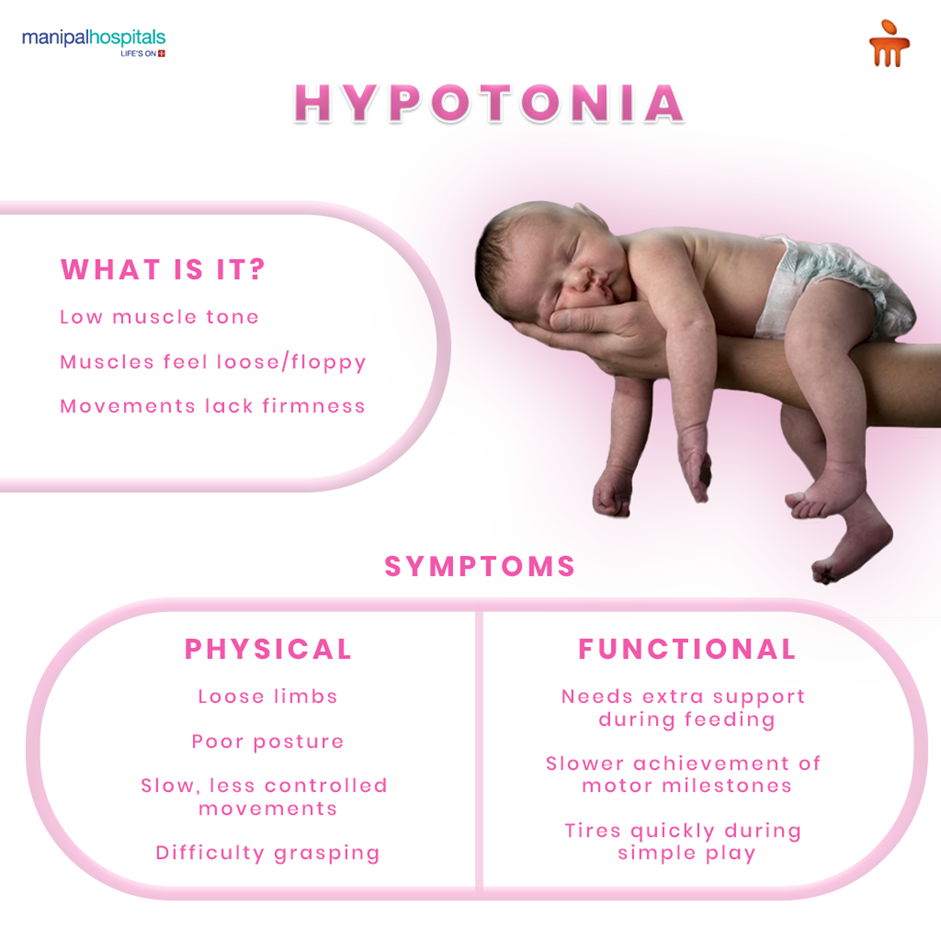
Hypotonia, also called "floppy infant syndrome", describes a condition where a child’s muscles feel looser than usual or lack firmness. It may either be present at birth - neonatal hypotonia or show up during infancy (within the first year) - infantile hypotonia. Some children with this condition move more slowly or need more time to manage everyday movements, prompting parents to seek medical help at the leading paediatric hospital in Mysuru.
Understanding Early Signs of Hypotonia
Many families notice early signs during everyday routines. These signs can differ from child to child, but a few patterns appear often. Some children have trouble holding up their heads. Others may feel floppy when lifted. These simple observations encourage families to speak with a medical team. Common early indicators include:
-
Rolling, sitting, or crawling may take more time
-
Feeding may feel challenging as holding the posture becomes tiring
-
Joints may look more flexible than usual
-
Movements can appear slower or less controlled
These indicators do not confirm hypotonia, yet they guide people towards further checks. Patterns such as neonatal hypotonia are noted quite early, while infantile hypotonia becomes clearer as development unfolds through the first months.
Causes of Hypotonia in Children
There are several causes of hypotonia in children. Sometimes the cause appears at birth. Other times it develops during childhood. Many situations have explanations that remain clear, but a few might require more exploration.
-
Congenital Factors: Some children are born with conditions that influence how their muscles respond. When this happens, the pattern is often noticed as neonatal hypotonia. Babies with this early presentation show signs within days or weeks of life. These outcomes follow developmental pathways that begin during pregnancy.
-
Developmental Factors: There are also situations where the body works differently as the child grows. These patterns may progress slowly. They might become obvious when the child reaches new milestones. Infantile hypotonia often fits into this category. Infants may struggle slightly with stability or coordination, and parents sense that something feels unusual.
-
Environmental Influences: There are instances where external factors affect the body’s responses. Illnesses, nutritional gaps, or other short-term concerns may contribute. These influences can make the child appear less firm or less steady. With time and supportive care, many of these situations improve.
-
Genetic Pathways: Some causes follow family patterns. Certain genetic conditions may shape the way the body holds posture or manages movement. This is not always the case, yet it is one part of the broader picture. Families are encouraged to seek guidance if they notice repeated patterns among close relatives.
Symptoms of Hypotonia
Symptoms of hypotonia are variable, ranging from very subtle to obvious. Since the symptoms first appear during early growth, they are often noticed by parents of other family members during feeding times, play sessions, and interactions. The symptoms are classified as follows:
Physical Signs
-
Delayed head control
-
Arms and legs feeling looser
-
Difficulty maintaining posture
-
Challenges with grasping objects
-
Lower stability during simple movements
Children with neonatal hypotonia often show these symptoms at birth. Those with infantile hypotonia may show them later, but still early in life. Watching for these patterns helps parents decide when to seek a check.
Functional Signs
Symptoms also appear during daily routines. Dressing the child may feel different. Holding the child upright may require more support. Reaching for toys might take extra effort. Crawling and sitting require more time, which may raise concerns. These simple observations help guide families toward supportive resources.
How Hypotonia Affects Daily Life?
Children with Hypotonia navigate the world at their own pace. It is important for parents and primary caregivers to understand the impact hypotonia has on their child's routine activities and make suitable adjustments.
-
Impact on Mobility: Mobility might develop more slowly. Sitting may take longer. Rolling over might seem difficult. Crawling, pulling to stand, and walking may appear delayed. This does not define the child’s ability; it only means they grow through a different timeline.
-
Impact on Social Interactions: Children with hypotonia may prefer shorter play periods because movements tire them sooner. They may need more breaks during activity. Interaction remains joyful and meaningful, although they might adjust their pace. Parents often find creative ways to keep play lively without overwhelming the child.
-
Impact on Daily Activities: Simple activities such as holding a cup, reaching for food, or climbing on a sofa may require more time. The child often improves with practice and steady support. Families learn to create routines that encourage growth at a comfortable pace.
Diagnosis and Evaluation
Evaluation for Hypotonia starts with observation. Medical teams look at how the child moves, holds posture, and responds during simple tasks. There is no single test that identifies hypotonia every time. Instead, assessment includes various small steps.
What the Evaluation May Include
-
Observing the child during feeding and play
-
Checking posture and flexibility
-
Reviewing early milestones
-
Assessing the pace of movement development
-
Discussing birth history and family background
Diagnosing patterns such as neonatal hypotonia or infantile hypotonia requires attention to timing. Early signs point towards the neonatal pattern, while later signs lean towards the infantile pattern.
Why Early Checks Matter
Early checks help families understand what support may benefit the child. They also guide decisions about therapies or other interventions. When people act early, the child receives time to grow with more comfort and stability.
Treatment Options Available
Treatment for hypotonia focuses on helping children build strength, coordination, and confidence. It does not follow a single plan because each child’s needs differ. Care teams usually develop individual pathways that feel realistic for families.
-
Therapy-Based Support: Therapies often play a central part in supporting children. Sessions often involve small movements that help a child find better balance and control. They use their arms and legs in steady, repeated ways that slowly build confidence. Families also learn a few easy activities they can try at home during normal daily moments
-
Home-Based Activities: Caregivers play an important role in helping children progress. Simple routines such as gentle stretching, playful reaching activities, or supported sitting can help. These do not replace therapy but contribute nicely to daily progress.
-
Addressing Underlying Causes: When Hypotonia is connected to another condition, supporting that underlying factor becomes part of the plan. If the cause is nutritional, guidance is offered. If illness contributes, recovery often leads to improvement. When genetic concerns are present, families are given clearer pathways for support.
Living with Hypotonia
Life with hypotonia brings both challenges and meaningful steps forward. Families often learn new ways to encourage progress. Each milestone becomes a moment of celebration. There is no fixed timeline, and children develop through varied experiences.
-
Role of Caregivers: Caregivers often adapt routines to help the child grow steadily. They learn supportive positions for feeding and create playful moments that strengthen the child’s movements. They observe small improvements that guide further steps.
-
Building Confidence Over Time: Children with patterns such as neonatal hypotonia or infantile hypotonia can gain confidence through regular practice. They learn that movement becomes easier through repetition. Families watch these changes and often feel reassured as progress becomes visible.
How to Support a Child at Home?
There are simple steps families can try at home. These steps do not replace therapy but support daily growth. They create an environment where the child can practise movements safely.
Simple, Supportive Ideas
-
Encourage short play sessions that involve reaching
-
Allow the child to explore safe spaces on the floor
-
Support sitting with cushions placed nearby
-
Offer toys that invite grasping and holding
-
Include gentle pushing or pulling games
These small steps help children learn movement patterns in natural ways. Families often combine home activities with professional guidance for better outcomes.
When to Seek Guidance?
Parents often wonder when they should speak with a healthcare team. It may be time to seek guidance when everyday tasks become noticeably harder for the child. Struggles with holding the head, moving limbs, or reaching for objects may raise questions. Delays in major milestones also prompt a check.
What Families Can Expect?
Families can expect clear explanations and supportive conversations. They can ask questions freely, discuss early signs and talk about patterns that seem connected to neonatal hypotonia or infantile hypotonia. These discussions help families understand what steps to take next.
A Short Note
Children with hypotonia often make progress in meaningful ways. Some improve steadily, while others move in small steps. Both paths hold value. Families learn to appreciate the child’s pace and celebrate achievements that appear through patient support.
If you feel unsure about your child’s movements, you can reach out to the paediatrics team at Manipal Hospital Mysuru. They offer conversations, assessments, and guidance that help families understand what their child may need during early development.
Frequently Asked Questions
Hypotonia means a child’s muscles feel looser than usual, so some movements take more time. Parents often notice this during the early months when certain milestones come later. Every child is different, so calm observation helps people understand what they are seeing.
Some families notice signs during infancy, especially in patterns like neonatal Hypotonia. Babies might feel less firm when lifted or may need more time to hold their head steady. These early moments help parents decide when to seek a check.
Assessment usually involves watching how the child moves, holds posture, and responds during simple activities. Teams may ask about birth details and daily routines to build a clearer picture. There is no single test, so evaluation happens through small steps.
Many children with hypotonia show progress through regular support and simple therapy. Activities that encourage balance and control help them grow at a comfortable pace. Families often notice gradual changes that feel meaningful.
If parents notice unsteady body movements, delay in their child's milestones, such as failure to attain neck stability, head control, or body firmness, or if the child experiences difficulty in managing everyday tasks, they can consider consulting an expert. Early guidance helps families understand the next steps.
Share this Article


Recent Blogs

Understanding Metallic Taste in the Mouth: A Kidney's Silent Signal?
19 Jun 20268 Min Read
Have you ever experienced a strange, persistent metallic taste in your mouth? While often benign, this peculiar sensation, medically known as dysgeusia, can sometimes be a subtle yet significant indicator of underlying health issues. There are several causes of metallic taste in the mouth, and one of them is kidney dysfunction. In this blog an experienced nephrologist in Mysuru discusses in detail what a metallic taste in the mouth is, the causes, and more importantly, when it might be a sign that your kidneys are trying to tell you something important.
Read NowInsulin Resistance in Women: Early Symptoms You Should Know
17 Jun 20267 Min Read
In the intricate landscape of women's health, certain conditions often go unnoticed until they manifest into more significant concerns. One such silent yet powerful player is insulin resistance. It's a condition where your body's cells don't respond effectively to insulin, leading to elevated blood sugar levels. For many women, understanding the early insulin resistance symptoms in females can be a game-changer, enabling timely intervention and preventing a cascade of health issues. In this blog, an experienced gynaecologist in Mysuru explains in detail the nuances of insulin resistance in women, highlighting the crucial early signs you should be aware of. Recognising these signs of insulin resistance in females is the first step towards taking control of your health journey.
Read NowDecoding Low Blood Pressure: Symptoms, Causes, and When to Seek Expert Help
17 Jun 20269 Min Read
Blood pressure is a vital sign, a fundamental indicator of our cardiovascular health. While high blood pressure often makes the news, low blood pressure, medically known as hypotension, can also be a concern. It's a condition where the force of blood against your artery walls is unusually low. For some, low blood pressure is a normal state, causing no issues. However, for others, it can lead to troubling symptoms and, in severe cases, indicate an underlying health problem requiring immediate medical attention. In this blog, a top interventional cardiologist in Mysore discusses in detail what low BP is, the causes of low BP, identifying the signs of low BP, and when it should be considered a medical concern.
Read NowKidney Pain vs Back Pain: How to Tell the Difference
12 Jun 20266 Min Read
You bend down to pick something up, and a dull ache settles in your lower back. Is it just muscle strain, or could it be something more serious? Many people struggle to tell the difference between back muscle pain and kidney pain, especially at the start. That is because the two can feel surprisingly similar. Back pain is often linked to posture, overuse, or strained muscles, while kidney pain may point to an infection, kidney stones, or another internal issue that needs medical attention. In this blog, a top nephrologist in Mysuru explains the key differences between kidney pain vs back pain, what usually causes each one, and when it is time to see a doctor.
Read NowUnderstanding the Early Warning Signs of Cancer
12 Jun 20265 Min Read
What if noticing a small change today could protect you from something far more serious tomorrow? Many cancers don’t announce themselves loudly at the start. They begin quietly, with subtle symptoms like feeling constantly tired, noticing a painless lump, or a generalised feeling that something just doesn't feel right inside the body. Although they are easy to brush aside, blame on stress, or postpone addressing, they matter. The survival rate for patients with early-stage malignancies (Stage I or II) is two to three times higher than that of patients with later-stage diagnoses. In addition to improving results, early detection frequently makes treatment easier, recovery quicker, and quality of life higher. Through this blog, an experienced cancer surgeon in Mysuru discusses early cancer warning signs of some common cancers seen in India, whose symptoms warrant medical care, and how prompt screening can make all the difference.
Read NowHow to Make Period Headaches Go Away: Tips and Remedies
05 Jun 20267 Min Read
You’re halfway through your day, and suddenly your head starts throbbing, right around your period. Sound familiar? These headaches may feel different from regular ones. At times, they might even feel like migraines. Hormonal fluctuations, particularly changes in oestrogen levels, are commonly responsible for headaches experienced during menstruation. These headaches are common but can be annoying and challenging to manage. You might notice it starts right before your period or on day one; that pattern matters. The good news is that you can lessen the frequency and severity of headaches during periods by learning more about why they happen and using some simple home remedies. In this blog, we bring you clinical insights from a top gynaecology hospital in Mysuru that explain the causes, symptoms, and useful ways to deal with them.
Read NowCOPD vs Asthma: Understanding the Key Differences
05 Jun 20267 Min Read
The ease of breathing is something we rarely notice until something is not right. When breathing becomes a struggle, even the simplest moments can feel overwhelming. Asthma and COPD are common breathing problems affecting millions of people worldwide. Still, many people ask, “Are COPD and asthma the same?” Although both conditions involve airflow limitation and breathing difficulties, they are not identical. It becomes crucial to know about the difference between COPD and asthma in order to diagnose them in a timely manner and treat them properly. In this blog, a leading pulmonologist in Mysuru explains in detail about COPD and asthma including the causes, symptoms, and how to differentiate between the two.
Read NowIs IVF Painful? What to Expect During Fertility Treatment
22 May 20267 Min Read
It can be challenging to start fertility treatment, especially when you keep asking yourself, "Is IVF painful?" This worry is a big source of stress for many couples, even before the process starts. The truth is, IVF (in vitro fertilisation) is usually not very painful. However, it does involve a number of medical steps that could cause mild discomfort at different points. Knowing what really happens during the process can help you get ready in both your body and mind. In this blog, a top reproductive medicine and IVF specialist in Mysuru explains each step of IVF, answers the question "Is IVF a painful process?" and tells you what kind of pain (if any) to expect. Most patients describe IVF as manageable, though some steps can feel moderately uncomfortable depending on individual sensitivity.
Read NowUnderstanding Fatty Liver Disease: A Gastroenterologist’s Guide to Diagnosis and Care
06 May 20267 Min Read
The problem of fatty liver disease is on the rise, more prevalent in city-dwelling individuals living a sedentary lifestyle. Although initially, it might seem innocuous, leaving the condition unchecked could be dangerous in the long run. Fatty liver causes, symptoms, and treatments are all necessary factors that must be considered to maintain the health of your liver. Through this blog a top gastroenterologist in Mysuru discusses fatty liver, where the focus will be on the diagnosis, risks, and treatment of fatty liver disease. It also addresses practical concerns such as how to reduce fatty liver quickly and prevent long-term damage.
Read NowHeart Attacks in Young People: Early Warnings, Risk Factors and How to Stay Safe
06 May 20267 Min Read
In recent years, cardiologists have been seeing a steady rise in heart attacks in young people, especially those under 40 years. This trend is concerning because many of these events happen without warning and lead to tremendous suffering and loss of young people. Understanding the cause of a heart attack at a young age is important for prevention. Factors like a sedentary lifestyle, stress, and co-existing health conditions can increase the risk. This blog an experienced cardiologist in Mysuru, explains the causes of myocardial infarction among youth, early warning signs, and ways to reduce the risk.
Read Now