


Early Signs of Arthritis and How to Act Before Joint Damage
Reviewed by: Dr. Ravikiran H G
Posted on
7 Min Read

Not sure what you’re looking for?
Get in touch with our representatives for help!
Contact UsDo your joints feel stiff in the morning or after sitting for a while? Small changes in movement, joint stiffness, or discomfort can be the first hint of a long-term joint condition. Noticing early symptoms of arthritis helps you act before damage becomes significant. This blog explains what to watch for, how signs vary by joint, what stage 1 early arthritis in hands looks like, the common early symptoms of arthritis in knees, and the steps you can take now. Read on so you know what to do and where to get appropriate arthritis treatment in Mysore if needed.
What Is Early Arthritis?
Arthritis describes inflammation and wear in a joint. Early arthritis is that stage of the disease where the effect on the joints is still subtle without any obvious damage and symptoms are still bearable. Lifestyle changes, seeking targeted tests, and starting effective treatment at this stage can help slow the progression and prevent damage to the joints. Understanding what the early signs of arthritis are gives you a clear path to timely care and better long-term function.
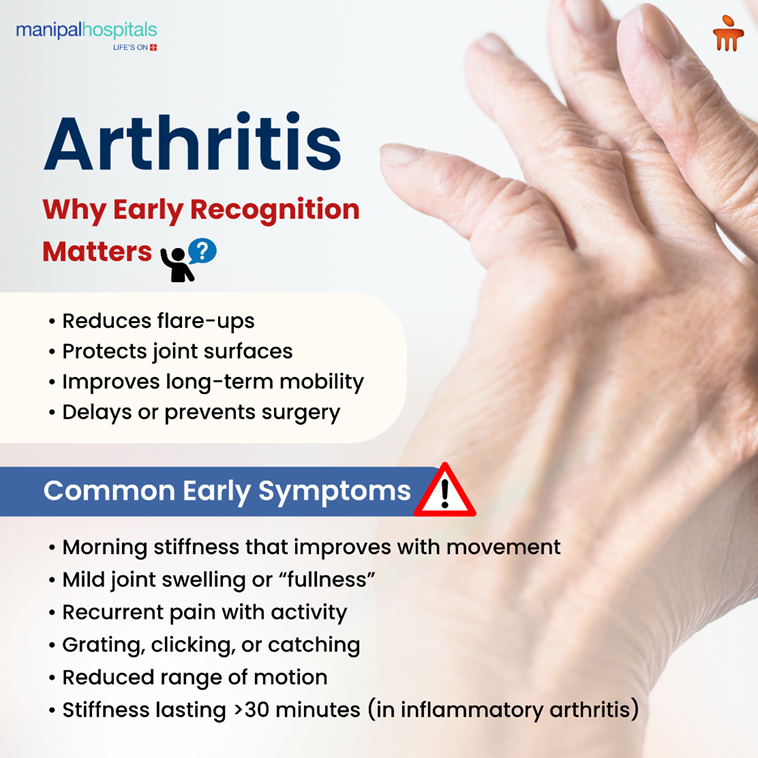
Common Early Signs of Arthritis
The following are the most common early symptoms of arthritis to watch for:
-
Joint stiffness that eases after movement.
-
Brief swelling or a feeling of fullness in the joint.
-
A grating or catching sensation with certain movements.
-
Mild but recurring pain with activity.
-
Reduced range of motion compared to the other side.
-
Morning stiffness lasting more than 30 minutes in inflammatory forms.
These signs can come and go at first. Because the symptoms are often mild, it is easy to dismiss them. That is why awareness matters.
Early Signs by Joint
Listed below are the typical early signs of arthritis in the most commonly affected joints. Use this as a quick reference to compare your symptoms.
|
Joint |
Typical Early Signs |
|
Hands |
Stiffness when gripping, difficulty opening jars, tender finger joints |
|
Knees |
Pain with stairs, swelling after activity, and difficulty fully straightening the leg |
|
Hips |
Stiffness when standing after sitting, discomfort that radiates to the groin or thigh |
|
Spine |
Localised back stiffness, reduced bending or twisting, intermittent nerve symptoms |
|
Shoulders |
Difficulty lifting the arm, aching with overhead activities, and catching sensation |
Practical Self-Checks You Can Do
You can perform simple checks at home to note changes:
-
Test morning stiffness timing. If it lasts more than 30 minutes, note that detail.
-
Compare joint movement with the opposite side. Asymmetry is significant.
-
Track pain related to specific activities like stairs or opening jars.
-
Check for morning grip weakness or difficulty with buttons.
Record findings and bring them to your appointment. Small details help the clinician decide next steps.
How Early Arthritis Is Diagnosed
Diagnosis begins with history and focused examination. The clinician will ask about symptom pattern, timing, and activities that worsen or improve the pain.
Typical diagnostic steps include:
-
Clinical examination of joint swelling, range of motion, and strength.
-
Simple X-rays to look for joint space narrowing or bone changes.
-
Ultrasound for soft tissue inflammation.
-
Blood tests are performed when inflammatory arthritis is a possibility.
-
MRI is used in selected cases when early structural change is suspected but not visible on X-ray.
Early diagnosis often relies on clinical skill. Tests support decisions, but the earliest window for intervention often occurs before dramatic imaging changes appear.
Non-Surgical Management for Early Arthritis
Many interventions reduce symptoms and slow progression when started early:
-
Physiotherapy to strengthen surrounding muscles and improve joint mechanics.
-
Targeted exercises to preserve the range of motion and function.
-
Weight management to reduce joint load, particularly for knees and hips.
-
Topical or oral anti-inflammatory medications for symptomatic relief.
-
Short-term use of splints or braces to support affected joints.
-
Joint protection techniques in daily tasks.
Early, consistent application of non-surgical measures often delays or prevents the need for invasive procedures.
When Medication or Injection is Appropriate
If symptoms persist despite conservative measures, medical options are available:
-
Nonsteroidal anti-inflammatory drugs for short-term symptom control.
-
Intra-articular injections, such as corticosteroid injections, are used to calm a flare.
-
Viscosupplementation in selected knee cases to improve joint lubrication.
-
Disease-modifying agents for inflammatory arthritis are used when diagnosed.
Your clinician will match therapy to your diagnosis, symptom severity, and overall health goals.
Surgical Options for Advanced or Refractory Cases
Surgery is rarely necessary in the earliest stages. When degeneration or persistent pain affects function despite optimal conservative care, options include:
-
Arthroscopic procedures to address mechanical symptoms in selected cases.
-
Realignment osteotomy in early uni-compartmental knee disease for appropriate candidates.
-
Joint replacement is considered when severe pain and loss of function persist.
Because early recognition often reduces the need for surgery, timely care remains the best strategy.
How to Prepare for A Clinical Visit
Gathering a few items before your appointment speeds diagnosis:
-
A symptom diary noting when pain occurs and what eases it.
-
Photos or notes of visible swelling or deformity, if present.
-
List of current medicines and any past joint injuries.
-
Questions you want to discuss, for example, about arthritis treatment in Mysore.
A well-prepared visit focuses time on diagnosis and the most effective next steps.
Living Well with Early Arthritis
Daily habits make a practical difference:
-
Keep active with low-impact exercise such as walking, swimming, or cycling.
-
Build strength through guided resistance work.
-
Use adaptive tools when required to reduce joint strain.
-
Balance rest and activity during flare-ups; avoid prolonged immobilisation.
-
Maintain a healthy weight to reduce knee stress.
Small, consistent changes combine to protect joints and improve comfort.
When to Seek Urgent Care
Seek prompt clinical advice if you notice:
-
Rapidly increasing swelling or severe pain unrelieved by simple measures.
-
New loss of motion or sudden inability to bear weight.
-
Signs of infection, such as fever with joint warmth and severe pain.
Timely review prevents complications and ensures infection or other urgent causes are not missed.
Conclusion
Knowing early symptoms of arthritis empowers you to act before the condition worsens. Consult our expert orthopaedic and rheumatology teams at Manipal Hospital Mysore for specialized diagnosis and a range of treatments. Early care preserves function and improves daily life.
Frequently Asked Questions
The earliest signals include morning stiffness, mild joint swelling, pain with specific activities, and reduced range of motion. Note timing, triggers, and whether symptoms improve with movement.
Stage 1 is marked by intermittent stiffness and mild discomfort with preserved daily function. Structural damage is minimal, so interventions often slow progression effectively.
Stage 1 is marked by intermittent stiffness and mild discomfort with preserved daily function. Structural damage is minimal, so interventions often slow progression effectively.
Early knee signs include pain on stairs, swelling after activity, feelings of instability, and creaking or locking. Weight loss and strengthening exercises help reduce symptoms.
Appropriate, low-impact exercise guided by a therapist improves strength and joint mechanics. High-impact activities without guidance can aggravate symptoms, so follow a tailored plan.
Share this Article


Recent Blogs

Understanding Metallic Taste in the Mouth: A Kidney's Silent Signal?
19 Jun 20268 Min Read
Have you ever experienced a strange, persistent metallic taste in your mouth? While often benign, this peculiar sensation, medically known as dysgeusia, can sometimes be a subtle yet significant indicator of underlying health issues. There are several causes of metallic taste in the mouth, and one of them is kidney dysfunction. In this blog an experienced nephrologist in Mysuru discusses in detail what a metallic taste in the mouth is, the causes, and more importantly, when it might be a sign that your kidneys are trying to tell you something important.
Read NowInsulin Resistance in Women: Early Symptoms You Should Know
17 Jun 20267 Min Read
In the intricate landscape of women's health, certain conditions often go unnoticed until they manifest into more significant concerns. One such silent yet powerful player is insulin resistance. It's a condition where your body's cells don't respond effectively to insulin, leading to elevated blood sugar levels. For many women, understanding the early insulin resistance symptoms in females can be a game-changer, enabling timely intervention and preventing a cascade of health issues. In this blog, an experienced gynaecologist in Mysuru explains in detail the nuances of insulin resistance in women, highlighting the crucial early signs you should be aware of. Recognising these signs of insulin resistance in females is the first step towards taking control of your health journey.
Read NowDecoding Low Blood Pressure: Symptoms, Causes, and When to Seek Expert Help
17 Jun 20269 Min Read
Blood pressure is a vital sign, a fundamental indicator of our cardiovascular health. While high blood pressure often makes the news, low blood pressure, medically known as hypotension, can also be a concern. It's a condition where the force of blood against your artery walls is unusually low. For some, low blood pressure is a normal state, causing no issues. However, for others, it can lead to troubling symptoms and, in severe cases, indicate an underlying health problem requiring immediate medical attention. In this blog, a top interventional cardiologist in Mysore discusses in detail what low BP is, the causes of low BP, identifying the signs of low BP, and when it should be considered a medical concern.
Read NowKidney Pain vs Back Pain: How to Tell the Difference
12 Jun 20266 Min Read
You bend down to pick something up, and a dull ache settles in your lower back. Is it just muscle strain, or could it be something more serious? Many people struggle to tell the difference between back muscle pain and kidney pain, especially at the start. That is because the two can feel surprisingly similar. Back pain is often linked to posture, overuse, or strained muscles, while kidney pain may point to an infection, kidney stones, or another internal issue that needs medical attention. In this blog, a top nephrologist in Mysuru explains the key differences between kidney pain vs back pain, what usually causes each one, and when it is time to see a doctor.
Read NowUnderstanding the Early Warning Signs of Cancer
12 Jun 20265 Min Read
What if noticing a small change today could protect you from something far more serious tomorrow? Many cancers don’t announce themselves loudly at the start. They begin quietly, with subtle symptoms like feeling constantly tired, noticing a painless lump, or a generalised feeling that something just doesn't feel right inside the body. Although they are easy to brush aside, blame on stress, or postpone addressing, they matter. The survival rate for patients with early-stage malignancies (Stage I or II) is two to three times higher than that of patients with later-stage diagnoses. In addition to improving results, early detection frequently makes treatment easier, recovery quicker, and quality of life higher. Through this blog, an experienced cancer surgeon in Mysuru discusses early cancer warning signs of some common cancers seen in India, whose symptoms warrant medical care, and how prompt screening can make all the difference.
Read NowHow to Make Period Headaches Go Away: Tips and Remedies
05 Jun 20267 Min Read
You’re halfway through your day, and suddenly your head starts throbbing, right around your period. Sound familiar? These headaches may feel different from regular ones. At times, they might even feel like migraines. Hormonal fluctuations, particularly changes in oestrogen levels, are commonly responsible for headaches experienced during menstruation. These headaches are common but can be annoying and challenging to manage. You might notice it starts right before your period or on day one; that pattern matters. The good news is that you can lessen the frequency and severity of headaches during periods by learning more about why they happen and using some simple home remedies. In this blog, we bring you clinical insights from a top gynaecology hospital in Mysuru that explain the causes, symptoms, and useful ways to deal with them.
Read NowCOPD vs Asthma: Understanding the Key Differences
05 Jun 20267 Min Read
The ease of breathing is something we rarely notice until something is not right. When breathing becomes a struggle, even the simplest moments can feel overwhelming. Asthma and COPD are common breathing problems affecting millions of people worldwide. Still, many people ask, “Are COPD and asthma the same?” Although both conditions involve airflow limitation and breathing difficulties, they are not identical. It becomes crucial to know about the difference between COPD and asthma in order to diagnose them in a timely manner and treat them properly. In this blog, a leading pulmonologist in Mysuru explains in detail about COPD and asthma including the causes, symptoms, and how to differentiate between the two.
Read NowIs IVF Painful? What to Expect During Fertility Treatment
22 May 20267 Min Read
It can be challenging to start fertility treatment, especially when you keep asking yourself, "Is IVF painful?" This worry is a big source of stress for many couples, even before the process starts. The truth is, IVF (in vitro fertilisation) is usually not very painful. However, it does involve a number of medical steps that could cause mild discomfort at different points. Knowing what really happens during the process can help you get ready in both your body and mind. In this blog, a top reproductive medicine and IVF specialist in Mysuru explains each step of IVF, answers the question "Is IVF a painful process?" and tells you what kind of pain (if any) to expect. Most patients describe IVF as manageable, though some steps can feel moderately uncomfortable depending on individual sensitivity.
Read NowUnderstanding Fatty Liver Disease: A Gastroenterologist’s Guide to Diagnosis and Care
06 May 20267 Min Read
The problem of fatty liver disease is on the rise, more prevalent in city-dwelling individuals living a sedentary lifestyle. Although initially, it might seem innocuous, leaving the condition unchecked could be dangerous in the long run. Fatty liver causes, symptoms, and treatments are all necessary factors that must be considered to maintain the health of your liver. Through this blog a top gastroenterologist in Mysuru discusses fatty liver, where the focus will be on the diagnosis, risks, and treatment of fatty liver disease. It also addresses practical concerns such as how to reduce fatty liver quickly and prevent long-term damage.
Read NowHeart Attacks in Young People: Early Warnings, Risk Factors and How to Stay Safe
06 May 20267 Min Read
In recent years, cardiologists have been seeing a steady rise in heart attacks in young people, especially those under 40 years. This trend is concerning because many of these events happen without warning and lead to tremendous suffering and loss of young people. Understanding the cause of a heart attack at a young age is important for prevention. Factors like a sedentary lifestyle, stress, and co-existing health conditions can increase the risk. This blog an experienced cardiologist in Mysuru, explains the causes of myocardial infarction among youth, early warning signs, and ways to reduce the risk.
Read Now