


Testicular Cancer Explained: Early Signs, Causes, Stages, Diagnosis & Treatment Options
Reviewed by: Manipal Hospitals
Posted on
7 Min Read

Not sure what you’re looking for?
Get in touch with our representatives for help!
Contact UsTesticular cancer might not be a topic many openly discuss, but it’s one every man should be aware of it especially if you're in your 20s, 30s or 40s. This type of cancer affects the testicles, part of the male reproductive system and is responsible for producing sperm and testosterone. While testicular cancer is rare compared to other cancers, it’s the most common cancer in younger men. However, most cases are highly treatable, even when diagnosed at a later stage.
This blog explains everything you need to know, from early signs of testicular cancer to its causes, diagnosis, and treatment options. We aim to help you or your loved ones recognise testicular cancer symptoms early and feel empowered to take the right steps.
Let’s start with the basics.
What Is Testicular Cancer?
To put it simply, testicular cancer occurs when cells in one or both testicles begin to grow uncontrollably. These can form a lump or tumour. While the condition is rare compared to other cancers, it is most likely to affect young and middle-aged men.
We observed two main types of testicular cancer:
-
Seminomas - slow-growing and usually found in older men.
-
Non-seminomas – more aggressive and tend to grow quickly.
No matter the type, most cases respond well to treatment, especially when diagnosed early.
What are the Symptoms of Testicular Cancer?
The early signs of testicular cancer are often subtle, but paying attention to your body can help you spot them early. It’s important to know the early signs of testicular cancer so you can act quickly.
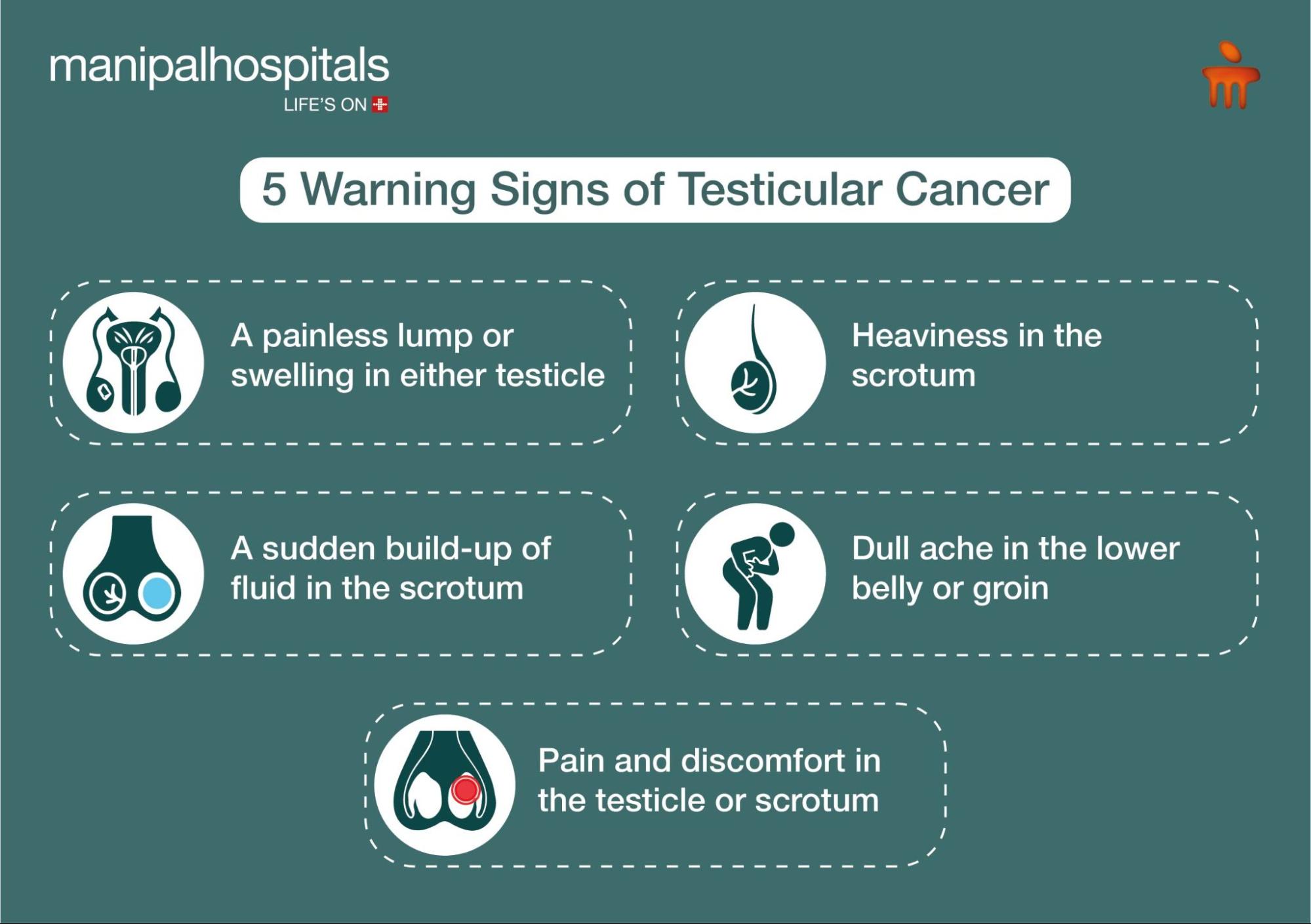
So, below are the 5 testicular cancer symptoms:
-
A painless lump or swelling in either testicle
-
Heaviness in the scrotum
-
A sudden build-up of fluid in the scrotum
-
Dull ache in the lower belly or groin
-
Pain and discomfort in the testicle or scrotum
Some people also experience below listed signs as testicular cancer symptoms:
-
Due to hormone changes, there might be breast tenderness or growth
-
Lower back pain may occur if the cancer has spread.
These signs may not always mean cancer. But if they persist for more than a few days, get them checked.
Testicular Cancer Causes and Risk Factors
The exact causes of testicular cancer are still unclear, but doctors believe it’s linked to genetic and developmental factors.
Common risk factors include:
-
Undescended testicle (cryptorchidism)
-
Family history of testicular cancer
-
Abnormal testicle development (conditions like Klinefelter syndrome)
-
Age – most common between 15 and 45
-
Ethnicity – higher risk in white men
Having one or more risk factors doesn’t guarantee you’ll get it, but it’s a reason to be more aware of your body.
Stages of Testicular Cancer
Once diagnosed, doctors will try to figure out how far the cancer has spread. This is called staging.
Testicular Cancer Stages:
-
Stage 0: This is also called Carcinoma in situ. In this stage, the cancer cells are only in the testicle and haven’t spread.
-
Stage 1: Cancer is only in the testicle but may have invaded nearby tissues.
-
Stage 2: Cancer has spread to the lymph nodes.
-
Stage 3: Cancer has spread to distant parts of the body (lungs, liver, etc.)
Early-stage cancers have an excellent survival rate, over 95% if caught early. That’s why early detection is key.
Testicular Cancer Diagnosis: Tests and Exams
So, how is testicular cancer found?
It usually starts with a physical check-up. If your doctor suspects anything unusual, they may suggest:
-
Ultrasound of the scrotum: to get a closer look at any lumps
-
Blood tests: to check for tumour markers (proteins made by cancer cells)
-
MRI or CT scan: to detect if the cancer has spread
-
Surgical removal (orchiectomy): Sometimes the testicle may be removed to confirm the diagnosis and stop the spread
Testicular Cancer Treatment Options
The treatment for testicular cancer depends on the type, stage, and overall health. The doctor will personalise the care, but here are the most common testicular cancer treatment paths:
1. Surgery (Orchiectomy)
This is the first step in almost all cases. The affected testicle is removed to prevent the cancer from spreading. It’s a simple, safe procedure. Most men live healthy lives with one testicle.
2. Radiation Therapy
Mainly used for seminomas. In this treatment, powerful X-rays are used to kill cancer cells. It may be used after surgery to reduce the risk of cancer returning.
3. Chemotherapy
This is more common when cancer has spread or for non-seminomas. In this treatment, drugs are used to destroy cancer cells in the body. While it may cause side effects like nausea and hair loss. This is a very effective testicular cancer treatment.
4. Active Surveillance
For early-stage cancer, your doctor may recommend watchful waiting. You’ll have regular check-ups, scans, and blood tests. This avoids unnecessary treatment and works well when the risk is low.
Living with and Beyond Testicular Cancer
Most men with testicular cancer go on to live long and healthy lives. However, you may need to consider other treatments for fertility if you're planning to have children in the future.
Regular follow-ups, healthy lifestyle choices, and emotional support are key to long-term wellness.
Don’t be afraid to ask for help, talk to your doctor, connect with a support group, or speak to a counsellor if needed.
How to Check Yourself for Testicular Cancer?
Monthly self-exams are one of the easiest ways to catch issues early.
-
Do it during or after a warm shower when the skin is relaxed.
-
Gently roll each testicle between your fingers.
-
Feel for any lumps, hardness, or swelling.
If anything feels unusual, don’t panic, but do speak to a doctor. Early action can save your life.
When to See a Doctor?
One should consult a doctor if the following symptoms are there:
-
Swelling and a lump in the testicle
-
A heavy feeling in the scrotum
-
Any change in the testicles' size or shape
Don’t feel embarrassed. These could be signs of testicular cancer or another health issue that needs care.
Conclusion
Testicular cancer may sound scary, but it’s one of the most treatable cancers. When caught early, the chances of a full recovery are very high. So don’t ignore changes in your body.
Check yourself regularly, stay aware of the early signs of testicular cancer, and speak to your doctor if anything doesn’t feel right. Stay informed. Stay alert. And take care of your health.
Frequently Asked Questions
Testicular cancer can sometimes run in families, especially if a close male relative (like a father or brother) has had it. However, most cases of testicle cancer have no family history. If you have a family history, it’s better to talk to your doctor about regular screening.
Yes, if not detected early, testicular cancer can spread to lymph nodes, lungs, liver, or even the brain. This makes the early diagnosis and treatment critical.
Some forms, like non-seminomas, can grow and spread quickly. Others, like seminomas, are slower. Regular check-ups and acting fast when symptoms appear help in early detection and treatment.
Yes, especially if both testicles are removed or if the remaining one isn’t working properly. In such cases, hormone replacement therapy may be needed to maintain normal testosterone levels.
Yes, in some cases, it can return, especially within the first few years after treatment. This is why regular follow-ups and scans are so important to monitor for recurrence.
Share this Article


Recent Blogs

Test blog - oct 1
01 Oct 20267 Min Read
Understanding Insulin Resistance: A Core Concept Insulin is a vital hormone In the intricate landscape of women's health, certain conditions often go unnoticed until they manifest into more significant concerns. One such silent yet powerful player is insulin resistance. It's a condition where your body's cells don't respond effectively to insulin, leading to elevated blood sugar levels. For many women, understanding the early insulin resistance symptoms in females can be a game-changer, enabling timely intervention and preventing a cascade of health issues. In this blog, an experienced gynaecologist in Mysuru explains in detail the nuances of insulin resistance in women, highlighting the crucial early signs you should be aware of. Recognising these signs of insulin resistance in females is the first step towards taking control of your health journey. it. For women, the prevalence can be even higher, particularly in certain life stages or conditions. Causes of Insulin Resistance in Women While insulin resistance can affect anyone, women face unique physiological factors that can increase their susceptibility: Lifestyle Tips for Long-Term Liver Health The table below lists straightforward lifestyle tips to support lasting liver health and avoid extra damage. ljfslsdjksnfs3333333TestingTestingTestingTestingTestingTestingTestingTestingTestingTestingTestingTestingTestingTestingTestingTestingTestingTestingTestingTestingTestingTestingTestingTestingTestingTestingTestingTestingTestingTestingTestingTestingTestingTestingTestingTestingTestingTestingTestingTestingTesting uiuiiuhghhjTip Description Avoid processed and fried foods Reduces excess fat intake and supports better liver function Include antioxidant-rich foods Fruits and vegetables help protect liver cells from damage Stay physically active Regular exercise improves metabolism and reduces fat accumulation in the liver Monitor weight regularly Helps in maintaining a healthy weight and preventing fat buildup Schedule routine health check-ups Enables early detection and management of liver-related issues These habits support long-term recovery and reduce the risk of future fatty liver problems.
Read NowTypes of Nerve Injury: Causes, Symptoms & Recovery Guide
24 Sept 20260 Min Read
Nerve injuries happen when a nerve is pinched, stretched, cut or damaged. These injuries can cause numbness, tingling, or sharp pain.
Read Nowtesting admin blogs
20 Sept 20262 Min Read
dislocated-hip-symptoms test https://manipaltest.cosmicnet.xyz/referral-program/
Read NowDislocated Hip: Understanding Symptoms, Causes, and Treatment Options
26 Aug 20265 Min Read
A dislocated hip is a severe injury that occurs when the head of the thigh bone (femur) is forced out of the hip socket (acetabulum). This traumatic event can be incredibly painful and immediately incapacitating, requiring urgent medical attention. This blog explores the symptoms, causes, diagnosis, and treatment of hip dislocation with expert insights from specialists at Manipal Hospitals, a top orthopaedic hospital in Vijayawada, offering comprehensive hip dislocation treatment in Vijayawada to help patients achieve the best possible recovery. Understanding the signs, causes, and available treatment options is crucial for anyone who has experienced or knows someone who has experienced this injury. Early intervention is key to preventing long-term complications and ensuring a successful recovery.
Read NowFluttering in Chest: Causes, Symptoms & When to See a Doctor
26 Jun 20266 Min Read
A sudden, strange tapping, flipping or thumping inside your chest can be highly unsettling. This feeling can match the sensation of a brief skipped beat or a sudden twitch. This sensation is commonly known as a fluttering chest. While a fluttering feeling in the chest can be alarming and cause your anxiety to spike, it is actually a very common experience. In many cases, it is harmless. However, in some cases, it points to an underlying medical issue that needs attention.
Read Now10 Warning Signs of an Unhealthy Gut You Must Not Ignore
26 Jun 20266 Min Read
Your gut does much more than digest food. It plays a key role in your energy levels, immune system, mood, and overall well-being. When your gut is healthy, your body works smoothly. But when something is wrong, your body often sends warning signals. Unfortunately, many people ignore these signs or assume they are caused by stress, lack of sleep, or a busy lifestyle. Recognising the early signs of poor gut health can help you make changes before the problem becomes worse. Here are 10 signs of an unhealthy gut that you should never ignore.
Read NowWhat Creatinine Level Indicates Kidney Failure? Doctors Explain
22 Jun 20266 Min Read
Creatinine is a waste product produced by your muscles every day. Healthy kidneys remove it from the blood and pass it out through urine. When the kidneys are not working properly, creatinine can build up in the bloodstream. Seeing a high creatinine level in your blood test report can be working. Many people immediately think it's kidney failure. However, creatinine levels alone do not tell the whole story. Doctors look at several factors, including your age, overall health, and kidney function tests, before determining how well your kidneys are working.
Read NowStomach Cancer Lump: What It Feels Like & When to See a Doctor
22 Jun 20267 Min Read
Finding an unusual bump or swelling on your body can be alarming. If you notice a change in your tummy, it is completely natural to feel a wave of anxiety and wonder what it might mean. One thought that might cross your mind is whether it could be a stomach cancer lump. Feeling concerned is completely valid, but it helps to know that most abdominal changes may have very simple explanations. Understanding what to look for can help quiet some of that worry.
Read NowUnderstanding CT scan and its role in cancer detection.
15 Jun 20268 Min Read
When doctors suspect a serious health condition, imaging tests often play a crucial role in diagnosis. One of the most used imaging tools is a computed tomography (CT) scan. A CT scan provides detailed cross-sectional images of the body`s organs, tissues, and blood vessels. These images can reveal abnormalities that may indicate the presence of cancer. However, understanding what a CT scan can and cannot do is important for accurate diagnosis and treatment planning. However, can a CT scan detect cancer? A CT scan is extremely important in detecting cancer, but it is not always definitive on its own
Read NowTypes of Nerve Injury: Causes, Symptoms & Recovery Guide
15 Jun 20266 Min Read
Nerve injuries happen when a nerve is pinched, stretched, cut or damaged. These injuries can cause numbness, tingling, or sharp pain. Nerves are cords that carry electrical signals from your brain and spinal cord (central nervous system) to the rest of your body and vice versa. These signals allow you to move your muscles and feel sensations like touch and temperature. When a nerve is damaged, these signals are disrupted.
Read Now